
Hebron, Sansana, South Hebron Hills, Wed 21.10.09, Morning
Translator: Charles K.
Sansana
Michal received a phone call yesterday at 5:30 in the afternoon from a Palestinian at the checkpoint who complained that it was very crowded – both she and I tried to contact S., who is in charge of the crossing, but he must have been screening his calls. We assumed that it would be bad this morning as well. We were wrong: by 06:40 all the laborers had already gone through, and inspection of prisoner families had begun – four busloads. There are no problems with the “back-to-back” procedure at the sand crossing.
Route 60
A prominent sign of the Southern Hebron Hills local council wishes us a safe trip…So why is it only in Hebrew?! There’s very little traffic in any case, and no military vehicles.
Routes 317, 356
All the roadblocks of earth mounds and large boulders which blocked the roads to the Palestinian villages have been removed. Many children on the way to school near the Zif junction. Many new olive trees are being planted in Sousiya, to the right of the road from Beersheva. It looks like Jewish plantings (they’re in barrels) – another way to take over land. Moreover, on the hill, past the single-family homes, another building is under construction. It looks like a public building, and it’s not clear whether it’s also on private Palestinian land.
Hebron
Two soldiers stand at the first checkpoint giving access to the Tomb of the Patriarchs’ parking lot – a checkpoint operated by the Border Police. Many children pass through on their way to school, and one of the soldiers keeps making comments and kidding around with the girls.
The other soldier stops one of the Palestinians – who was born in 1991 – and asks him to lift his shirt. He looks at his socks and then at his belt, takes his ID card and tells him to wait by the side of the road – but doesn’t immediately transmit the information over the walkie-talkie. Then he stops another man, born in 1992, and goes through exactly the same procedure… Here, too, he waits before transmitting the information.
This is the first time we’ve seen such behavior while children are going through on their way to school. When we asked why the inspection has become more rigorous, the soldiers said, “Yesterday they threw building blocks at us.” A peace activist from CTP arrived and told us that since Golani soldiers have been manning the position, they counted at the morning inspection at the Pharmacy checkpoint 260 schoolbags that were opened. It seemed to us that the detainees would be released more quickly were we to leave, so we left.
Pharmacy checkpoint: Manned by Golani soldiers, who are in fact inspecting every child’s schoolbag. One of the soldiers asks over the radio whether we’re allowed to be here. We remain, and he doesn’t mention it again, so he must have been told that we’re allowed to be here. We don’t ask for permission. In response to our question about why they’re inspecting the schoolbags, and to our request that they be more polite, they tell us that last night a Molotov cocktail was thrown at the checkpoint – once again, the chicken and the egg. To us, at least, it’s clear that if we hadn’t been there, no one would have thrown Molotov cocktails at us. In any case, the 19-year-old soldier didn’t see the connection.
After 8AM – Hebron, area H2, again looks deserted – the children are in school. We didn’t see any detainees at the other checkpoints. We bought excellent home-made labeneh at a grocery we hadn’t been to before. And at our “office” next to the checkpoint at the Kafisha neighborhood we contributed to the Palestinian economy by ordering chairs from a metal shop.
Leaving Hebron, we see a cluster of people next to the Giva’t Harsina military base: an ambulance and a fire truck. There had been a serious traffic accident, and a car had overturned in front of the entrance – we didn’t stay around to get details, because the drivers of the ambulance and the fire truck were settlers from Kiryat Arba and from Hebron; we’re afraid of them and want to avoid unnecessary confrontations with them.
Route 35
Ha’zayit crossing is open, with no flying checkpoint, but all the pillboxes are manned as usual.
Tarqumiyya – The olive press is open but they have no business because there’s no crop. People don’t even have oil for household use, and a liter can cost NIS 70. People go to Jordan to bring back olive oil, and they’re sad because there aren’t any olives. At the metal shop in Hebron we saw three jerricans filled with oil that had been bought in Nablus, which they wanted to return because they said the olive oil had been diluted with corn oil.
Again we heard stories about what goes on in the morning at the Tarqumiyya checkpoint and about unnecessary harassment. We tried to meet with Zion, who’s in charge of the crossing, but he couldn’t see us today. We made an appointment for next week.
Hebron
See all reports for this place-
According to Wye Plantation Accords (1997), Hebron is divided in two: H1 is under Palestinian Authority control, H2 is under Israeli control. In Hebron there are 170,000 Palestinian citizens, 60,000 of them in H2. Between the two areas are permanent checkpoints, manned at all hours, preventing Palestinian movement between them and controlling passage of permit holders such as teachers and schoolchildren. Some 800 Jews live in Avraham Avinu Quarter and Tel Rumeida, on Givat HaAvot and in the wholesale market.
Checkpoints observed in H2:
- Bet Hameriva CP- manned with a pillbox
- Kapisha quarter CP (the northern side of Zion axis) - manned with a pillbox
- The 160 turn CP (the southern side of Zion axis) - manned with a pillbox
- Avraham Avinu quarter - watch station
- The pharmacy CP - checking inside a caravan with a magnometer
- Tarpat (1929) CP - checking inside a caravan with a magnometer
- Tel Rumeida CP - guarding station
- Beit Hadassah CP - guarding station
Three checkpoints around the Tomb of the Patriarchs
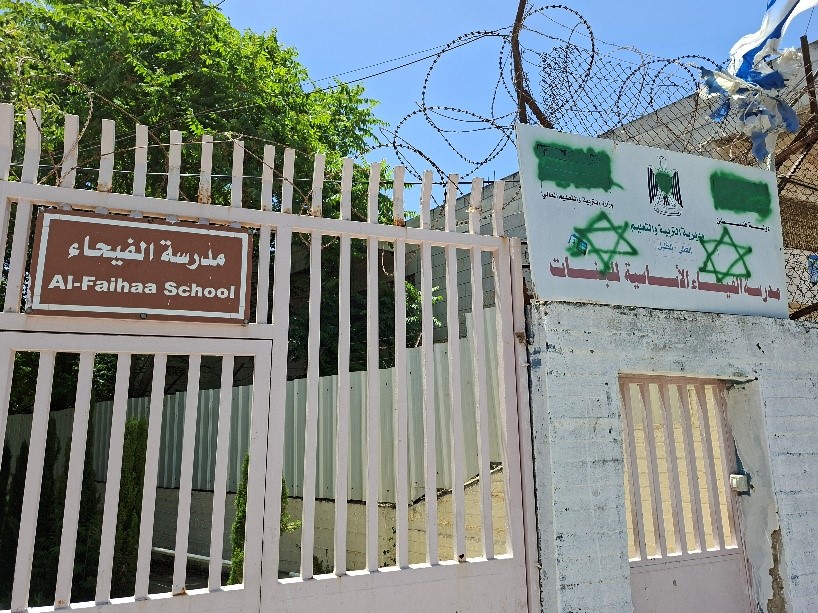 Lea ShakdielMay-27-2025Hebron, settlers vandalized the sign of the girls' school
-
Meitar checkpoint / Sansana
See all reports for this place-
Meitar Checkpoint / Sansana The checkpoint is located on the Green Line and serves as a border crossing between Israel and the West Bank. It is managed by the Border Crossing Authority of the Defense Ministry. It is comprised of sections for the transfer of goods as well as a vehicle checkpoint (intended for holders of blue identity cards, foreign nationals or diplomats and international organizations). Passing of Palestinians is prohibited, except for those with entry permits to Israel. Palestinians are permitted to cross on foot only. The crossing has a DCO / DCL / DCL / DCL (District Coordination Office), a customs unit, supervision, and a police unit. In the last year, a breach has been opened in the fence, not far from the crossing. This breach is known to all, including the army. There does not appear to be any interest in blocking it, probably as it permits needed Palestinian workers without the bureaucratic permits to get to work in Israel. Food stalls and a parking area economy have been created, but incidents of violent abuse by border police have also been recorded. Updated April 2022
-
South Hebron Hills
See all reports for this place-
South Hebron Hills
South Hebron Hills is a large area in the West Bank's southern part.
Yatta is a major city in this area: right in the border zone between the fertile region of Hebron and its surroundings and the desert of the Hebron Hills. Yatta has about 64,000 inhabitants.
The surrounding villages are called Masafer Yatta (Yatta's daughter villages). Their inhabitants subsist on livestock and agriculture. Agriculture is possible only in small plots, especially near streams. Most of the area consists of rocky terraces.Since the beginning of the 1980s, many settlements have been established on the agricultural land cultivated by the Palestinians in the South Hebron Hills region: Carmel, Maon, Susia, Masadot Yehuda, Othniel, and more. Since the settlements were established and Palestinians cultivation areas have been reduced; the residents of the South Hebron Hills have been suffering from harassment by the settlers. Attempts to evict and demolish houses have continued, along with withholding water and electricity. The military and police usually refrain from intervening in violent incidents between settlers and Palestinians do not enforce the law when it comes to the investigation of extensive violent Jewish settlers. The harassment in the South Hebron Hills includes attacking and attempting to burn residential tents, harassing dogs, harming herds, and preventing access to pastures.
There are several checkpoints in the South Hebron Hills, on Routes 317 and 60. In most of them, no military presence is apparent, but rather an array of pillboxes monitor the villages. Roadblocks are frequently set up according to the settlers and the army's needs. These are located at the Zif Junction, the Dura-al Fawwar crossing, and the Sheep Junction at the southern entrance to Hebron.
Updated April 2022
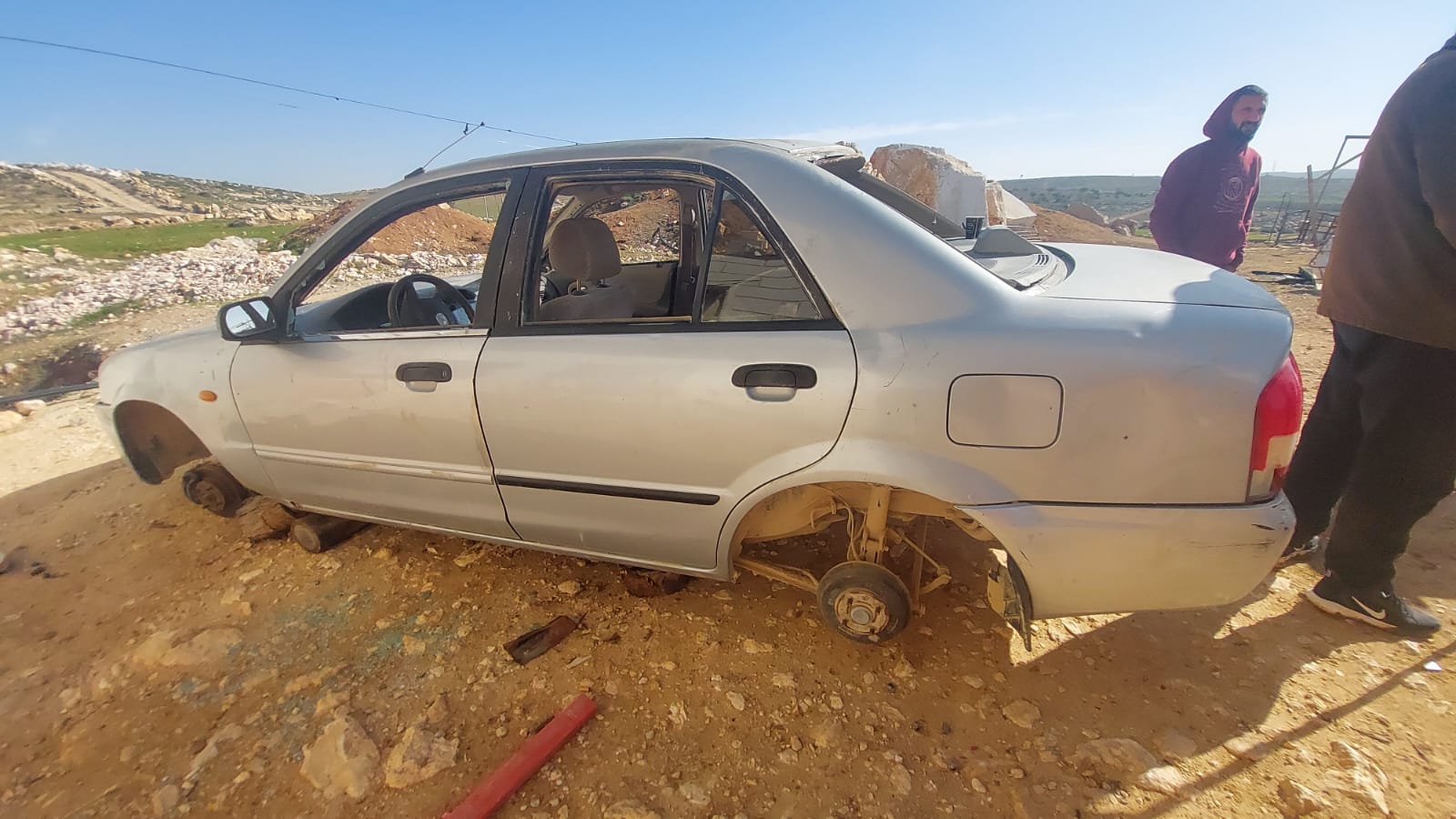 Michal TsadikDec-23-2025Wadi Shahish - The family car vandalized by settlers
-