
Hebron, South Hebron Hills
Hebron
A “boring” ride, nothing out of the ordinary. Even the balloon above Beit Haggai is normal by now. But Hebron doesn’t change…Anat Cohen livened things up. I don’t know when she noticed us, but when we returned from the lovely, renovated Worshippers’ Route stretching from Kiryat Arab to the approaches of the Cave of the Patriarchs we saw she was following us, driving and photographing. We continued, parked in the lot next to the pharmacy. She also parked.
We ignored her, walked to the checkpoint. A Border Police soldier asked whether we’re Israelis, and then reminds us we’re forbidden to cross to area H2. Since it was quiet there, with no detainees, we returned to our vehicle. We ignored her, she waited in her car, we entered ours and she circled around us. We were happy she didn’t get out to confront us; it was clear she wanted to prevent us from driving to Shuhadeh Street, near her house. We decided not to give her an opportunity to get into an argument with us and didn’t go there.
We drove to the Zion route and she left. We saw new cameras above Beit Hameriva, but it’s still fortified and manned by soldiers. Our friend B. continues building his second floor, unimpeded.
Highway 35
We drove toward the Beit Anin-Sa’ir junction. A great deal of traffic on Highway 60. Girls finish school early and try to cross the road home to Sa’ir. They wait a long time, unable to cross, until Netanya and a teacher who arrives manage to cross them safely. Someone says they promised to build a plaza there and preparations have begun. We’ll see what happens. A school for Palestinian girls isn’t sufficiently important.
We meet an old acquaintance near Idna’s olive press. He says that once a month he has to go through the Tarqumiyya checkpoint, and each time it’s awful. Once they told him to get undressed; he refused and returned home. “Doesn’t Israel understand that if they station people there who treat us like animals, they reflect on Israel itself?” he asks.
Southern Hebron Hills
Sylvia called. There’s someone in Shweika, a village next to the illegal outpost of Mitzpeh Eshtamoa, whom she’s helping appeal a blacklisting; she’d like us to speak to him.
We made a appointment and met him. During the past two months he’d been attacked and beaten by settlers; once they even came into his home, and once he’d been attacked while grazing his sheep in the field. This is a village whose fields have been frequently damaged. Last year settlers burned 55 dunums of wheat. What did the authorities do? Nothing. But the residents lost their work permits.
What’s there to say?! All the state’s actions in this part of the country are overwhelmingly “logical and benign.”
“Yesh Din” is involved, as well as Sylvia; let’s hope they can help. We’ll keep in touch with him.
Hebron
See all reports for this place-
According to Wye Plantation Accords (1997), Hebron is divided in two: H1 is under Palestinian Authority control, H2 is under Israeli control. In Hebron there are 170,000 Palestinian citizens, 60,000 of them in H2. Between the two areas are permanent checkpoints, manned at all hours, preventing Palestinian movement between them and controlling passage of permit holders such as teachers and schoolchildren. Some 800 Jews live in Avraham Avinu Quarter and Tel Rumeida, on Givat HaAvot and in the wholesale market.
Checkpoints observed in H2:
- Bet Hameriva CP- manned with a pillbox
- Kapisha quarter CP (the northern side of Zion axis) - manned with a pillbox
- The 160 turn CP (the southern side of Zion axis) - manned with a pillbox
- Avraham Avinu quarter - watch station
- The pharmacy CP - checking inside a caravan with a magnometer
- Tarpat (1929) CP - checking inside a caravan with a magnometer
- Tel Rumeida CP - guarding station
- Beit Hadassah CP - guarding station
Three checkpoints around the Tomb of the Patriarchs
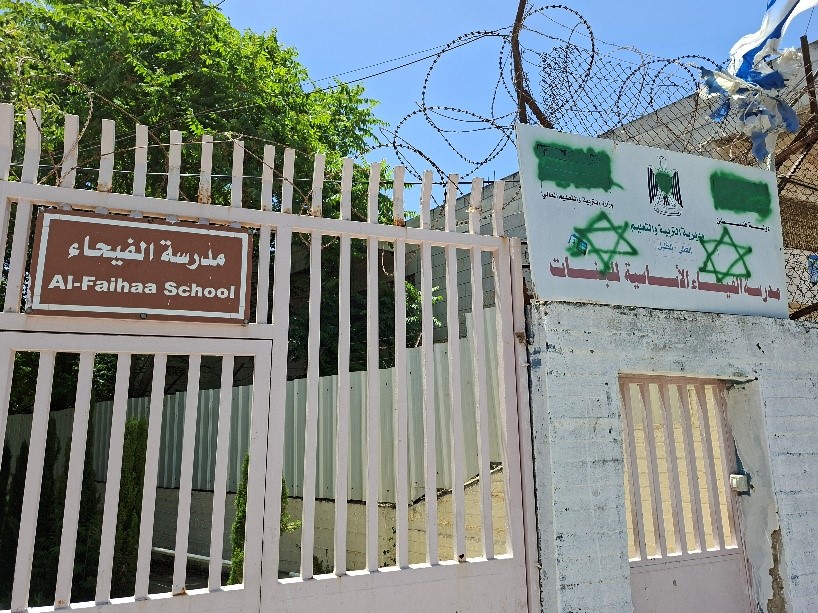 Lea ShakdielMay-27-2025Hebron, settlers vandalized the sign of the girls' school
-
South Hebron Hills
See all reports for this place-
South Hebron Hills
South Hebron Hills is a large area in the West Bank's southern part.
Yatta is a major city in this area: right in the border zone between the fertile region of Hebron and its surroundings and the desert of the Hebron Hills. Yatta has about 64,000 inhabitants.
The surrounding villages are called Masafer Yatta (Yatta's daughter villages). Their inhabitants subsist on livestock and agriculture. Agriculture is possible only in small plots, especially near streams. Most of the area consists of rocky terraces.Since the beginning of the 1980s, many settlements have been established on the agricultural land cultivated by the Palestinians in the South Hebron Hills region: Carmel, Maon, Susia, Masadot Yehuda, Othniel, and more. Since the settlements were established and Palestinians cultivation areas have been reduced; the residents of the South Hebron Hills have been suffering from harassment by the settlers. Attempts to evict and demolish houses have continued, along with withholding water and electricity. The military and police usually refrain from intervening in violent incidents between settlers and Palestinians do not enforce the law when it comes to the investigation of extensive violent Jewish settlers. The harassment in the South Hebron Hills includes attacking and attempting to burn residential tents, harassing dogs, harming herds, and preventing access to pastures.
There are several checkpoints in the South Hebron Hills, on Routes 317 and 60. In most of them, no military presence is apparent, but rather an array of pillboxes monitor the villages. Roadblocks are frequently set up according to the settlers and the army's needs. These are located at the Zif Junction, the Dura-al Fawwar crossing, and the Sheep Junction at the southern entrance to Hebron.
Updated April 2022
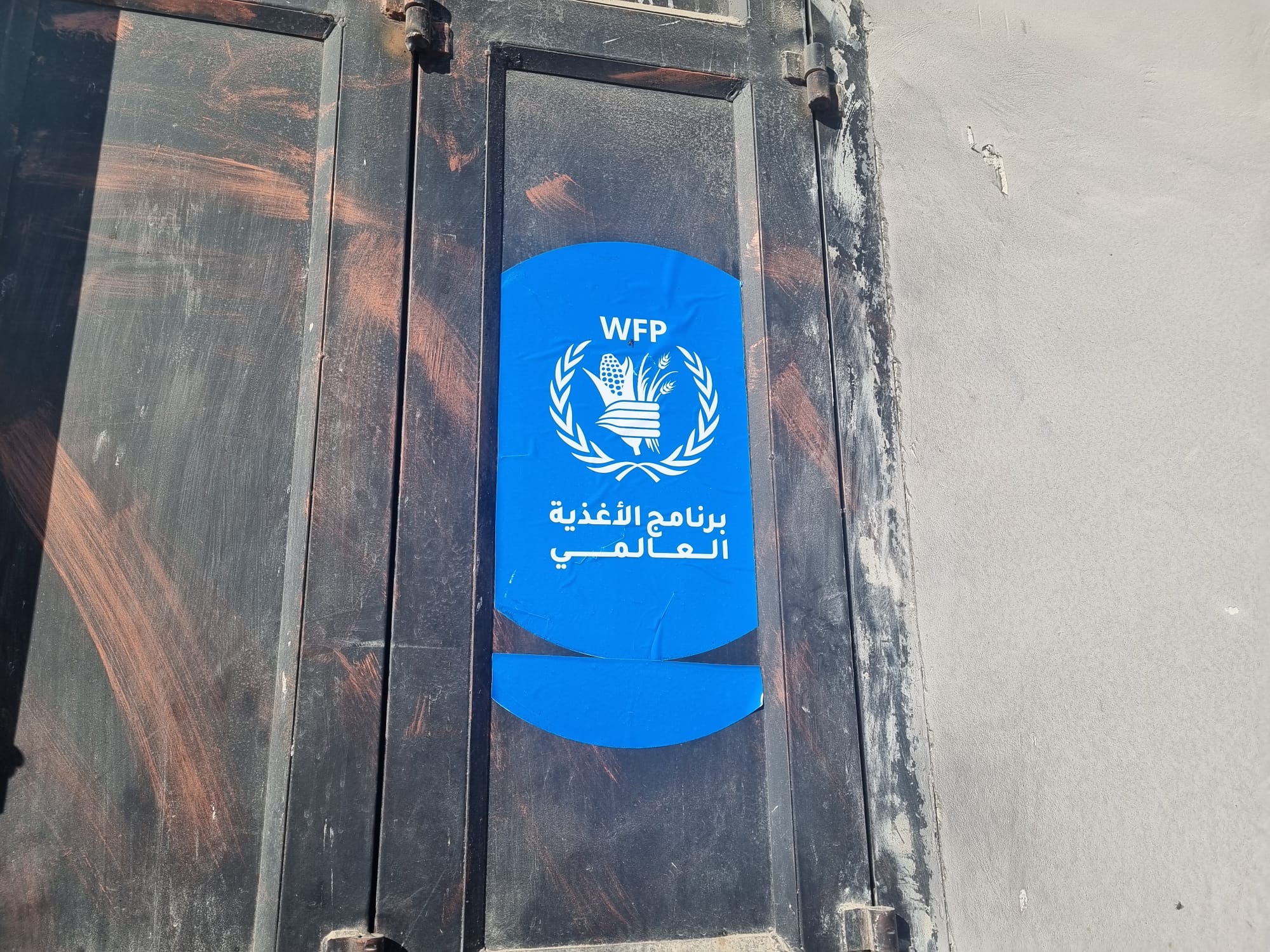 Smadar BeckerDec-14-2025A World Food Program (WFP) sticker at the entrance to a grocery store in Tuwani
-