
Hebron, South Hebron Hills
The occupation’s having a birthday these days – it’s already 47 years old, and a man. It already feels like a damn routine we’ve all gotten used to. That feeling remained with me throughout my shift.
We reach the Meitar crossing in time to meet the bus leaving for the beach day, full of women and small children, without a single man. H, the kindergarten teacher, said that at the checkpoint they first told her she had to go through the Bethlehem checkpoint; she insisted and G., the checkpoint commander, decided to let them through. We telephoned Gil’ad who entered the dates of the upcoming trips in the log and promised they’d go through with no problems.
We went to Tuwani to arrange the final permits for their trip to the beach on Thursday. From there we drove to the Hebron DCL along with T., the teacher in charge of the bus. We waited there with him to ensure he’s admitted and taken care of. Two of the four who didn’t receive permits had problems with their ID numbers and the others had been blacklisted by the police.
Photo caption: The Palestinians are the ultimate “other” – we wonder whether the Israeli school system treats them differently it’s been “educated.”
Summer vacation has started in the Palestinian Authority; the children are in the streets. There were no detainees at any checkpoint. On the way up to Tel Rumeida we met Fa’iza who’s in charge of the Tel Rumeida women’s club. She invited us to her home; we drank coffee. She wants us to run activities together. We promised to try. She volunteers in B’Tselem; she showed us on her computer how her son was arrested and not the settlers’ children who’d beaten him…So long as Fa’iza keeps inviting us, there’s hope the peace candle won’t be extinguished.
Hebron
See all reports for this place-
According to Wye Plantation Accords (1997), Hebron is divided in two: H1 is under Palestinian Authority control, H2 is under Israeli control. In Hebron there are 170,000 Palestinian citizens, 60,000 of them in H2. Between the two areas are permanent checkpoints, manned at all hours, preventing Palestinian movement between them and controlling passage of permit holders such as teachers and schoolchildren. Some 800 Jews live in Avraham Avinu Quarter and Tel Rumeida, on Givat HaAvot and in the wholesale market.
Checkpoints observed in H2:
- Bet Hameriva CP- manned with a pillbox
- Kapisha quarter CP (the northern side of Zion axis) - manned with a pillbox
- The 160 turn CP (the southern side of Zion axis) - manned with a pillbox
- Avraham Avinu quarter - watch station
- The pharmacy CP - checking inside a caravan with a magnometer
- Tarpat (1929) CP - checking inside a caravan with a magnometer
- Tel Rumeida CP - guarding station
- Beit Hadassah CP - guarding station
Three checkpoints around the Tomb of the Patriarchs
 Raya YeorDec-18-2025Hebron - Yusri Jaber and part of his family
-
South Hebron Hills
See all reports for this place-
South Hebron Hills
South Hebron Hills is a large area in the West Bank's southern part.
Yatta is a major city in this area: right in the border zone between the fertile region of Hebron and its surroundings and the desert of the Hebron Hills. Yatta has about 64,000 inhabitants.
The surrounding villages are called Masafer Yatta (Yatta's daughter villages). Their inhabitants subsist on livestock and agriculture. Agriculture is possible only in small plots, especially near streams. Most of the area consists of rocky terraces.Since the beginning of the 1980s, many settlements have been established on the agricultural land cultivated by the Palestinians in the South Hebron Hills region: Carmel, Maon, Susia, Masadot Yehuda, Othniel, and more. Since the settlements were established and Palestinians cultivation areas have been reduced; the residents of the South Hebron Hills have been suffering from harassment by the settlers. Attempts to evict and demolish houses have continued, along with withholding water and electricity. The military and police usually refrain from intervening in violent incidents between settlers and Palestinians do not enforce the law when it comes to the investigation of extensive violent Jewish settlers. The harassment in the South Hebron Hills includes attacking and attempting to burn residential tents, harassing dogs, harming herds, and preventing access to pastures.
There are several checkpoints in the South Hebron Hills, on Routes 317 and 60. In most of them, no military presence is apparent, but rather an array of pillboxes monitor the villages. Roadblocks are frequently set up according to the settlers and the army's needs. These are located at the Zif Junction, the Dura-al Fawwar crossing, and the Sheep Junction at the southern entrance to Hebron.
Updated April 2022
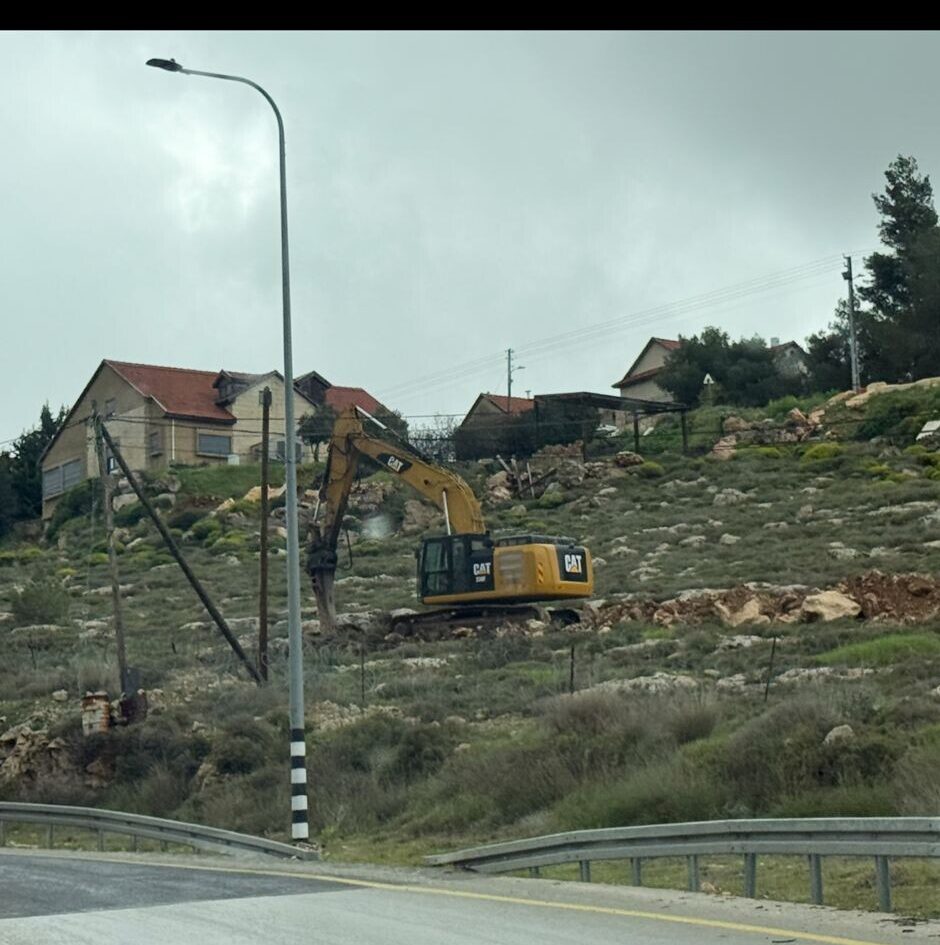 MuhammadFeb-24-2026South Hebron Hill, Beit Hagai: Paving an internal security road
-