
Hebron, South Hebron Hills
Because of Ramadan we held the shift very early in the morning.
Sparse traffic on the roads. At every junction and at the entrance to every settlement, soldiers with weapons aimed at the road. They are taking a chance, but I also hoped that none of their finger would accidentally slip on the guard and kill me.
In Hebron, everything is closed. But the people of Israel live and continue to travel, Ramadan or not. In the large parking lot of the Cave of the Patriarchs compound, a group of religious girls with a teacher with a head covering, get off a bus and prepare to visit and pray in the compound. In the corner where there is refreshment for soldiers near Beit Hadassah, a group of secular youth, boys and girls, not exactly soldiers, refresh themselves and concentrate next to the guide preparing for the tour. I add a story from last week: Pelech Tel Aviv High School, very feminist and liberal, set up a trip with accommodation in the Gush Etzion area. Two parents were puzzled about the inclusion of dubious sites on the route, the Biar water aqueduct, and the Boaz Field Farm. It turned out that the two families had inquired from Hagit Ofran from Peace Now, who confirmed the illegal status of these two sites. The complaint to the school administration removed both sites from the route. Five students decided not to participate at all in a trip which had been scheduled without prior consulation with them and which included the settlements.
Notices along the way: from the northern entrance to Kiryat Arba (not to the left-wing government, for the return of Oron and Hadar’s bodies), and from Route 60 before Shuyukh (Naming the new road that improves the route of the Levinger couple who first settled in Hebron on Passover 1970, meaning those who were responsible for the establishment of Kiryat Arba in response to what had happened there in previous years and also for the renewal of the Jewish settlement in Hebron later, and close to this – the marketing new homes in the settlement of Maon.
Hebron
See all reports for this place-
According to Wye Plantation Accords (1997), Hebron is divided in two: H1 is under Palestinian Authority control, H2 is under Israeli control. In Hebron there are 170,000 Palestinian citizens, 60,000 of them in H2. Between the two areas are permanent checkpoints, manned at all hours, preventing Palestinian movement between them and controlling passage of permit holders such as teachers and schoolchildren. Some 800 Jews live in Avraham Avinu Quarter and Tel Rumeida, on Givat HaAvot and in the wholesale market.
Checkpoints observed in H2:
- Bet Hameriva CP- manned with a pillbox
- Kapisha quarter CP (the northern side of Zion axis) - manned with a pillbox
- The 160 turn CP (the southern side of Zion axis) - manned with a pillbox
- Avraham Avinu quarter - watch station
- The pharmacy CP - checking inside a caravan with a magnometer
- Tarpat (1929) CP - checking inside a caravan with a magnometer
- Tel Rumeida CP - guarding station
- Beit Hadassah CP - guarding station
Three checkpoints around the Tomb of the Patriarchs
 Raya YeorDec-18-2025Hebron - Yusri Jaber and part of his family
-
South Hebron Hills
See all reports for this place-
South Hebron Hills
South Hebron Hills is a large area in the West Bank's southern part.
Yatta is a major city in this area: right in the border zone between the fertile region of Hebron and its surroundings and the desert of the Hebron Hills. Yatta has about 64,000 inhabitants.
The surrounding villages are called Masafer Yatta (Yatta's daughter villages). Their inhabitants subsist on livestock and agriculture. Agriculture is possible only in small plots, especially near streams. Most of the area consists of rocky terraces.Since the beginning of the 1980s, many settlements have been established on the agricultural land cultivated by the Palestinians in the South Hebron Hills region: Carmel, Maon, Susia, Masadot Yehuda, Othniel, and more. Since the settlements were established and Palestinians cultivation areas have been reduced; the residents of the South Hebron Hills have been suffering from harassment by the settlers. Attempts to evict and demolish houses have continued, along with withholding water and electricity. The military and police usually refrain from intervening in violent incidents between settlers and Palestinians do not enforce the law when it comes to the investigation of extensive violent Jewish settlers. The harassment in the South Hebron Hills includes attacking and attempting to burn residential tents, harassing dogs, harming herds, and preventing access to pastures.
There are several checkpoints in the South Hebron Hills, on Routes 317 and 60. In most of them, no military presence is apparent, but rather an array of pillboxes monitor the villages. Roadblocks are frequently set up according to the settlers and the army's needs. These are located at the Zif Junction, the Dura-al Fawwar crossing, and the Sheep Junction at the southern entrance to Hebron.
Updated April 2022
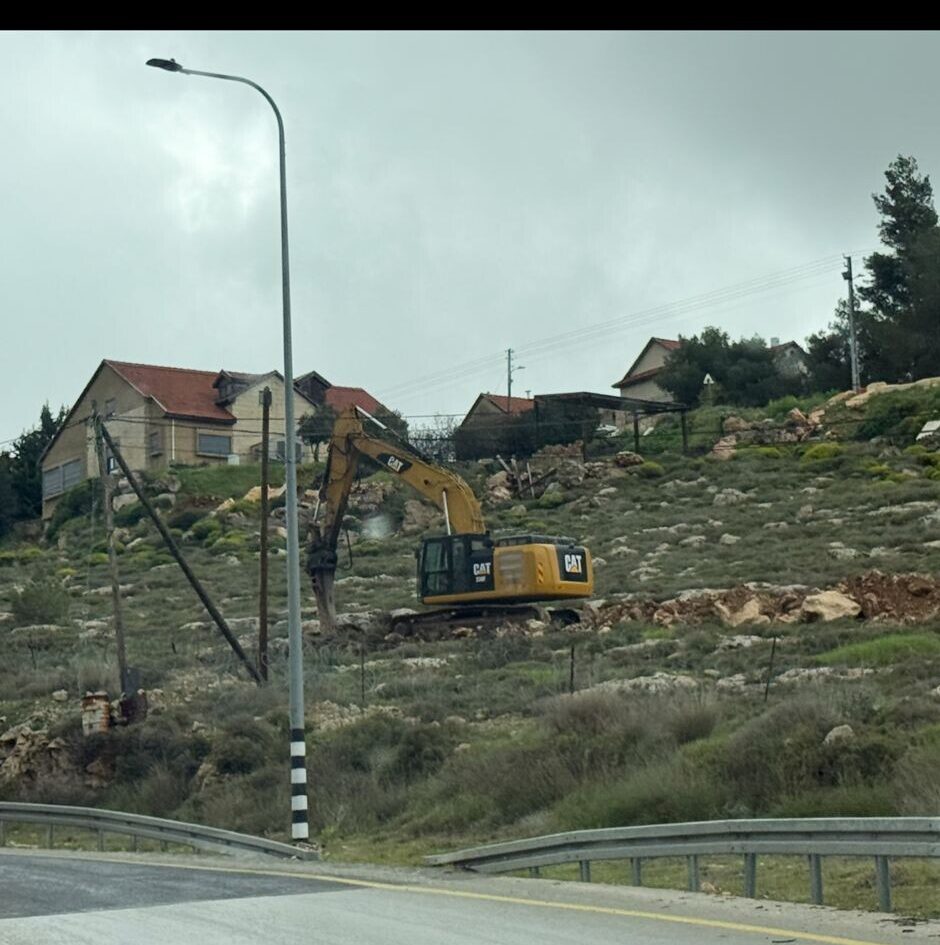 MuhammadFeb-24-2026South Hebron Hill, Beit Hagai: Paving an internal security road
-