
Hebron, South Hebron Hills, Mon 14.11.11, Morning
Translator: Charles K.
Meitar crossing
By 6:45 the Palestinian side was already empty of workers; they’re waiting on the Israeli side for their employers and are on their way to work.
Route 60 is quiet and deserted.
We reached the Kvasim junction without delay, but not before we tried to understand what had happened at Beit Haggai and beyond.
We slowed down, assuming, and hoping, that wherever the soldiers are they’re checking cars more carefully, and we wanted them to become familiar with ours [if they hadn’t noted it earlier], so there wouldn’t be any mistakes…
We didn’t see an army presence there today either. No soldiers came down from pillboxes anywhere along the way.
Hebron
It’s quiet, many children on their way to school.
Many representatives of peace groups and TIPH at every checkpoint.
They’re all monitoring the children’s crossings.
The soldiers don’t detain anyone; all pass through the scanner without anyone interfering.
A group of teachers who live near the Cordova school are on their way there. They don’t have to go through the checkpoint. The others continue to make a long detour to avoid going through the scanner. Neither side compromised its principles.
CPT activists remind us that this Saturday a special event will be held because of the “Hayyei Sara” torah portion. Another “Jewish exception” day on which everyone’s invited to come pray at the Cave of the Patriarchs to commemorate the death and burial of Sarah the matriarch. On that day, the Hebron settlers invite [even more enthusiastically than usual] everyone to demonstrate their right to possess the entire land, and Hebron in particular. The peace groups express their fear that the settlers will be more aggressive to the Palestinians that day. We hope not, but ask them to call us if necessary.
Since nothing out of the ordinary was going on, and the occupation routine was demoralizing as ever, we could leave Hebron early. We decide to continue on Route 60 to Beit Umar. The road was lovely, pastoral. The vineyards were glorious in their autumn colors. What a misleading landscape.
The pillboxes rise all along the way; the army’s presence has also increased, starting from Karmei Tzur. The observation balloon floats above Beit Umar.
We turn left at the Gush Etzion junction, toward the Jaba checkpoint. It’s manned by the military police. We wonder how long they’ll be there. For some reason, the soldiers are much more flexible, less strict. They “make do” with asking where we’re coming from, a quick, superficial inspection of our ID cards, and “cause no trouble.” The crossing was “pleasant.” From there we drove through the Elah Valley to Highway 6, and then home.
What a “lovely trip” we had.
Hebron
See all reports for this place-
According to Wye Plantation Accords (1997), Hebron is divided in two: H1 is under Palestinian Authority control, H2 is under Israeli control. In Hebron there are 170,000 Palestinian citizens, 60,000 of them in H2. Between the two areas are permanent checkpoints, manned at all hours, preventing Palestinian movement between them and controlling passage of permit holders such as teachers and schoolchildren. Some 800 Jews live in Avraham Avinu Quarter and Tel Rumeida, on Givat HaAvot and in the wholesale market.
Checkpoints observed in H2:
- Bet Hameriva CP- manned with a pillbox
- Kapisha quarter CP (the northern side of Zion axis) - manned with a pillbox
- The 160 turn CP (the southern side of Zion axis) - manned with a pillbox
- Avraham Avinu quarter - watch station
- The pharmacy CP - checking inside a caravan with a magnometer
- Tarpat (1929) CP - checking inside a caravan with a magnometer
- Tel Rumeida CP - guarding station
- Beit Hadassah CP - guarding station
Three checkpoints around the Tomb of the Patriarchs
 Raya YeorDec-18-2025Hebron - Yusri Jaber and part of his family
-
Jaba' (Lil)
See all reports for this place-
Jaba' (Lil) In fact, the Jaba checkpoint is east of the Qalandiya checkpoint. Its declared purpose is the prevention of Israeli citizens from entering Area A. A road checkpoint for vehicles, located on Road 65, borders the southern fence of Kfar Jaba, about three kilometers east of the Qalandiya checkpoint, on the road leading to the settlement of Adam on Road 60. Archaeological excavations within the village found the remains of a cloth house from the First Temple period. The events that led to the construction of the checkpoint are precisely here: on the day of the abduction of Gilad Shalit and before the outbreak of the Second Lebanon War, a 17-year-old man from one of the settlements was abducted by a Palestinian cell. His body was found several days later at the entrances to Ramallah. A military investigation revealed that his abductors had taken him along this route. The checkpoint was set up to prevent future kidnappings and to warn settlers from traveling to Ramallah and entering Area A (which is forbidden for Israelis). The checkpoint that operates around the clock. Usually only vehicles traveling in the direction of Ramallah are inspected. (November 2016): Every morning, when the settlers en masse travel to Jerusalem on Route 60 and every afternoon they return from Jerusalem on Route 60, the army initiates a traffic jam at the entrance to the Jaba checkpoint and stops the movement of Palestinians traveling toward Route 60. (February 2020): In the last two years the checkpoint has not always been manned. Sometimes the soldiers come and just stand, sometimes they come and stop and check those who enter the village, sometimes they patrol the alleys of the village, sometimes they fire stun grenades and gas and sometimes they invade houses and stop young people, say those passing through the Hazma checkpoint. (Updated February 2020)
-
South Hebron Hills
See all reports for this place-
South Hebron Hills
South Hebron Hills is a large area in the West Bank's southern part.
Yatta is a major city in this area: right in the border zone between the fertile region of Hebron and its surroundings and the desert of the Hebron Hills. Yatta has about 64,000 inhabitants.
The surrounding villages are called Masafer Yatta (Yatta's daughter villages). Their inhabitants subsist on livestock and agriculture. Agriculture is possible only in small plots, especially near streams. Most of the area consists of rocky terraces.Since the beginning of the 1980s, many settlements have been established on the agricultural land cultivated by the Palestinians in the South Hebron Hills region: Carmel, Maon, Susia, Masadot Yehuda, Othniel, and more. Since the settlements were established and Palestinians cultivation areas have been reduced; the residents of the South Hebron Hills have been suffering from harassment by the settlers. Attempts to evict and demolish houses have continued, along with withholding water and electricity. The military and police usually refrain from intervening in violent incidents between settlers and Palestinians do not enforce the law when it comes to the investigation of extensive violent Jewish settlers. The harassment in the South Hebron Hills includes attacking and attempting to burn residential tents, harassing dogs, harming herds, and preventing access to pastures.
There are several checkpoints in the South Hebron Hills, on Routes 317 and 60. In most of them, no military presence is apparent, but rather an array of pillboxes monitor the villages. Roadblocks are frequently set up according to the settlers and the army's needs. These are located at the Zif Junction, the Dura-al Fawwar crossing, and the Sheep Junction at the southern entrance to Hebron.
Updated April 2022
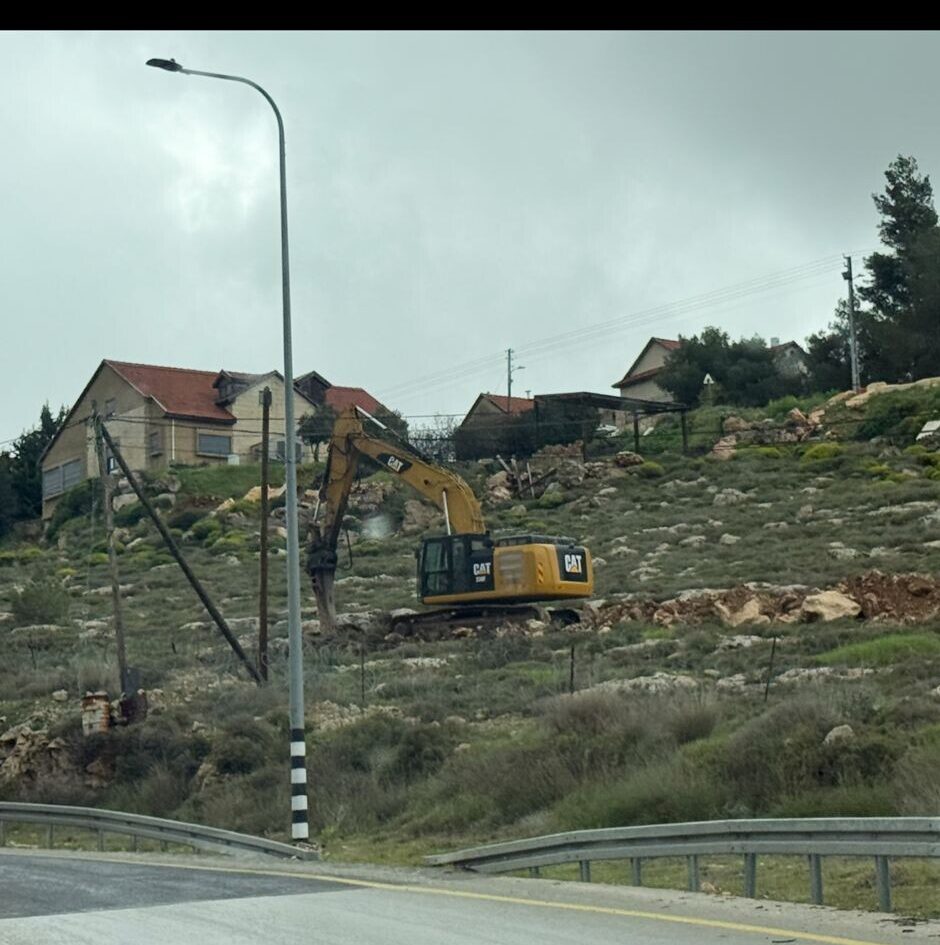 MuhammadFeb-24-2026South Hebron Hill, Beit Hagai: Paving an internal security road
-