
Hebron, South Hebron Hills, Mon 3.12.12, Morning
Translator: Charles K.
Highway 317 is quiet. Will we have nothing to report again? Don’t worry; there’s never a dull moment.
Hebron
Hebron also seems sleepy at 9 AM. But it only looks that way.
We drove to the beginning of the Worshippers’ Route, next to the memorial to Dror Weinberg and his men.
Written on the wall of a house: “When an Arab dies, I celebrate.” We’d photographed it in the past.
A man who lives there tells us what usually happens on Friday: Palestinian residents are forbidden to move about; only settlers are allowed to pass; soldiers are on the roofs and in the pillbox.
“What do you think about declaring a Palestinian state?”, we ask. When peace comes, God willing. He smiles.
No detainees at the checkpoints.
A squad of Nahal soldiers goes through the Pharmacy checkpoint to Area H1.
“Why did they cross?”, we ask.
A patient soldier hadn’t heard the briefing but is sure there’s a reason, maybe they’re looking for someone.
“I support the state,” he says.
“So do we,” we reply, “which is why we’re here.”
His questioning glance indicates he didn’t really understand what we meant, but he remains polite.
M., our driver, calls us back to the car because he heard on the “Voice of Palestine” station about a car set on fire and “Price Tag” graffiti in Dahariyya. We hurry to the car.
On our way out of the city we see another squad of soldiers, this time on the Worshippers’ Route, also going to H1 neighborhoods.
Something’s going on during this quiet morning in Hebron.
Highway 60
The balloon floats in the sky above .
We drove to the entrance to Dahariyya. Close to last month’s arson location there’s again a car burned next to a house.
Sprayed on a stone wall: “Price Tag! Congratulations to [illegible].”
Someone came to “celebrate” with the Palestinians.
The residents report that the wife heard the arsonists at 3 AM, but they didn’t see anything. Hagit notifies Ohad Hemo and sends photographs.
If there aren’t enough topics for the news reports, all Israel will hear of it.
The Israel police came and left a copy of the complaint and telephone contact numbers, if necessary.
They don’t really know what to do with it. Nor have we anything to add other than to explain what the documents are. More press photographers arrive, interview people and take pictures.
The chronicle of occupation. A chronicle of settler terror and violence.
Hebron
See all reports for this place-
According to Wye Plantation Accords (1997), Hebron is divided in two: H1 is under Palestinian Authority control, H2 is under Israeli control. In Hebron there are 170,000 Palestinian citizens, 60,000 of them in H2. Between the two areas are permanent checkpoints, manned at all hours, preventing Palestinian movement between them and controlling passage of permit holders such as teachers and schoolchildren. Some 800 Jews live in Avraham Avinu Quarter and Tel Rumeida, on Givat HaAvot and in the wholesale market.
Checkpoints observed in H2:
- Bet Hameriva CP- manned with a pillbox
- Kapisha quarter CP (the northern side of Zion axis) - manned with a pillbox
- The 160 turn CP (the southern side of Zion axis) - manned with a pillbox
- Avraham Avinu quarter - watch station
- The pharmacy CP - checking inside a caravan with a magnometer
- Tarpat (1929) CP - checking inside a caravan with a magnometer
- Tel Rumeida CP - guarding station
- Beit Hadassah CP - guarding station
Three checkpoints around the Tomb of the Patriarchs
 Raya YeorDec-18-2025Hebron - Yusri Jaber and part of his family
-
South Hebron Hills
See all reports for this place-
South Hebron Hills
South Hebron Hills is a large area in the West Bank's southern part.
Yatta is a major city in this area: right in the border zone between the fertile region of Hebron and its surroundings and the desert of the Hebron Hills. Yatta has about 64,000 inhabitants.
The surrounding villages are called Masafer Yatta (Yatta's daughter villages). Their inhabitants subsist on livestock and agriculture. Agriculture is possible only in small plots, especially near streams. Most of the area consists of rocky terraces.Since the beginning of the 1980s, many settlements have been established on the agricultural land cultivated by the Palestinians in the South Hebron Hills region: Carmel, Maon, Susia, Masadot Yehuda, Othniel, and more. Since the settlements were established and Palestinians cultivation areas have been reduced; the residents of the South Hebron Hills have been suffering from harassment by the settlers. Attempts to evict and demolish houses have continued, along with withholding water and electricity. The military and police usually refrain from intervening in violent incidents between settlers and Palestinians do not enforce the law when it comes to the investigation of extensive violent Jewish settlers. The harassment in the South Hebron Hills includes attacking and attempting to burn residential tents, harassing dogs, harming herds, and preventing access to pastures.
There are several checkpoints in the South Hebron Hills, on Routes 317 and 60. In most of them, no military presence is apparent, but rather an array of pillboxes monitor the villages. Roadblocks are frequently set up according to the settlers and the army's needs. These are located at the Zif Junction, the Dura-al Fawwar crossing, and the Sheep Junction at the southern entrance to Hebron.
Updated April 2022
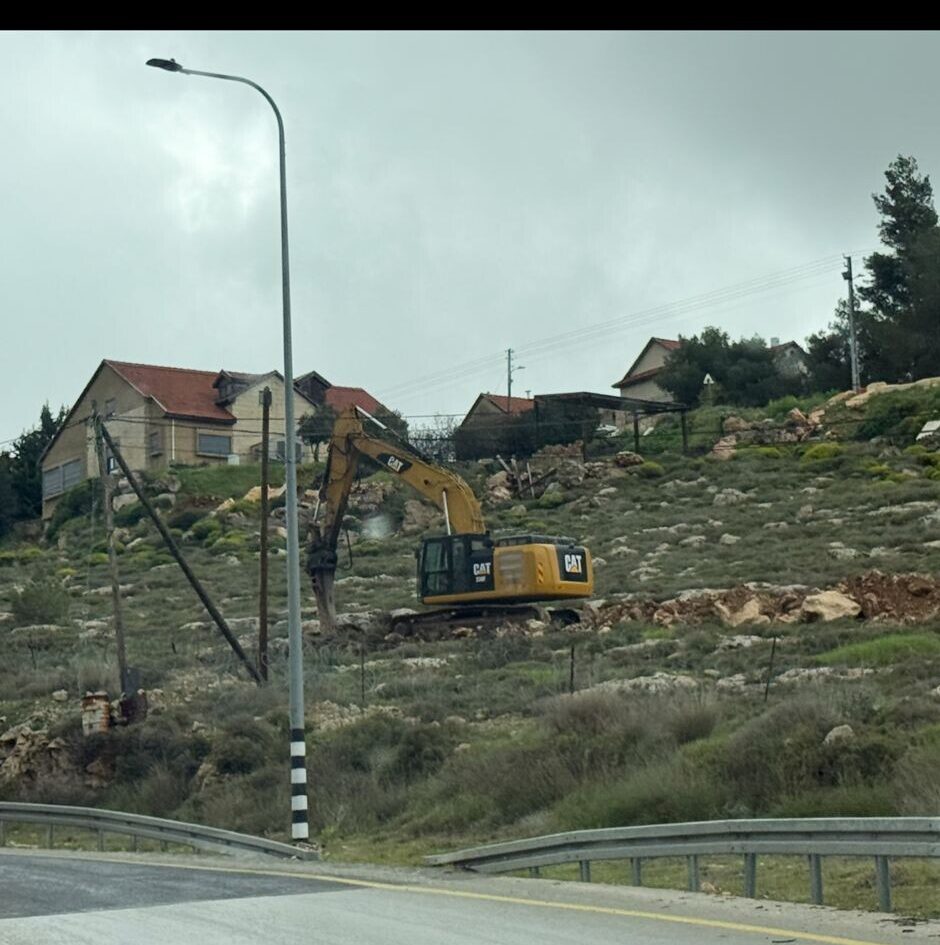 MuhammadFeb-24-2026South Hebron Hill, Beit Hagai: Paving an internal security road
-