
Hebron, South Hebron Hills, Mon 7.2.11, Morning
Translation: Bracha B.A.
Sansana-Meitar Crossing
At 06:30 there are already no workers waiting. On the other hand, three cars do wait to enter Israel with their hoods open and the dogs sniffing at them. I have been going out on shifts for a long time but never seen this before. The drivers enter a caravan to be checked. M., our driver, says that occasionally they do this to people with Arab Israelis (Bedouin) too, but that those who look like settlers are never checked. This is racism dictated by appearance and not by color. When we returned there were two busses of families waiting in the parking lot that had arrived while we were away. The passengers reported that everything was OK.
Route 60
It is two weeks after Tu Bishvat and the almond trees here are just beginning to flower. There is a bit of green vegetation for the flocks. At the entrance to Samoa there is a large billboard advertising a Blackberry with a man drinking coffee dressed in a business suit. It looks ironic against the background of the poor locals dressed in kafiyyas and eagerly hoping to get a work permit for the day. This is an illustration of the financial feasibility of the occupation. Winter holiday is over and the children are walking to school. The pillboxes are all manned and there are no temporary roadblocks.
At the entrance to Beit Hagai there is an army jeep and soldiers went out to look around, standing in the cold.
The Entrance to Beit Naim– We follow a jeep that has driven up to the vineyard belonging to a settler. He is working in the vineyard with four soldiers on guard. One can easily understand now what the security budget is spent on and why the price of bread has gone up.
Hebron
The pillbox on Gross Square is empty, but on the roof of the wholesale market where the squatters were evicted there is another guard position and a soldier is standing there. The Palestinian families from whom the market was confiscated will not return to live here as it now stands.
Patriarchs' Tombs' Cave: there are several young detainees at the checkpoint next to the Cave. Within ten minutesthey are all released, having being informed (by us) that no one can be detained for over 20 min. unless an officer explicitly authorizes. An officer from the Border Police is driving around in a white car. The checkpoint opens for him as well as for laborers who are coming renovate the house belonging to Abed, the store's owner.
The Pharmacy Checkpoint–A quarrel erupts between the youth selling pita and the soldiers when they attempted to confiscate a small knife in his possession. The sixteen year old was enraged and a ten-year-old attempted to calm him down. The soldiers claim that with such a knife he could murder another Shalhevet Paz (an Jewish infant girl shot to death some years ago in Hebron). After we intervened the youth finally agreed to leave the knife at the checkpoint and receive it back when he returns.
This is the routing of occupation. We come only for a minute but the Palestinians live with this all the time.
At Azam's metal shop people tell us about the Palestinian police and their investigations, and the bearded members of Hamas. The Middle East is a complex place.
Hebron
See all reports for this place-
According to Wye Plantation Accords (1997), Hebron is divided in two: H1 is under Palestinian Authority control, H2 is under Israeli control. In Hebron there are 170,000 Palestinian citizens, 60,000 of them in H2. Between the two areas are permanent checkpoints, manned at all hours, preventing Palestinian movement between them and controlling passage of permit holders such as teachers and schoolchildren. Some 800 Jews live in Avraham Avinu Quarter and Tel Rumeida, on Givat HaAvot and in the wholesale market.
Checkpoints observed in H2:
- Bet Hameriva CP- manned with a pillbox
- Kapisha quarter CP (the northern side of Zion axis) - manned with a pillbox
- The 160 turn CP (the southern side of Zion axis) - manned with a pillbox
- Avraham Avinu quarter - watch station
- The pharmacy CP - checking inside a caravan with a magnometer
- Tarpat (1929) CP - checking inside a caravan with a magnometer
- Tel Rumeida CP - guarding station
- Beit Hadassah CP - guarding station
Three checkpoints around the Tomb of the Patriarchs
 Raya YeorDec-18-2025Hebron - Yusri Jaber and part of his family
-
South Hebron Hills
See all reports for this place-
South Hebron Hills
South Hebron Hills is a large area in the West Bank's southern part.
Yatta is a major city in this area: right in the border zone between the fertile region of Hebron and its surroundings and the desert of the Hebron Hills. Yatta has about 64,000 inhabitants.
The surrounding villages are called Masafer Yatta (Yatta's daughter villages). Their inhabitants subsist on livestock and agriculture. Agriculture is possible only in small plots, especially near streams. Most of the area consists of rocky terraces.Since the beginning of the 1980s, many settlements have been established on the agricultural land cultivated by the Palestinians in the South Hebron Hills region: Carmel, Maon, Susia, Masadot Yehuda, Othniel, and more. Since the settlements were established and Palestinians cultivation areas have been reduced; the residents of the South Hebron Hills have been suffering from harassment by the settlers. Attempts to evict and demolish houses have continued, along with withholding water and electricity. The military and police usually refrain from intervening in violent incidents between settlers and Palestinians do not enforce the law when it comes to the investigation of extensive violent Jewish settlers. The harassment in the South Hebron Hills includes attacking and attempting to burn residential tents, harassing dogs, harming herds, and preventing access to pastures.
There are several checkpoints in the South Hebron Hills, on Routes 317 and 60. In most of them, no military presence is apparent, but rather an array of pillboxes monitor the villages. Roadblocks are frequently set up according to the settlers and the army's needs. These are located at the Zif Junction, the Dura-al Fawwar crossing, and the Sheep Junction at the southern entrance to Hebron.
Updated April 2022
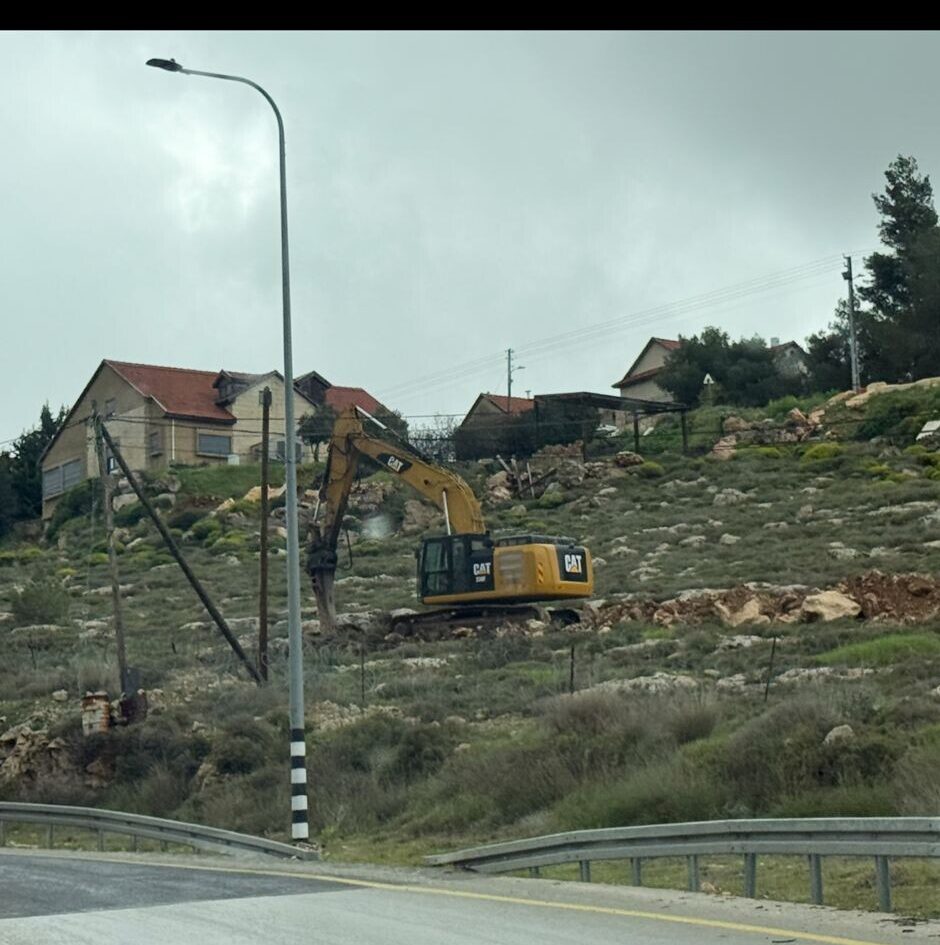 MuhammadFeb-24-2026South Hebron Hill, Beit Hagai: Paving an internal security road
-