
Hebron, South Hebron Hills, Sun 20.1.13, Afternoon
Translator: Charles K.
We decided to leave at two in the afternoon since the schoolchildren were still on winter vacation.
Route 60
Heavy traffic, also of Israeli cars, but mostly Palestinian. Here and there people are walking on the roadside. A little farther on we see agricultural fields that have been very well taken care of. We see no military presence anywhere. Blue skies above, the sun warm and pleasant…almost ideal.
Hebron
Election posters of national religious parties at the entrance to Hebron, as well as around the entrance and parking area of the Cave of the Patriarchs. Later we learn that the Hebronites think they’ll win a large majority. The Ja’abri kids are playing ball next to Beit Hameriva-Hashalom and wave to us.
Israeli tourists get off buses at the Cave of the Patriarchs plaza. The checkpoints are very quiet, only bored soldiers.
We go up to Tel Rumeida and take a tour of the “no man’s land” between H1 and H2. Friendly children on the winding path say hello and each introduces himself.
In Beit Hashoter, where Michael used to live and which today serves as a local, well-maintained sports and community center we meet A., the brother of an old acquaintance. He came home to Hebron after years abroad attending university. But today, five months on, he’s unemployed and worried. A. invites us to sit in his courtyard and talk while his friend prepares tea. He asks us apprehensively what will happen, since “Bibi will win and his number three, Baruch Marzel, will run Israel.” We reassure him and ourselves that “Bibi may not win and Baruch Marzel is far from being number three and, God willing, let’s hope he won’t succeed at all.” At least one hope was realized. He also refers to the growing despair and anger in Hebron and thinks that Hamas will benefit greatly from it. “Isn’t that what Bibi wants?” We had nothing reassuring to respond to that.
On our way back we heard in the local grocery store about two children detained by a policeman at a checkpoint for carrying a cooking gas canister. Residents of Tel Rumeida are allowed to obtain cooking gas in only one way: to carry the canister themselves or with a hand-cart. They’re not allowed to use a vehicle. Not to Tel Rumeida, located on a hill, the road to it from the checkpoint steep and difficult for anyone, particularly with a full canister. The frightened children, who didn’t have a phone to call anyone they knew, waited until someone from the military unit bothered (thank you) to call a former local member of B’Tselem who came down to the checkpoint, “identified” the children and they went up to Tel Rumeida with their merchandise. He then came back down to say hello and we were happy to meet a delightful old acquaintance and just stand outside the grocery to chat.
Hebron
See all reports for this place-
According to Wye Plantation Accords (1997), Hebron is divided in two: H1 is under Palestinian Authority control, H2 is under Israeli control. In Hebron there are 170,000 Palestinian citizens, 60,000 of them in H2. Between the two areas are permanent checkpoints, manned at all hours, preventing Palestinian movement between them and controlling passage of permit holders such as teachers and schoolchildren. Some 800 Jews live in Avraham Avinu Quarter and Tel Rumeida, on Givat HaAvot and in the wholesale market.
Checkpoints observed in H2:
- Bet Hameriva CP- manned with a pillbox
- Kapisha quarter CP (the northern side of Zion axis) - manned with a pillbox
- The 160 turn CP (the southern side of Zion axis) - manned with a pillbox
- Avraham Avinu quarter - watch station
- The pharmacy CP - checking inside a caravan with a magnometer
- Tarpat (1929) CP - checking inside a caravan with a magnometer
- Tel Rumeida CP - guarding station
- Beit Hadassah CP - guarding station
Three checkpoints around the Tomb of the Patriarchs
 Raya YeorDec-18-2025Hebron - Yusri Jaber and part of his family
-
South Hebron Hills
See all reports for this place-
South Hebron Hills
South Hebron Hills is a large area in the West Bank's southern part.
Yatta is a major city in this area: right in the border zone between the fertile region of Hebron and its surroundings and the desert of the Hebron Hills. Yatta has about 64,000 inhabitants.
The surrounding villages are called Masafer Yatta (Yatta's daughter villages). Their inhabitants subsist on livestock and agriculture. Agriculture is possible only in small plots, especially near streams. Most of the area consists of rocky terraces.Since the beginning of the 1980s, many settlements have been established on the agricultural land cultivated by the Palestinians in the South Hebron Hills region: Carmel, Maon, Susia, Masadot Yehuda, Othniel, and more. Since the settlements were established and Palestinians cultivation areas have been reduced; the residents of the South Hebron Hills have been suffering from harassment by the settlers. Attempts to evict and demolish houses have continued, along with withholding water and electricity. The military and police usually refrain from intervening in violent incidents between settlers and Palestinians do not enforce the law when it comes to the investigation of extensive violent Jewish settlers. The harassment in the South Hebron Hills includes attacking and attempting to burn residential tents, harassing dogs, harming herds, and preventing access to pastures.
There are several checkpoints in the South Hebron Hills, on Routes 317 and 60. In most of them, no military presence is apparent, but rather an array of pillboxes monitor the villages. Roadblocks are frequently set up according to the settlers and the army's needs. These are located at the Zif Junction, the Dura-al Fawwar crossing, and the Sheep Junction at the southern entrance to Hebron.
Updated April 2022
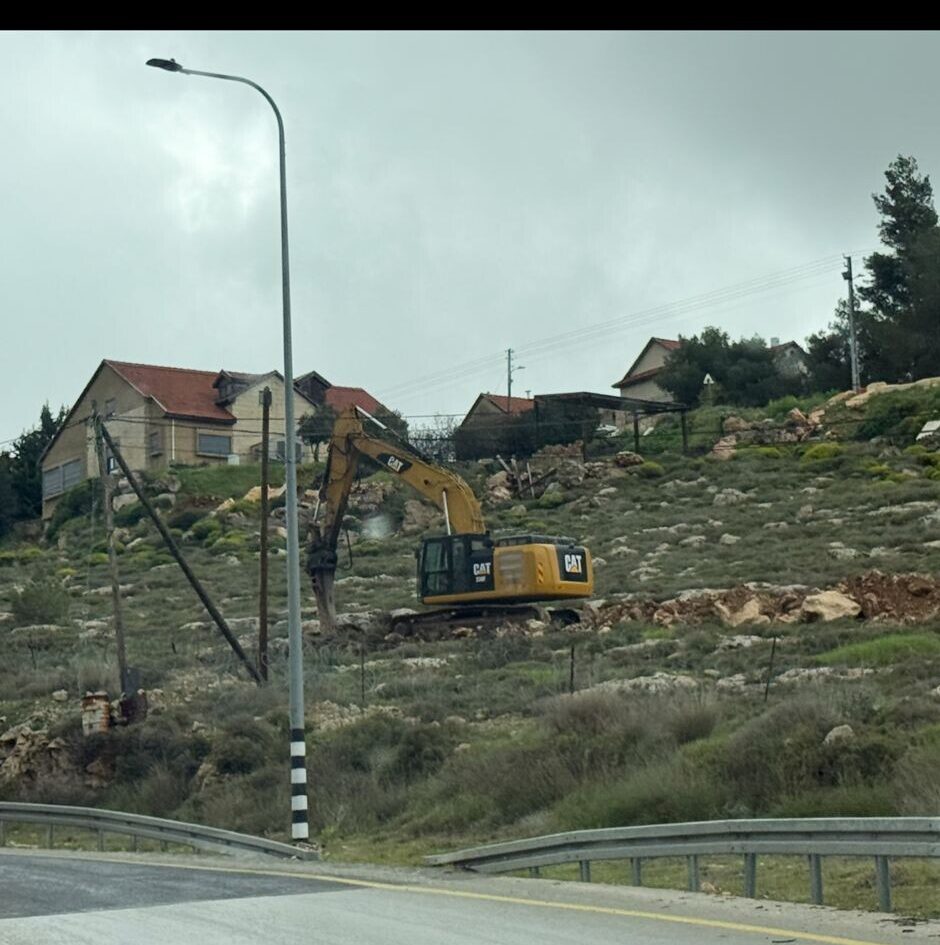 MuhammadFeb-24-2026South Hebron Hill, Beit Hagai: Paving an internal security road
-