
Hebron, South Hebron Hills, Sun 22.5.11, Morning
Translator: Charles K.
Meitar crossing
No workers in the fenced corridor leading to the inspection area. The parking lot on the Israel side also appears almost empty, a sign that the workers are crossing quickly and smoothly even though it’s the first day of the week. Relatives of prisoners gather in the inspection shed, two buses awaiting them on the Israeli side.
Route 60
The road is almost empty at this hour, all checkpoints are open and there’s no military presence in the area.
Hebron
Kiryat Arba is quiet, apparently recovering from yesterday’s bonfires (Jewish holiday of Lag Ba'omer). Two soldiers guard the entrance to the worshippers’ route. Curve 160 – new colorful graffiti greets us: “Welcome to Hebron, City of the Patriarchs.” The pillbox is also decorated; the soldiers claim they did it themselves. “Exit only” is written in English on the yellow barrier. The Cave of the Patriarchs area is quiet. We entered the area of the wholesale market; Leah photographed the contents of the abandoned rooms. We found the smoking remains of a bonfire that had nothing combustible nearby. A few remains of bonfires were visible along Shuhada Street, but what particularly caught our eye were signs for the children’s Lag Ba’Omer parade. They were apparently waiting for it at home. Along Shuhada Street graffiti slogans in a colorful American style sometimes covered earlier drawings and slogans. Did followers of Rabbi Nach Nach (Nachman of Bracelow) come to decorate the city?
At the top of Shuhada Street there’s a Giv’ati soldier who doesn’t know about our organization, even though he was inducted in March, 2009, and said he went through training to serve in Hebron. He started talking to us, but was primarily interested in attacking what we were saying, and finally told us we’d been brainwashed. He told us of a tense incident yesterday, about Palestinian children who beat a young, innocent settler. While we were talking he refused to allow TIPH observers to reach the Avraham Avinu neighborhood. We met another pair of observers opposite the Cave of the Patriarchs and asked whether the army restricts their entry to any locations. They said they have the right to go everywhere but sometimes the commander on site stops them.
On our way back we found four youths detained at Curve 160 – they looked to be about 15-18. Each one was sent to sit by himself at a different corner of the junction. When we asked the Border Police soldiers, they said the youths had been fresh or interfered with their work. One’s offense was that he didn’t have an ID, or had forgotten it at home. While we were talking to one of the detainees the soldiers turned him into a prisoner instead of a detainee. Perhaps our active participation in the incident, and our attempt to find out what was going on, made things worse. An armored army jeep suddenly appeared along with a Border Police vehicle and a police jeep; they and the checkpoint guards spoke off to one side, and finally each vehicle took one of the detainees to the police station. The soldiers at the checkpoint explained that the youths will be interrogated, spend a day in jail and then be released. Their computer record will also apparently have a blot on it that will be extremely difficult to erase. Is that how youths are taught to love Israel?
The way back was smooth and fast. Things didn’t seem particularly tense.
Hebron
See all reports for this place-
According to Wye Plantation Accords (1997), Hebron is divided in two: H1 is under Palestinian Authority control, H2 is under Israeli control. In Hebron there are 170,000 Palestinian citizens, 60,000 of them in H2. Between the two areas are permanent checkpoints, manned at all hours, preventing Palestinian movement between them and controlling passage of permit holders such as teachers and schoolchildren. Some 800 Jews live in Avraham Avinu Quarter and Tel Rumeida, on Givat HaAvot and in the wholesale market.
Checkpoints observed in H2:
- Bet Hameriva CP- manned with a pillbox
- Kapisha quarter CP (the northern side of Zion axis) - manned with a pillbox
- The 160 turn CP (the southern side of Zion axis) - manned with a pillbox
- Avraham Avinu quarter - watch station
- The pharmacy CP - checking inside a caravan with a magnometer
- Tarpat (1929) CP - checking inside a caravan with a magnometer
- Tel Rumeida CP - guarding station
- Beit Hadassah CP - guarding station
Three checkpoints around the Tomb of the Patriarchs
 Raya YeorDec-18-2025Hebron - Yusri Jaber and part of his family
-
South Hebron Hills
See all reports for this place-
South Hebron Hills
South Hebron Hills is a large area in the West Bank's southern part.
Yatta is a major city in this area: right in the border zone between the fertile region of Hebron and its surroundings and the desert of the Hebron Hills. Yatta has about 64,000 inhabitants.
The surrounding villages are called Masafer Yatta (Yatta's daughter villages). Their inhabitants subsist on livestock and agriculture. Agriculture is possible only in small plots, especially near streams. Most of the area consists of rocky terraces.Since the beginning of the 1980s, many settlements have been established on the agricultural land cultivated by the Palestinians in the South Hebron Hills region: Carmel, Maon, Susia, Masadot Yehuda, Othniel, and more. Since the settlements were established and Palestinians cultivation areas have been reduced; the residents of the South Hebron Hills have been suffering from harassment by the settlers. Attempts to evict and demolish houses have continued, along with withholding water and electricity. The military and police usually refrain from intervening in violent incidents between settlers and Palestinians do not enforce the law when it comes to the investigation of extensive violent Jewish settlers. The harassment in the South Hebron Hills includes attacking and attempting to burn residential tents, harassing dogs, harming herds, and preventing access to pastures.
There are several checkpoints in the South Hebron Hills, on Routes 317 and 60. In most of them, no military presence is apparent, but rather an array of pillboxes monitor the villages. Roadblocks are frequently set up according to the settlers and the army's needs. These are located at the Zif Junction, the Dura-al Fawwar crossing, and the Sheep Junction at the southern entrance to Hebron.
Updated April 2022
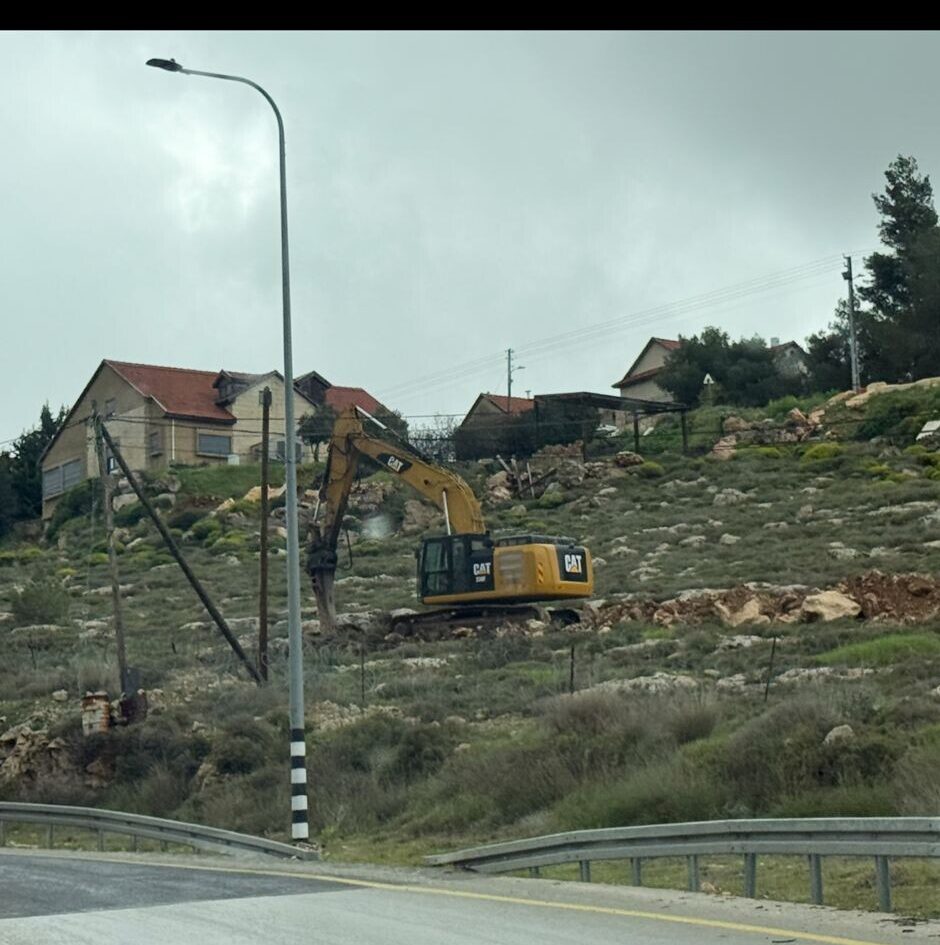 MuhammadFeb-24-2026South Hebron Hill, Beit Hagai: Paving an internal security road
-