
Hebron, South Hebron Hills, Tarqumiya, יום ג’ 16.10.07, בוקר
Sansana, Southern Hebron Hills, Hebron and Tarkumiya
0630-1200
Abstract: Lavi Battalion returned to its old ways. The border checkpoints of Tarkumiya and Sansana are not functioning as they should. The Rotem battalion on the Givati Brigade is new in Hebron.
Sansana: We arrived at 6:30. Pandemonium. More than 40 vehicles are waiting on the Israeli side waiting for the Palestinian workers to cross. The drivers waiting on the parking lot yelled at us “What’s going on here? We’ve been here since 4 a.m.”We passed to the Palestinian side and saw the line was very long. We didn’t count, but it was about 150 standing in the queue.
We called Tarek and to the spokesman of Yehuda Brigade.
We returned to the Israeli side to observe the checking procedures. Two checking positions are operating and the women soldiers were speaking politely. Each checking took from 1-5 minutes. Ltd Guy, The new commander of the checkpoint came to talk to us. He told us that he didn’t see any problems and there was nothing wrong. All the workers pass through by 8. He doesn’t relate to the fact that some of them will lose a day of work if they come through so late. But he is not authorized to open another checking station. He claims that during the week Sun and Mon are problematic in Tarkumiya, Tues is problematic in Sansana and Weds-Fri are not problematic.
Today, for example, 800 workers had already passed through before we arrived. He doesn’t understand why one day there are 800 and another day only 500. He also claims that after the privatization it will be even worse, because now they don’t pass anything through the screening machines, but the private companies will and this will take even longer. It seems to us that they constructed the checkpoint with only two counters and that’s the source of the problem. According to Guy in Tarkumiya four checking stations are planned. At every station four soldiers can carry out the checking on two lines. Today only two soldiers are manning each station and checking only one line at each counter. Why? One of the workers suggests opening a checkpoint at Nazlin- Beit Yattir (east of Sansana, which will reduce the pressure on Sansana.)
7:15 we left, when we returned at 12:00 it was deserted.
Tarkumiya: Arrived at 0920. 60 trucks and cars in a very long line. It turns out the Vehicle Registration Dept. is operating today. Also, orders were given to be more thorough, so every car is checked. The commander of the checkpoint “S” that they have to take apart the seats as well. Only when we arrive do they open another line for checking vehicles. An elderly civilian volunteer – this is his first day at Tarkumiya. The workers passed through in the morning without incident. The last bus of prisoners’ families is now being checked. Six buses to Ktziot, and one to Hadarim prison. The buses arrive at six, but all leave together because of they have a police escort. Each bus takes about 25 minutes to check. This is reasonable for 50 passengers. But when one has to wait until all the buses are checked, families have to wait from 2 ½- 3 hours at the checkpoint. The Red Cross representative tells us that yesterday at Tarkumiya one of the scanners broke down, and the checking by hand meant that they queue held up for four hours.
Hebron: The Rotem battalion on the Givati Brigade has replaced the 202 battalion of the paratroopers. The flags are now violet and white. The soldiers are in their first days in Hebron and look scared to death. They stand outside the checkpoint with their guns pointed and tell all the children to take off their belts which trigger the alarm system. They are very alert. At Tel Rumeida a soldier decides to stop everyone one who passes and takes the ID card or carries out a body check. The Palestinians don’t resist. A peace activist tells us that they day before the soldiers order people to take off their shirts. We know that this will stop once the soldiers calm down. At the curve of the road between Kiriat Arba and the Cave of the Patriarchs if a military jeep. They don’t stop anyone but their guns are pointed. At the Cave of the Patriarchs that a 16 year boy who was caught at the metal detector carrying a knife, took it because of a fight between Hamulot. On the route of the worshippers the army has taken over a rooftop again, new sandbags and camouflage nets. At Bassam’s grocery they tell us that the day before the settlers in the disputed house tried to stop a horse and cart loaded with cinderblocks. The soldiers stopped the horse and cart, but then decided let it go through. We asked the people at the grocery to call us when something like this happens. It’s hard to help after the fact.
Highway 35: Within a distance of 10-15 kilometers there are 4 manned pillboxes, Machsom ElJura, Halhoul-Hebron Bridge, Beit Khil, Idna-Takumiya.
Highway 60: Lavi Battalion has returned to its old ways. The sheep’s crossing – 10:30, military jeep with 4 soldiers sets up a new checkpoint. They stop a mule and cart and check the produce. While this is going on, pedestrians are going back and forth. In the meantime, a battered Fiat Uno comes from Yatta with a mother and father and 2 little girls. Only a wreck like this can pass through the boulders set up as blockades and cars are not allowed to cross #60. But the father decides to cross anyway. The soldiers see the car and run after it. He stops. I yell at the soldier “leave it alone, there are 2 little girls in the car, what you care?” The soldier and driver talk, and the soldier returns to the jeep. The driver turns on the car and drives away. The soldier comes back. There are yellow taxis all around, the soldiers are nervous, they start harassing everyone. Samoa: 7:45 military jeep. When we returned at 11:00 there are 3 taxis with the passengers standing outside. The same jeep #728 is still there. The 3 taxis did the “unforgivable” – they came via unpaved roads and got onto #60 – the shortest way to Hebron. One of the drivers was detained, and the soldiers confiscated his car keys at 8:30, and got them back at 11:00. The officer, a Ltd from the Lavi Battalion doesn’t care about the driver’s earnings. In another taxi there is a woman is quite ill, with her mother and another 2 passengers, on their way to the Alia Hospital in Hebron. The officer lets them pass. The 3rd taxi with 3 small children, women and men – are all waiting for the detained driver. Two hours on the highway so they’ll learn a lesson.
We give water to the passengers and start to call to the spokesman and to the Humanitarian hot line. That apparently gets the officer to take the driver’s ID to be checked. After 20 minutes that we’re there everyone is released.
Hebron
See all reports for this place-
According to Wye Plantation Accords (1997), Hebron is divided in two: H1 is under Palestinian Authority control, H2 is under Israeli control. In Hebron there are 170,000 Palestinian citizens, 60,000 of them in H2. Between the two areas are permanent checkpoints, manned at all hours, preventing Palestinian movement between them and controlling passage of permit holders such as teachers and schoolchildren. Some 800 Jews live in Avraham Avinu Quarter and Tel Rumeida, on Givat HaAvot and in the wholesale market.
Checkpoints observed in H2:
- Bet Hameriva CP- manned with a pillbox
- Kapisha quarter CP (the northern side of Zion axis) - manned with a pillbox
- The 160 turn CP (the southern side of Zion axis) - manned with a pillbox
- Avraham Avinu quarter - watch station
- The pharmacy CP - checking inside a caravan with a magnometer
- Tarpat (1929) CP - checking inside a caravan with a magnometer
- Tel Rumeida CP - guarding station
- Beit Hadassah CP - guarding station
Three checkpoints around the Tomb of the Patriarchs
 Raya YeorDec-18-2025Hebron - Yusri Jaber and part of his family
-
South Hebron Hills
See all reports for this place-
South Hebron Hills
South Hebron Hills is a large area in the West Bank's southern part.
Yatta is a major city in this area: right in the border zone between the fertile region of Hebron and its surroundings and the desert of the Hebron Hills. Yatta has about 64,000 inhabitants.
The surrounding villages are called Masafer Yatta (Yatta's daughter villages). Their inhabitants subsist on livestock and agriculture. Agriculture is possible only in small plots, especially near streams. Most of the area consists of rocky terraces.Since the beginning of the 1980s, many settlements have been established on the agricultural land cultivated by the Palestinians in the South Hebron Hills region: Carmel, Maon, Susia, Masadot Yehuda, Othniel, and more. Since the settlements were established and Palestinians cultivation areas have been reduced; the residents of the South Hebron Hills have been suffering from harassment by the settlers. Attempts to evict and demolish houses have continued, along with withholding water and electricity. The military and police usually refrain from intervening in violent incidents between settlers and Palestinians do not enforce the law when it comes to the investigation of extensive violent Jewish settlers. The harassment in the South Hebron Hills includes attacking and attempting to burn residential tents, harassing dogs, harming herds, and preventing access to pastures.
There are several checkpoints in the South Hebron Hills, on Routes 317 and 60. In most of them, no military presence is apparent, but rather an array of pillboxes monitor the villages. Roadblocks are frequently set up according to the settlers and the army's needs. These are located at the Zif Junction, the Dura-al Fawwar crossing, and the Sheep Junction at the southern entrance to Hebron.
Updated April 2022
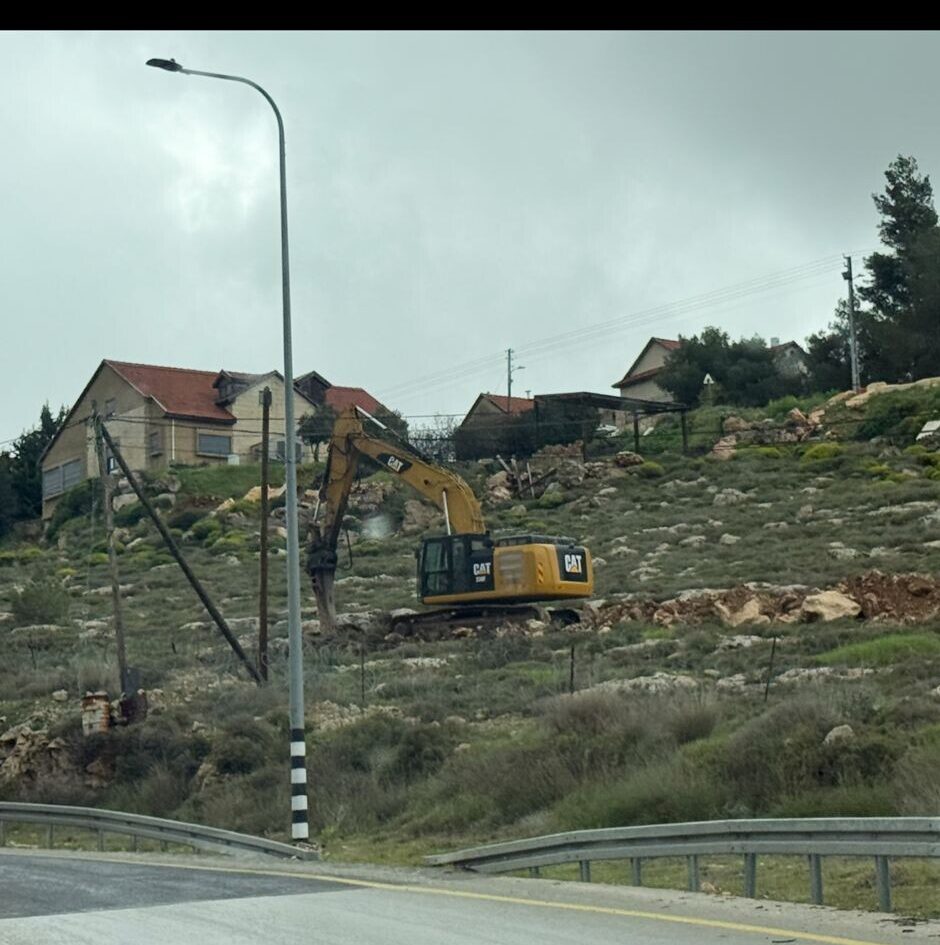 MuhammadFeb-24-2026South Hebron Hill, Beit Hagai: Paving an internal security road
-
Tarqumiya CP
See all reports for this place-
The Tarqumiya Checkpoint is one of the largest and busiest checkpoints where people and goods cross into Israel. It is located on the Separation Barrier close to the Green Line, on Road 35 (connecting Beer Sheva and Hebron). It is run by the Israel Defense Ministry’s Crossings Administration with civilian secuirty companies running the day to day operations. The checkpoint is indeed open to vehicles in both directions 24/7, but Palestinians are prevented from crossing in vehicles, except in special cases. MachsomWatch activists visit the checkpoint as it opens at 3:45 am, in order to observe the daily passage of nearly 10,000 Palestinian workers. The workers arrive from throughout the Southern West Bank. Our activists report on the tremendous overcrowding at this checkpoint; they have observed young men climbing and scrambling on the fences and roofs of the ‘access cages’. This is how the work day begins for those who ‘build the land of Israel’. updated November 2019
-