
Hebron, South Hebron Hills, Tarqumiya, Tue 11.9.12, Morning
Translated by Naomi Gal
Tarqumiya
We started the shift in Tarqumya, where last week, as reported by Hagit on September 3, 2012, the passing through the checkpoint was annoying due to security guards’ conduct. .
Upset and angry, our driver forgot his license there, so we came back to find it.
The place was empty and we found the missing license. This time around the soldiers’ behavior was fair.
South Hebron Hills – Route 35, Route 60
All the way to Hebron there are no signs of the tension we’ll encounter in town later.
In Beit Anun girls are attempting to cross the busy road in order to get to school on the other side.
An Invisible teacher’s voice over a mike urges the girls to hurry up and get there on time, the girls are running. The time is 7:30. A Military vehicle is stationed nearby and Hagit expresses a naïve hope that maybe they are here to secure the dangerous passage of the girls.
Unfortunately the soldiers are not there to safe guard the girls and neither are the Palestinians.
There is no bridge across the road for pedestrians’ safety, as they would have built if this was a Jewish community. Jews’ cars are racing right there and Palestinians are not that careful either, although large groups of girls are crossing the road every morning.
So we waited until the last students crossed this busy, frightening road, Route 60.
Hebron
The unusual tension can be felt already at the entrance to the city. Many vehicles for dispersing protests are parked around the Cave of the Patriarchs. The shops are closed.
On Curve 160 there are paratroopers, not the usual border police. We'll get back to them.
Checkpoint Tarpat and Shuhada Street
It seems they added more guard posts on the way leading to Shuhada Street .
.
Due to what we heard on the news last night we ask the soldiers about the situation. They talk about Molotov cocktails that were thrown in recent days. There are soldiers on the market’s roofs. There are soldiers everywhere on Shuhada Street.
We reached Trp”t checkpoint. The road is filled with stones, lemons and the remains of measures that were taken to disperse the protesters – something we have never seen before. It seems that a particularly harsh event had taken place here.
The zone’s commander we already know is sitting bleary-eyed with his soldiers at the bottom of Tel Rumeida. We approach them wanting to know what went on. He recognizes us and suggests we follow him to the other side of the metal detector in H1.
There we find a real battlefield; the road is strewn with stones, lemons, potatoes, among them the remains of tear gas grenades in quantities that leave no room for doubt .
.
The soldiers say that like in all cities in the West Bank there were demonstrations against the Palestinian Government, and especially against Salam Fayyad. From morning till late at night they kept throwing whatever they could find.
The IDF is in Hebron, in charge of peace and security, and this is where the soldiers became lightning-rods and got their “share”. In such a situation it’s easy for the local leadership to divert all the rage at the soldiers and this is what happened.
The soldiers point at the many vegetables that were thrown and say: they demonstrated against the cost of living. Isn’t a shame to waste so many lemons?
The devoted and polite officer does not agree with us that they should not be there in the first place. He is convinced that if the IDF would not be there, then these kinds of events will take place in Israel.
He, too, tells about soldiers being attacked two days ago and the throwing of a Molotov cocktail.
We, who saw aplenty in this impossible city, never saw anything like that.
Curve 160
We went back to curve 160 because last week we heard that little girls who were passing on the carousel were injured when their feet got caught, commotion ensued and an army medic treated them. The soldiers knew nothing about it, were not there when it happened and did not encounter such cases themselves.
When we suggest they should lift the gate in the morning and at noon, when small kids are on their way to school, so that they won’t get entangled in the carousel, they say they have no authority to make decisions and that such a request should be addressed to an officer who is at least a Colonel. Guy Hazut, who was the Territorial Brigade Commander, left, and we still haven’t met the new one, so we called Hannah in Ramat Gan and agreed that she would try to do something about it.
On second thought, I do not understand why they put obstacles such as the carousel. The yellow gate is there to monitor the passage of cars from Jabal Johar toward Zion Route that are on the way to neighborhoods around the Cave of the Patriarchs (of course, we do not justify the existence of the gate but you could find a 'rational' explanation for its existence in Hebron’s weird logic).
But why make it difficult for the few people who pass by and for kids on their way to school? Again a question that’s blowing in the wind.
According to “B'tselem” activist who was there, the soldiers (paratroopers) who joined the Nahal soldiers are more humane than the border policemen that were there during the last two years, since this curve turned into a checkpoint.
Coming back, we met people from Dhahariya zone who told us about a tough day of outrageous demonstrations involving burning tires, etc. There is a lot of anger over the bad economy and the powerless leadership that lacks authority, and is only concerned by its own needs. If you listened carefully you could detect that there might be others responsible for this situation.
Hebron
See all reports for this place-
According to Wye Plantation Accords (1997), Hebron is divided in two: H1 is under Palestinian Authority control, H2 is under Israeli control. In Hebron there are 170,000 Palestinian citizens, 60,000 of them in H2. Between the two areas are permanent checkpoints, manned at all hours, preventing Palestinian movement between them and controlling passage of permit holders such as teachers and schoolchildren. Some 800 Jews live in Avraham Avinu Quarter and Tel Rumeida, on Givat HaAvot and in the wholesale market.
Checkpoints observed in H2:
- Bet Hameriva CP- manned with a pillbox
- Kapisha quarter CP (the northern side of Zion axis) - manned with a pillbox
- The 160 turn CP (the southern side of Zion axis) - manned with a pillbox
- Avraham Avinu quarter - watch station
- The pharmacy CP - checking inside a caravan with a magnometer
- Tarpat (1929) CP - checking inside a caravan with a magnometer
- Tel Rumeida CP - guarding station
- Beit Hadassah CP - guarding station
Three checkpoints around the Tomb of the Patriarchs
 Raya YeorDec-18-2025Hebron - Yusri Jaber and part of his family
-
South Hebron Hills
See all reports for this place-
South Hebron Hills
South Hebron Hills is a large area in the West Bank's southern part.
Yatta is a major city in this area: right in the border zone between the fertile region of Hebron and its surroundings and the desert of the Hebron Hills. Yatta has about 64,000 inhabitants.
The surrounding villages are called Masafer Yatta (Yatta's daughter villages). Their inhabitants subsist on livestock and agriculture. Agriculture is possible only in small plots, especially near streams. Most of the area consists of rocky terraces.Since the beginning of the 1980s, many settlements have been established on the agricultural land cultivated by the Palestinians in the South Hebron Hills region: Carmel, Maon, Susia, Masadot Yehuda, Othniel, and more. Since the settlements were established and Palestinians cultivation areas have been reduced; the residents of the South Hebron Hills have been suffering from harassment by the settlers. Attempts to evict and demolish houses have continued, along with withholding water and electricity. The military and police usually refrain from intervening in violent incidents between settlers and Palestinians do not enforce the law when it comes to the investigation of extensive violent Jewish settlers. The harassment in the South Hebron Hills includes attacking and attempting to burn residential tents, harassing dogs, harming herds, and preventing access to pastures.
There are several checkpoints in the South Hebron Hills, on Routes 317 and 60. In most of them, no military presence is apparent, but rather an array of pillboxes monitor the villages. Roadblocks are frequently set up according to the settlers and the army's needs. These are located at the Zif Junction, the Dura-al Fawwar crossing, and the Sheep Junction at the southern entrance to Hebron.
Updated April 2022
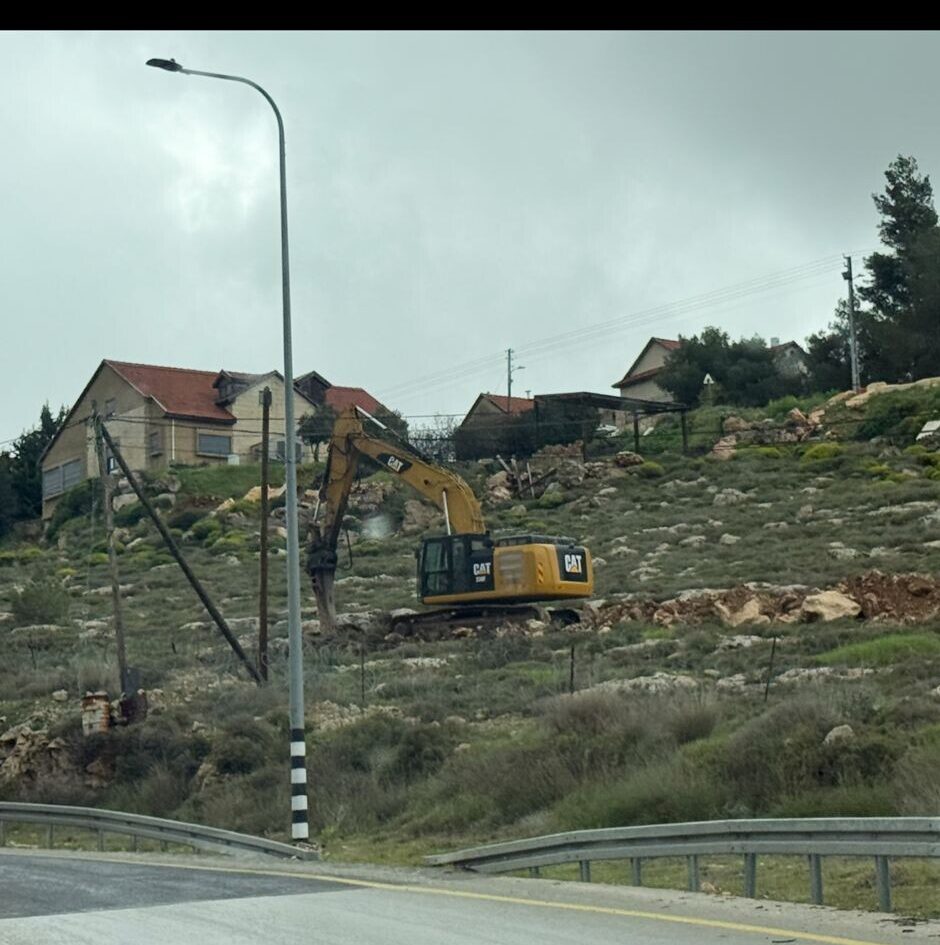 MuhammadFeb-24-2026South Hebron Hill, Beit Hagai: Paving an internal security road
-
Tarqumiya CP
See all reports for this place-
The Tarqumiya Checkpoint is one of the largest and busiest checkpoints where people and goods cross into Israel. It is located on the Separation Barrier close to the Green Line, on Road 35 (connecting Beer Sheva and Hebron). It is run by the Israel Defense Ministry’s Crossings Administration with civilian secuirty companies running the day to day operations. The checkpoint is indeed open to vehicles in both directions 24/7, but Palestinians are prevented from crossing in vehicles, except in special cases. MachsomWatch activists visit the checkpoint as it opens at 3:45 am, in order to observe the daily passage of nearly 10,000 Palestinian workers. The workers arrive from throughout the Southern West Bank. Our activists report on the tremendous overcrowding at this checkpoint; they have observed young men climbing and scrambling on the fences and roofs of the ‘access cages’. This is how the work day begins for those who ‘build the land of Israel’. updated November 2019
-