
Hebron, South Hebron Hills, Tarqumiya, Tue 30.11.10, Morning
Translated by Bracha B.A.
1. Route 317 and Metzudot Yehudah
2. Hebron
3. Shikma Prison – Why are prisoners released without certificates and essential belongings?
We began the shift relatively late at Meitar crossing and when we arrived all the workers had already gone through. There were only prisoner's families waiting.
Route 317
The road was much quieter than Route 60.
The drought this year is already visible at the edge of the Judean Desert.
We approached the Metzudot Yehudah crossing. The signpost welcoming visitors to the crossing is clearly for Israelis only. And indeed, the only people crossing through are settlers or commuters from Jerusalem and back. The only others permitted to cross here are members of the Abu Kabita clan who live on either side of the separation fence and school children who walk to the school in Emanzil. The rest are commercial vehicles and trucks. The army base is now manned by the Golani brigade. We stopped to photograph the signpost and suddenly a jeep appeared and stopped. A young officer got out and asked who we were and what we were doing. "I hope you're not of the trouble-makers' lot, like Ezra Barbadi (Nawwi?)" he says. We identified ourselves. "Ah", he retors, "I've heard about you." The conversation is polite but quick and he opines that the problems are not due to the settlers. We crossed through safely.
The Chever crossing is still open. At the grocery store at the Zif junction a man asks us to help him find work. He once worked in Tel Aviv in construction and has now had no work for three years because no one wants to hire him.
Route 60
We continued driving along Route 60, which had a lot of traffic and military vehicles.
At the Bani Naim junction two soldiers are checking cars while another stands on the hill observing from above.
The entrance to Hebron and the new neighborhood of Neve Mamreh are almost done. Once again the guard, a local, welcomes us warmly and invites us to visit his home. Perhaps we should consider his offer. Peace begins at home.
Hebron
It is depressing to see the ghost town of Hebron in area H2. The children are already at school.
At 9am there are only a few people about and jeeps stand at every corner on the Worshippers' Path. Only at the Cave of the Patriarchs guards from the Border police detain people. Luckily, they were quick to release them. People pass through the remaining checkpoints without being checked.
The second part of the shift
We left Hebron via Route 35 towards Tarquomiya to visit the Shikma Prison near Ashkelon.
A red signpost warning Israelis not to enter Area A stands at the junction between Idna and Tarquomiya. The grocery store and olive press that we regularly visit are 50 meters behind the sign, and we feel like criminals entering, but they are a regular part of our route.
Tarquomiya Crossing
Here things are stricter. We are asked who we are and where we are going, and they also check our vehicle. But the checkpoint is now being landscaped and becoming an attractive place…
Shikma Prison
A man who called us explained that he was released from the Shikma prison without his personal belongings, which he brought with him when arrested, so we drove to the Shikma prison to retreive his stuff. On the way we called to ask about the man's belongings and the woman who spoke with us, identified as the prison's treasurer, said she never heard of our organization but promised to help. We arrived at the prison — an ugly place with fences and barbed wire all round, located in the middle of Ashkelon. We pounded on the glass door at the visitors' entrance. Finally someone opened the door and asked if things were OK. We answered that we certainly hope so, presented the relevant papers and asked to speak to Nava. We were certainly not the kind of people he is accustomed to seeing there. He is polite and goes to call Nava but it takes a while to get everything sorted out because he mis-named me. Finally, Nava relents and brings the man's belongings, not before photocopying related documents. We ask how it is possible to release people without handing them back e.g. their wallet, personal documents, cell phone, etc. The man, who is also from the treasury department, explains that the problem is that some people are released only after being taken to court at Mahane Ofer, and when it so happens, their belongings remain back in prison. They now need an order to take their belongings and return them. Would it be so difficult to take their belongings with them to the Mahane Offer court and then give them back after they are released after the trial? This seems a long and unnecessary procedure. What sense does it make to release people and then re-arrest them because they are found with no papers through no fault of their own? Eventually, I signed the necessary papers and received the man's belongings which will be returned to him by whoever's on tomorrow's shift.
Hebron
See all reports for this place-
According to Wye Plantation Accords (1997), Hebron is divided in two: H1 is under Palestinian Authority control, H2 is under Israeli control. In Hebron there are 170,000 Palestinian citizens, 60,000 of them in H2. Between the two areas are permanent checkpoints, manned at all hours, preventing Palestinian movement between them and controlling passage of permit holders such as teachers and schoolchildren. Some 800 Jews live in Avraham Avinu Quarter and Tel Rumeida, on Givat HaAvot and in the wholesale market.
Checkpoints observed in H2:
- Bet Hameriva CP- manned with a pillbox
- Kapisha quarter CP (the northern side of Zion axis) - manned with a pillbox
- The 160 turn CP (the southern side of Zion axis) - manned with a pillbox
- Avraham Avinu quarter - watch station
- The pharmacy CP - checking inside a caravan with a magnometer
- Tarpat (1929) CP - checking inside a caravan with a magnometer
- Tel Rumeida CP - guarding station
- Beit Hadassah CP - guarding station
Three checkpoints around the Tomb of the Patriarchs
 Raya YeorDec-18-2025Hebron - Yusri Jaber and part of his family
-
South Hebron Hills
See all reports for this place-
South Hebron Hills
South Hebron Hills is a large area in the West Bank's southern part.
Yatta is a major city in this area: right in the border zone between the fertile region of Hebron and its surroundings and the desert of the Hebron Hills. Yatta has about 64,000 inhabitants.
The surrounding villages are called Masafer Yatta (Yatta's daughter villages). Their inhabitants subsist on livestock and agriculture. Agriculture is possible only in small plots, especially near streams. Most of the area consists of rocky terraces.Since the beginning of the 1980s, many settlements have been established on the agricultural land cultivated by the Palestinians in the South Hebron Hills region: Carmel, Maon, Susia, Masadot Yehuda, Othniel, and more. Since the settlements were established and Palestinians cultivation areas have been reduced; the residents of the South Hebron Hills have been suffering from harassment by the settlers. Attempts to evict and demolish houses have continued, along with withholding water and electricity. The military and police usually refrain from intervening in violent incidents between settlers and Palestinians do not enforce the law when it comes to the investigation of extensive violent Jewish settlers. The harassment in the South Hebron Hills includes attacking and attempting to burn residential tents, harassing dogs, harming herds, and preventing access to pastures.
There are several checkpoints in the South Hebron Hills, on Routes 317 and 60. In most of them, no military presence is apparent, but rather an array of pillboxes monitor the villages. Roadblocks are frequently set up according to the settlers and the army's needs. These are located at the Zif Junction, the Dura-al Fawwar crossing, and the Sheep Junction at the southern entrance to Hebron.
Updated April 2022
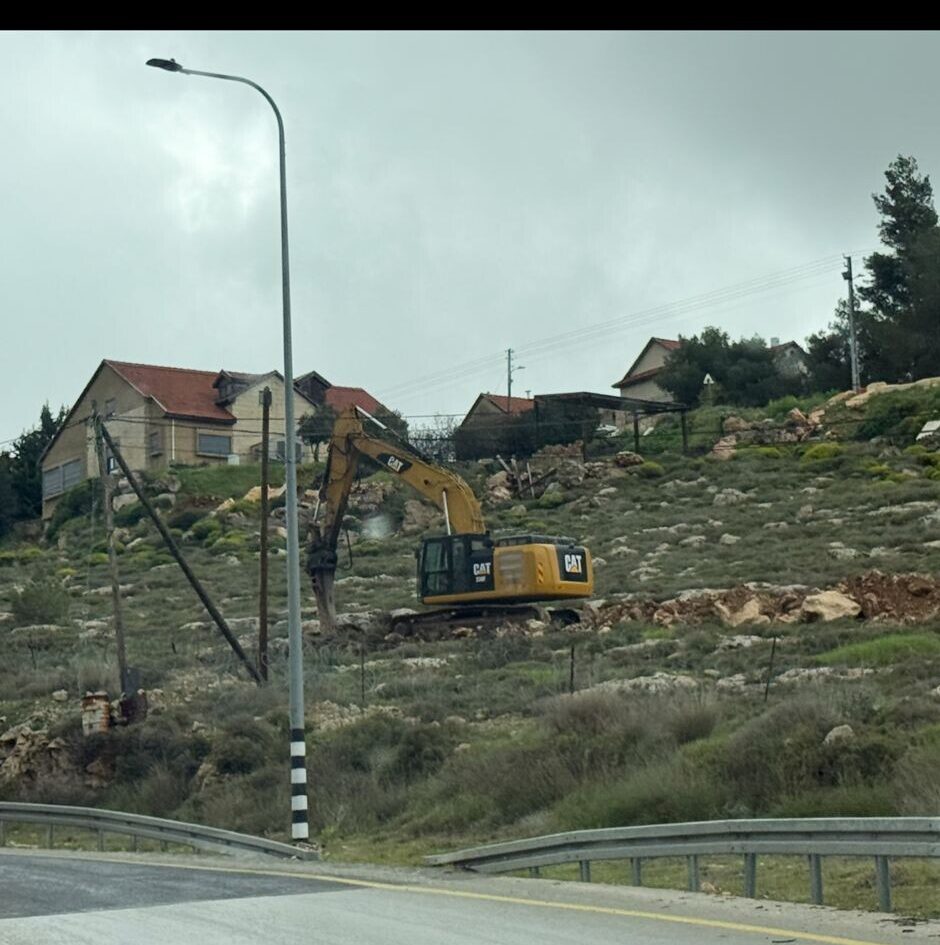 MuhammadFeb-24-2026South Hebron Hill, Beit Hagai: Paving an internal security road
-
Tarqumiya CP
See all reports for this place-
The Tarqumiya Checkpoint is one of the largest and busiest checkpoints where people and goods cross into Israel. It is located on the Separation Barrier close to the Green Line, on Road 35 (connecting Beer Sheva and Hebron). It is run by the Israel Defense Ministry’s Crossings Administration with civilian secuirty companies running the day to day operations. The checkpoint is indeed open to vehicles in both directions 24/7, but Palestinians are prevented from crossing in vehicles, except in special cases. MachsomWatch activists visit the checkpoint as it opens at 3:45 am, in order to observe the daily passage of nearly 10,000 Palestinian workers. The workers arrive from throughout the Southern West Bank. Our activists report on the tremendous overcrowding at this checkpoint; they have observed young men climbing and scrambling on the fences and roofs of the ‘access cages’. This is how the work day begins for those who ‘build the land of Israel’. updated November 2019
-