
Hebron, South Hebron Hills, Tue 17.5.11, Morning
Translator: Charles K.
The closure is over – back to the routine
Meitar checkpoint
All the workers crossed to the Israeli side. No visits of relatives.
Route 60
Quieter than on other days.
A small vineyard has been planted below Mitzpeh Eshtamo’a. Is it a sign that the settlers there are digging in?
Soldiers stop cars for inspection on the road to Ovda, but release them quickly.
Many children at the Dura-Elfawwar junction, on their way to school.
Soldiers are also at the sheep market at the Kvasim junction; they’re not interfering, other than by their presense.
Hebron
The entrance to Kiryat Arba is becoming increasingly grand. The plazas have been completed. I wonder how they’ll be decorated?
The guard at the entrance smiles ironically and asks, “Nu, how did you celebrate Nakba Day?”
Anat Cohen passes and manages to send a shiver down our spines simply by her presence. We’re glad she drove on rather than turning around to quarrel with us.
Giv’ati and Border Police soldiers at all the Hebron checkpoints, as usual, but we don’t see anyone detained anywhere. We met C.P.T. women. They again express their condolences at the passing of Tamar Golan, our colleague. They tell us that yesterday, on opposite sides of the Tarpa”t checkpoint, Palestinian residents of Hebron faced IDF soldiers. The Palestinians yelled and threw rocks; the soldiers lobbed smoke grenades.
We visited the Al Ibrahamiyya school for boys and the Al Fayha school for girls which are next to each other and adjoin the Cave of the Patriarchs compound.
We wanted to arrange a visit to these schools by students from Sapir College two weeks from now. The principal of the boy’s school telephones to someone and receives permission for the visit. Our conversation with him flows. He tells us he was a pupil in that school as a child, taught there and now he’s the principal.
He’s lived here his entire life. He has a bullet in his leg from 2001, but believes that the Palestinian people and the Israeli people can live together in peace. The problem, he says, is the leaders. We can’t argue with that.
Hagit tells him about the Beck family, that had property in Hebron, but in 1981 went to Natshe, the mayor, and gave him the deed to their property. They relinquished all of it until peace comes.
The principal shows us photographs of settlers attacking the children, but notes that things have calmed down recently.
The principal of the Al Fayha school for girls tells us that that the school must close whenever there’s a Jewish holiday, and about delays almost daily at the checkpoint at the Palestinian entrance to the Cave of the Patriarchs. We offer to help, as we did with the Cordoba School next to the Pharmacy checkpoint. She’s a proud, impressive woman; she says she won’t accept our help if the rest of the residents still must be inspected. She doesn’t say so explicitly, but her message is: “There shouldn’t be a checkpoint there at all. No one should have to be inspected leaving their home for work or school.” Is there anything to add?
Regarding the visit by students to her school, she’s somewhat hesitant and wants to check with her superiors. She also asks whether we can help her arrange a visit to the Biblical Zoo in Jerusalem. We’ll try.
Route 60
We left, drove to Beit Anun. Concrete cubes, and more concrete cubes, and more concrete cubes on both sides of Route 60 and the entrances to Beit Anun and to Hebron.
A military vehicle stops cars for inspection but let them off quickly when we arrive.
We returned via Route 317, where everything seems normal.
Hebron
See all reports for this place-
According to Wye Plantation Accords (1997), Hebron is divided in two: H1 is under Palestinian Authority control, H2 is under Israeli control. In Hebron there are 170,000 Palestinian citizens, 60,000 of them in H2. Between the two areas are permanent checkpoints, manned at all hours, preventing Palestinian movement between them and controlling passage of permit holders such as teachers and schoolchildren. Some 800 Jews live in Avraham Avinu Quarter and Tel Rumeida, on Givat HaAvot and in the wholesale market.
Checkpoints observed in H2:
- Bet Hameriva CP- manned with a pillbox
- Kapisha quarter CP (the northern side of Zion axis) - manned with a pillbox
- The 160 turn CP (the southern side of Zion axis) - manned with a pillbox
- Avraham Avinu quarter - watch station
- The pharmacy CP - checking inside a caravan with a magnometer
- Tarpat (1929) CP - checking inside a caravan with a magnometer
- Tel Rumeida CP - guarding station
- Beit Hadassah CP - guarding station
Three checkpoints around the Tomb of the Patriarchs
 Raya YeorDec-18-2025Hebron - Yusri Jaber and part of his family
-
South Hebron Hills
See all reports for this place-
South Hebron Hills
South Hebron Hills is a large area in the West Bank's southern part.
Yatta is a major city in this area: right in the border zone between the fertile region of Hebron and its surroundings and the desert of the Hebron Hills. Yatta has about 64,000 inhabitants.
The surrounding villages are called Masafer Yatta (Yatta's daughter villages). Their inhabitants subsist on livestock and agriculture. Agriculture is possible only in small plots, especially near streams. Most of the area consists of rocky terraces.Since the beginning of the 1980s, many settlements have been established on the agricultural land cultivated by the Palestinians in the South Hebron Hills region: Carmel, Maon, Susia, Masadot Yehuda, Othniel, and more. Since the settlements were established and Palestinians cultivation areas have been reduced; the residents of the South Hebron Hills have been suffering from harassment by the settlers. Attempts to evict and demolish houses have continued, along with withholding water and electricity. The military and police usually refrain from intervening in violent incidents between settlers and Palestinians do not enforce the law when it comes to the investigation of extensive violent Jewish settlers. The harassment in the South Hebron Hills includes attacking and attempting to burn residential tents, harassing dogs, harming herds, and preventing access to pastures.
There are several checkpoints in the South Hebron Hills, on Routes 317 and 60. In most of them, no military presence is apparent, but rather an array of pillboxes monitor the villages. Roadblocks are frequently set up according to the settlers and the army's needs. These are located at the Zif Junction, the Dura-al Fawwar crossing, and the Sheep Junction at the southern entrance to Hebron.
Updated April 2022
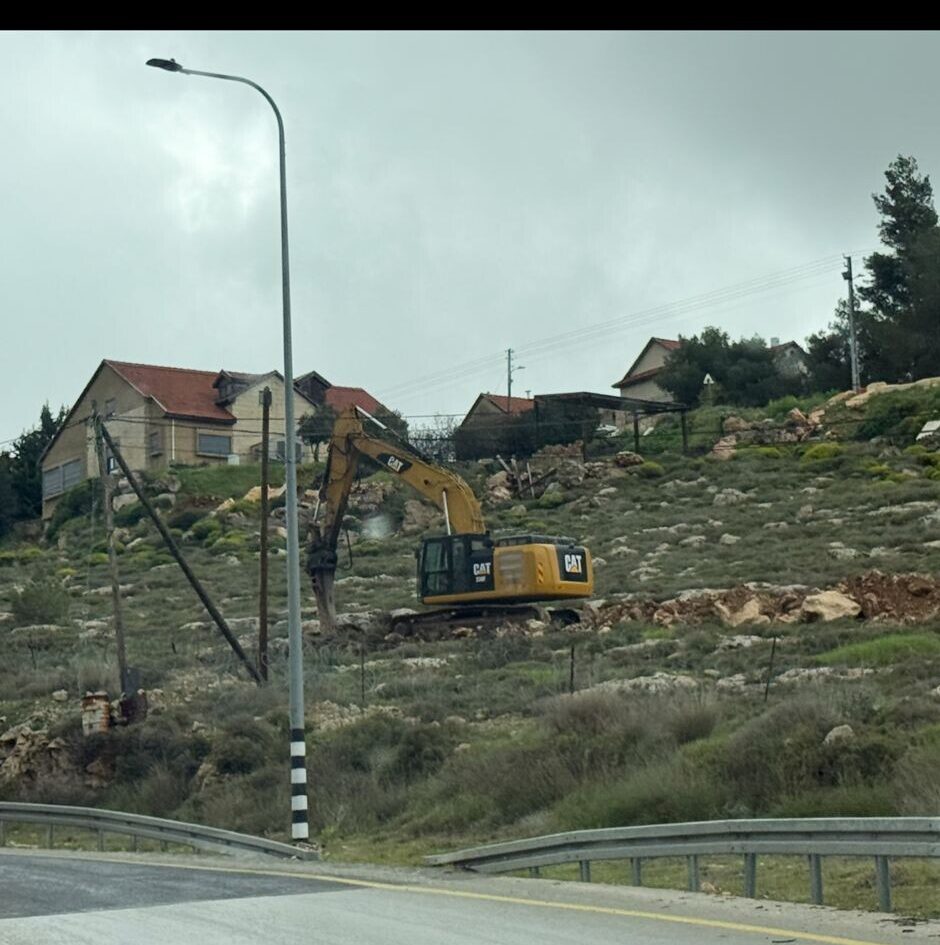 MuhammadFeb-24-2026South Hebron Hill, Beit Hagai: Paving an internal security road
-