
Hebron, South Hebron Hills, Tue 3.5.11, Morning
Translator: Charles K.
Meytar crossing
A bus with relatives of prisoners stands at the checkpoint. At 07:15 the relatives begin crossing, because the laborers already went through.
Route 60
The road is full of cars. Considerable military presence today. The balloon is in the air, military vehicles and soldiers at every junction.
There are soldiers at the turn to Samu’a, but they’re not stopping anyone.
Many soldiers at the turn to Dahariyya, and also along Route 60. It looks like some kind of military exercise. Soldiers came out of the pillbox at the Dura-Elfawwar junction but they’re not interfering with anyone. Children walk to the UNRWA school. There are also soldiers at the Kvasim junction, next to the sheep market.
Maybe it’s connected to the killing of Bin Laden? Maybe the upcoming Independence Day?
Hebron
Hagit Ofran, current head of Peace Now, asked us to check whether the army paved a road to the Mizpe Avichai outpost. We drove to the Giv’at Ha'harsina neighborhood which overlooks it. And in fact, a black asphalt “snake” parallels the winding dirt road to the settlement. We dared drive down closer, our knees trembling. We waited for a settler in his vehicle to get farther away from us and then drove closer. Piles of asphalt next to the gate marking the entrance and a new, unfinished portion of the road.
On our way back, a jeep with the deputy commander of the Tzabar battalion shows up. Half-joking, half-serious, he says he came because of us. “Did the army pave this road?,” we ask. "What road, what are you talking about?” he replies. We tell him what we saw. He seems surprised, and goes to see for himself.
On our way back we merged onto the fancy road into Hebron and saw large fenced areas of the old asphalt in preparation for resurfacing. M., our smart driver, says: “They took the asphalt from here and brought it to the road to the settlement. The piles of asphalt there don’t look new.” Apparently he’s right. The municipality doesn’t waste resources; the lawbreakers can use them. We wonder whether the army, who knows nothing, will do something.
in Hebron itself, everything looks the same.
A settler driving before us in an electric cart signals to soldiers at the Tarpa”t checkpoint, and then at Tel Rumeida, that we’re behind him. They grin to each other and slash their hands across their throats to indicate what they think of us.
The soldier at the entrance to Tel Rumeida is pleased. He stops us and asks M., our driver, for his ID. We say that we see he does what the settlers tell him to do. He smiles in embarrassment, but doesn’t stop. We tell him to check our ID’s as well, that we all have the same blue ID’s (of Israeli citizens). He responds rudely and keeps asking for only this one ID. We keep protesting his racist behavior. He, instead of looking for an honorable way out and backing down, becomes even ruder and tells us to wait while he calls the police. A settler comes down from Tel Rumeida and tries, in a surprisingly pleasant manner, to calm things down. “Come, let’s have something to drink, and talk,” he suggests. “M. as well?,” we naively enquire. He stammers… “Wait, I’ll go talk to Baruch Marzel. He’ll…host us…" "Thanks a lot." we replied. "We understand."
We call the Yehuda brigade. They promise to attend to the matter. The soldier called his commander and another soldier who was even ruder and cursed more than he was/did he himself. The officer instructs the soldiers not to answer us, but to search the vehicle – since he has to justify detaining us. “Don’t you understand, they come to argue with you so you’ll answer them,” he explains.
We call the Cave of the Patriarchs police station, and they show up immediately. The soldiers, who were on the verge of making the situation even more complicated, understood they had to back down, despite their cursing and the disgusting things they said to us. “Why aren’t you in Sderot?” they exclaimed, among other things. Finally they checked all of our ID’s! The police were friendly and polite, and we said goodbye.
Hebron
See all reports for this place-
According to Wye Plantation Accords (1997), Hebron is divided in two: H1 is under Palestinian Authority control, H2 is under Israeli control. In Hebron there are 170,000 Palestinian citizens, 60,000 of them in H2. Between the two areas are permanent checkpoints, manned at all hours, preventing Palestinian movement between them and controlling passage of permit holders such as teachers and schoolchildren. Some 800 Jews live in Avraham Avinu Quarter and Tel Rumeida, on Givat HaAvot and in the wholesale market.
Checkpoints observed in H2:
- Bet Hameriva CP- manned with a pillbox
- Kapisha quarter CP (the northern side of Zion axis) - manned with a pillbox
- The 160 turn CP (the southern side of Zion axis) - manned with a pillbox
- Avraham Avinu quarter - watch station
- The pharmacy CP - checking inside a caravan with a magnometer
- Tarpat (1929) CP - checking inside a caravan with a magnometer
- Tel Rumeida CP - guarding station
- Beit Hadassah CP - guarding station
Three checkpoints around the Tomb of the Patriarchs
 Raya YeorDec-18-2025Hebron - Yusri Jaber and part of his family
-
South Hebron Hills
See all reports for this place-
South Hebron Hills
South Hebron Hills is a large area in the West Bank's southern part.
Yatta is a major city in this area: right in the border zone between the fertile region of Hebron and its surroundings and the desert of the Hebron Hills. Yatta has about 64,000 inhabitants.
The surrounding villages are called Masafer Yatta (Yatta's daughter villages). Their inhabitants subsist on livestock and agriculture. Agriculture is possible only in small plots, especially near streams. Most of the area consists of rocky terraces.Since the beginning of the 1980s, many settlements have been established on the agricultural land cultivated by the Palestinians in the South Hebron Hills region: Carmel, Maon, Susia, Masadot Yehuda, Othniel, and more. Since the settlements were established and Palestinians cultivation areas have been reduced; the residents of the South Hebron Hills have been suffering from harassment by the settlers. Attempts to evict and demolish houses have continued, along with withholding water and electricity. The military and police usually refrain from intervening in violent incidents between settlers and Palestinians do not enforce the law when it comes to the investigation of extensive violent Jewish settlers. The harassment in the South Hebron Hills includes attacking and attempting to burn residential tents, harassing dogs, harming herds, and preventing access to pastures.
There are several checkpoints in the South Hebron Hills, on Routes 317 and 60. In most of them, no military presence is apparent, but rather an array of pillboxes monitor the villages. Roadblocks are frequently set up according to the settlers and the army's needs. These are located at the Zif Junction, the Dura-al Fawwar crossing, and the Sheep Junction at the southern entrance to Hebron.
Updated April 2022
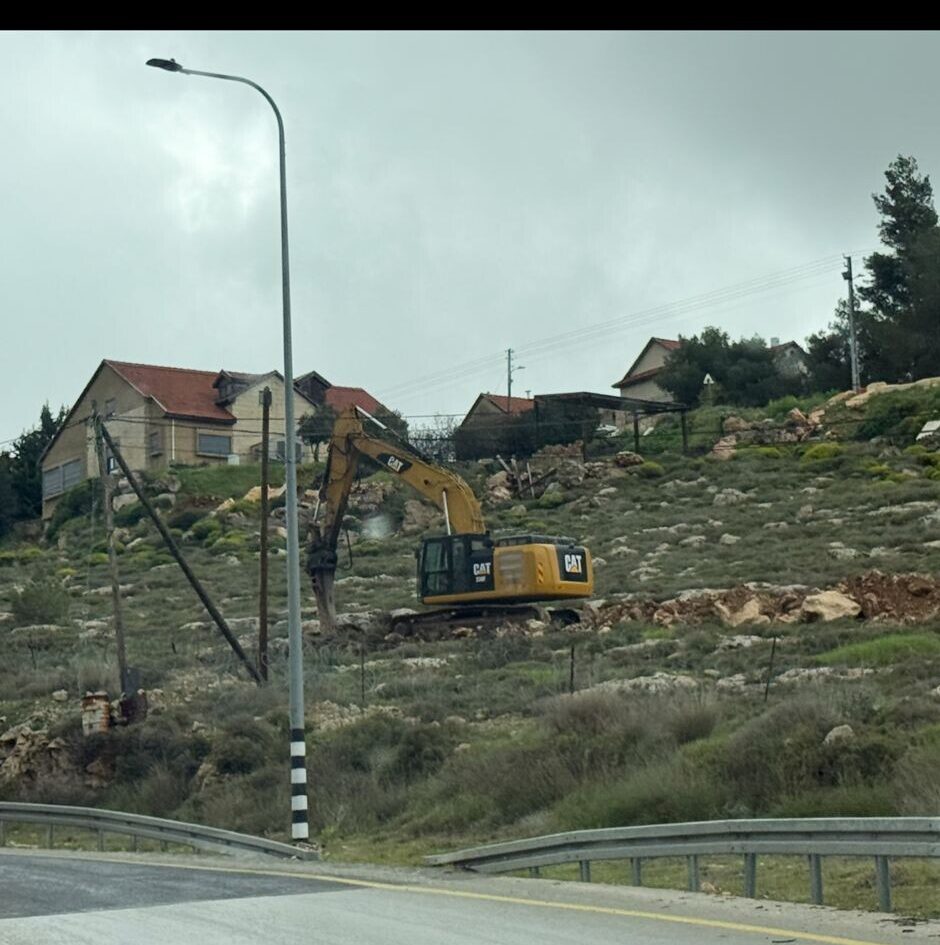 MuhammadFeb-24-2026South Hebron Hill, Beit Hagai: Paving an internal security road
-