
Hebron, South Hebron Hills, Tue 6.12.11, Morning
We left Beersheva at 7:30.
Sansana-Meitar
already clear of workers, but women and family members of prisoners were still trickling through to the waiting buses.
Route 60
was pretty clear and we didn't see a single soldier.
Hebron
After the usual tour of silent H2 – the old city of Hebron, we stopped at Abed's store opposite Gutnick's tourist center, because we saw a large group of girls waiting on the "Arab" side to enter the Ibrahimi mosque. However within minutes they streamed up the lane to the mosque, full of beans and chatter. We were still standing, nursing cups of hot sage tea when a pair of TIPH observers came up and got chatting to us. In answer to our questiion they said that H2 is very quiet these days, but if there are incidents they are not usually in the morning but in the afternoon or evening and at night, with shabbat being a particular time of tension. They gave us a pamphlet explaining who they were and what they do. Their website is at www.tiph.org This was the first time almost that we found TIPH observers to be friendly. One of them was Swiss, a lawyer by profession and the other was a Danish citizen. originally from Jerusalem whose family fled in 1967.
Afterwards Netanya and I walked up the Worshippers Alley. Along the way we encountered a settler in his car who stared at us but didn't bother us. When we got to the top of the alleyway, Ofer the photographer was waiting for us with his video and some curses that were so unoriginal and childishly vulgar that I myself could have done better (but decided silence was wiser!) Our settler from the alley was standing by grinning like an idiot, probably pleased that he had alerted Ofer to our dangerous presence. Don't these people do any work?!! Mohammed arrived and whisked us off. Unpleasant, but at least they didn't run us over …this time.
Hebron
See all reports for this place-
According to Wye Plantation Accords (1997), Hebron is divided in two: H1 is under Palestinian Authority control, H2 is under Israeli control. In Hebron there are 170,000 Palestinian citizens, 60,000 of them in H2. Between the two areas are permanent checkpoints, manned at all hours, preventing Palestinian movement between them and controlling passage of permit holders such as teachers and schoolchildren. Some 800 Jews live in Avraham Avinu Quarter and Tel Rumeida, on Givat HaAvot and in the wholesale market.
Checkpoints observed in H2:
- Bet Hameriva CP- manned with a pillbox
- Kapisha quarter CP (the northern side of Zion axis) - manned with a pillbox
- The 160 turn CP (the southern side of Zion axis) - manned with a pillbox
- Avraham Avinu quarter - watch station
- The pharmacy CP - checking inside a caravan with a magnometer
- Tarpat (1929) CP - checking inside a caravan with a magnometer
- Tel Rumeida CP - guarding station
- Beit Hadassah CP - guarding station
Three checkpoints around the Tomb of the Patriarchs
 Raya YeorDec-18-2025Hebron - Yusri Jaber and part of his family
-
South Hebron Hills
See all reports for this place-
South Hebron Hills
South Hebron Hills is a large area in the West Bank's southern part.
Yatta is a major city in this area: right in the border zone between the fertile region of Hebron and its surroundings and the desert of the Hebron Hills. Yatta has about 64,000 inhabitants.
The surrounding villages are called Masafer Yatta (Yatta's daughter villages). Their inhabitants subsist on livestock and agriculture. Agriculture is possible only in small plots, especially near streams. Most of the area consists of rocky terraces.Since the beginning of the 1980s, many settlements have been established on the agricultural land cultivated by the Palestinians in the South Hebron Hills region: Carmel, Maon, Susia, Masadot Yehuda, Othniel, and more. Since the settlements were established and Palestinians cultivation areas have been reduced; the residents of the South Hebron Hills have been suffering from harassment by the settlers. Attempts to evict and demolish houses have continued, along with withholding water and electricity. The military and police usually refrain from intervening in violent incidents between settlers and Palestinians do not enforce the law when it comes to the investigation of extensive violent Jewish settlers. The harassment in the South Hebron Hills includes attacking and attempting to burn residential tents, harassing dogs, harming herds, and preventing access to pastures.
There are several checkpoints in the South Hebron Hills, on Routes 317 and 60. In most of them, no military presence is apparent, but rather an array of pillboxes monitor the villages. Roadblocks are frequently set up according to the settlers and the army's needs. These are located at the Zif Junction, the Dura-al Fawwar crossing, and the Sheep Junction at the southern entrance to Hebron.
Updated April 2022
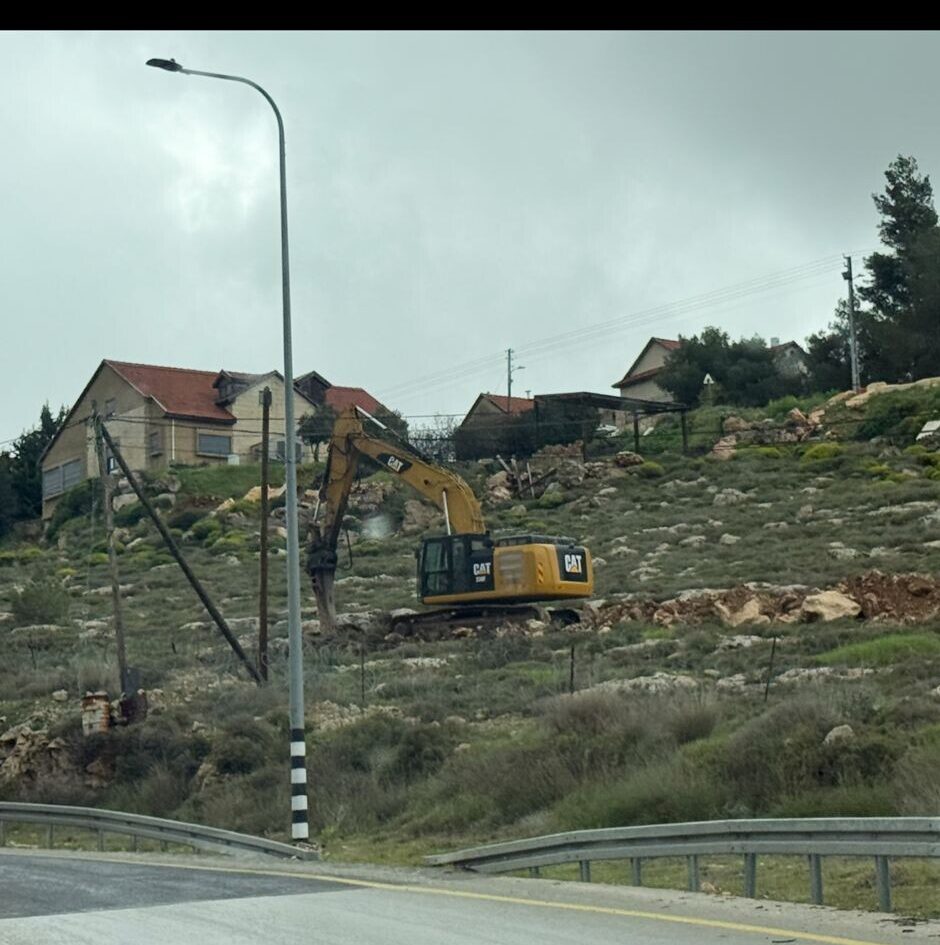 MuhammadFeb-24-2026South Hebron Hill, Beit Hagai: Paving an internal security road
-