
Hebron, South Hebron Hills, Tue 9.10.12, Morning

Translator: Charles K.
08:30-12:00
Highway 60
Nothing unusual at the Meitar checkpoint or along Highway 60 except for the sight of little children and women carrying infants walking from Yatta, apparently on their way to the clinic at Khirbet Tawwani.
They must walk for a few kilometers along an unpaved, uneven path, as well as cross a main highway.

Large signs announce Sussiya is expanding. The new homes are visible from the road.
Hebron
We started at Beit HaMeriva [House of Contention] — which the settlers now renamed “Beit HaShalom” [House of Peace]. We wanted to see whether any changes occurred after the court’s decision (namely, that the sale was legal and hence occupation may [theoretically] proceed). A large, festive Israeli flag has been spread over the building, announcing what’s to come. A solitary soldier stands on the roof.
“When are you leaving”, I ask.
“Don’t know,” he replies.
We visited the neighbors who had suffered, are now suffering and will continue to suffer from being too close to “Beit HaShalom.”
B. received a permit from the Hebron municipality to add a second story to his home. The municipality is the body authorized to permit construction in Area H2, but he was nevertheless forced to stop building due to the settlers’ pressure and the army’s threats.
He says that on the instructions of Yesh Din he’s going today to the “Hebron municipal renovation and construction authority” to meet with an attorney, hoping to solve his problem.
Hagit telephones Hagit Ofran, from Peace Now, who explains to B. that the army isn’t allowed to prevent him from building; it’s illegal. His actions are legitimate and justified. She’ll follow up also.
Hagit makes another phone call, to Zehava Galon. She wants a copy of the army’s stop-work order prohibiting construction. That’s the only way she’ll be able to do anything.
B. says there’s no such document. They simply came and threatened him, used violence, detained and handcuffed the laborers and stopped the work. We must keep following up and act because it’s clear that this is happening because he’s too close to Beit HaMeriva, and the Hebron Jews are allowed to do anything.
:The Cave of the Patriarchs
The Border Police soldiers again try to prevent M., our Moslem driver, from parking in the plaza. I show them a legal document indicating that there’s no obstacle to Moslems parking in that lot and they’re forced to back down. A copy of the document is in the car, if anyone should need it.
We saw posters announcing upcoming elections in Hebron, and wanted to learn more about them. People explained that these will be the first elections in 30 years, ten days from now. There are even parties with female candidates.
Everyone we speak to stresses that they’re not involved with politics, but all the parties promise nevertheless to improve social benefits, quality of life, health, education. The occupation’s negative effect on these areas is not often mentioned.
There doesn’t seem to be much trust of politicians. We get the feeling of “nothing new under the sun.”
A new green fence being erected along a portion of the worshippers route leading to the Cave of the Patriarchs, enclosing the way on this side as well and separating Jews from Palestinians.
There are no longer soldiers at Beit HaMachpela. That’s worrisome.
The army patrols all along Shuhada Street; settlers’ children play with a cart and donkey. “Where did the donkey come from?,” Hagit asks.
“What do you care!,” reply the little lords of the land who, like their parents, have forgotten that “courtesy preceded the Torah.”
Hebron
See all reports for this place-
According to Wye Plantation Accords (1997), Hebron is divided in two: H1 is under Palestinian Authority control, H2 is under Israeli control. In Hebron there are 170,000 Palestinian citizens, 60,000 of them in H2. Between the two areas are permanent checkpoints, manned at all hours, preventing Palestinian movement between them and controlling passage of permit holders such as teachers and schoolchildren. Some 800 Jews live in Avraham Avinu Quarter and Tel Rumeida, on Givat HaAvot and in the wholesale market.
Checkpoints observed in H2:
- Bet Hameriva CP- manned with a pillbox
- Kapisha quarter CP (the northern side of Zion axis) - manned with a pillbox
- The 160 turn CP (the southern side of Zion axis) - manned with a pillbox
- Avraham Avinu quarter - watch station
- The pharmacy CP - checking inside a caravan with a magnometer
- Tarpat (1929) CP - checking inside a caravan with a magnometer
- Tel Rumeida CP - guarding station
- Beit Hadassah CP - guarding station
Three checkpoints around the Tomb of the Patriarchs
 Raya YeorDec-18-2025Hebron - Yusri Jaber and part of his family
-
South Hebron Hills
See all reports for this place-
South Hebron Hills
South Hebron Hills is a large area in the West Bank's southern part.
Yatta is a major city in this area: right in the border zone between the fertile region of Hebron and its surroundings and the desert of the Hebron Hills. Yatta has about 64,000 inhabitants.
The surrounding villages are called Masafer Yatta (Yatta's daughter villages). Their inhabitants subsist on livestock and agriculture. Agriculture is possible only in small plots, especially near streams. Most of the area consists of rocky terraces.Since the beginning of the 1980s, many settlements have been established on the agricultural land cultivated by the Palestinians in the South Hebron Hills region: Carmel, Maon, Susia, Masadot Yehuda, Othniel, and more. Since the settlements were established and Palestinians cultivation areas have been reduced; the residents of the South Hebron Hills have been suffering from harassment by the settlers. Attempts to evict and demolish houses have continued, along with withholding water and electricity. The military and police usually refrain from intervening in violent incidents between settlers and Palestinians do not enforce the law when it comes to the investigation of extensive violent Jewish settlers. The harassment in the South Hebron Hills includes attacking and attempting to burn residential tents, harassing dogs, harming herds, and preventing access to pastures.
There are several checkpoints in the South Hebron Hills, on Routes 317 and 60. In most of them, no military presence is apparent, but rather an array of pillboxes monitor the villages. Roadblocks are frequently set up according to the settlers and the army's needs. These are located at the Zif Junction, the Dura-al Fawwar crossing, and the Sheep Junction at the southern entrance to Hebron.
Updated April 2022
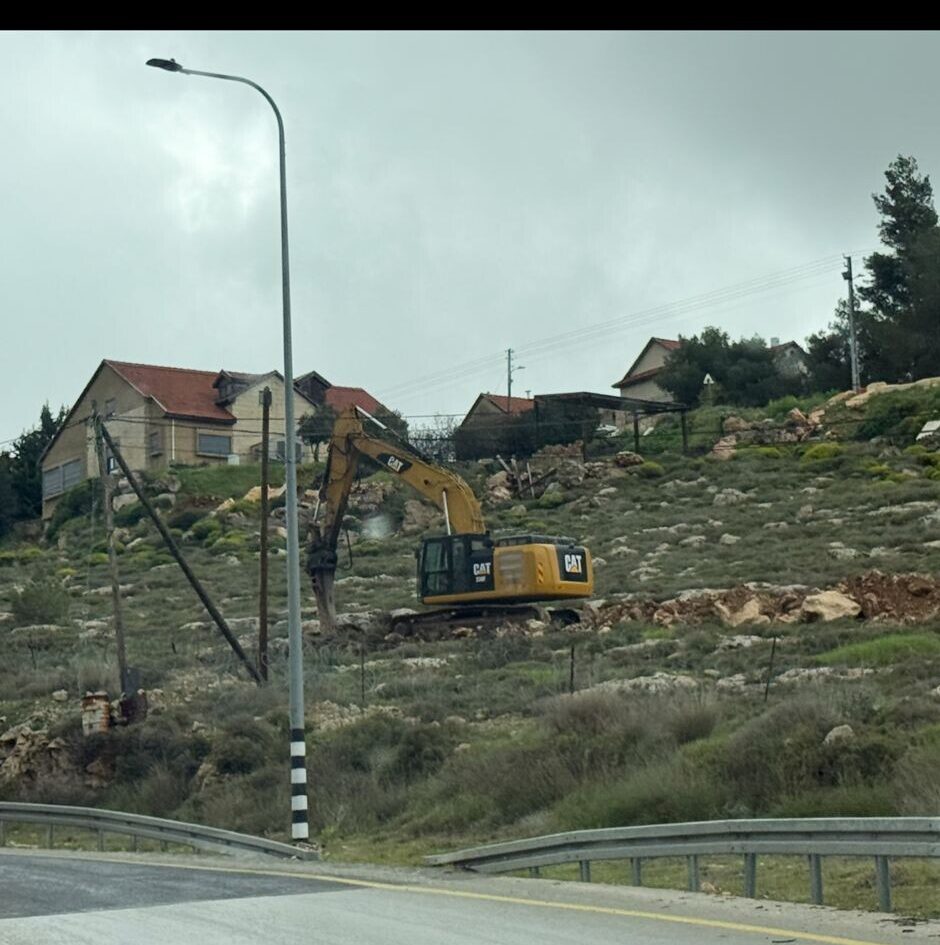 MuhammadFeb-24-2026South Hebron Hill, Beit Hagai: Paving an internal security road
-