
Hebron, South Hebron Hills, Wed 16.1.13, Morning
Translator: Charles K.
It’s 11:30; we’ve just gone through the Meitar checkpoint. No laborers crossing at this hour.
Highway 60
When we reach the Dura-Al Fawwar junction we see a Palestinian vehicles whose occupants are standing outside the car, being detained by two soldiers who are apparently reservists. We decide to stop off to the side to understand what’s happening. The soldier across the way waves to us to move from the road’s shoulder, and when he approaches he explains we’re not allowed to remain there because we’re a disturbance. Since the two detainees were released and drove off, we didn’t stay. The road is quiet, almost no traffic.
Hebron
Preparations are underway to erect a new army base on the imposing road between the Nofey Mamreh neighborhood and Kiryat Arba, just before the Harsina army base. Federman’s farm sits in the valley below; work seems to have begun again there. A road has been paved to the farm with a gate of barrels in which Washington palms have been planted decoratively on either side. Diagonally across the road there’s already a new guard booth. An army camouflage net is spread over it, indicating what it’s for.
That’s how it goes in Hebron: first the settlers are allowed to create facts on the ground, then they must be protected, so everyone who lives nearby and isn’t a settler has their movements restricted.
No indication of any changes at Beit HaMeriva, no unusual activity, even though the radio reported plans to re-occupy it.
We decide to visit our friend who lives opposite Beit HaMeriva. We speak with him, hear the latest news. He tells us that people came to him from the DCO regarding the building permit for his second storey, and he expects to receive a final answer any day now. He also tells us about many people who marched yesterday: about 120 settlers and their supporters stood outside Beit HaMeriva yelling that it belongs to them.
Later other people tells us that the march continued toward the Cave of the Patriarchs and reached Beit HaMachpelah, which is located between two elementary schools, Al Fayha and Al Ibrahamiyya, where the marchers shouted the same slogans. The locals said that in both places the police and the army controlled what was going on and prevented the settlers and their supporters from advancing. It’s interesting there were no media reports.
Michal and I decided to walk over to see the fence that had been erected two months ago. It separates settlers using the worshippers route from residents of the Palestinian neighborhood. But a soldier stops us – he’s stationed at a new emplacement that was added recently. He asks, of course, where we’ve come from and tells us – while speaking over his radio –that we’re not allowed through because it might be dangerous.
We explain that we’re aware of the danger and that our driver will meet us at the other end. The soldier insists, explaining to the person he’s talking to on the radio that Jews are involved. Nevertheless, says the voice over the radio, the road is dangerous because part of it isn’t secured and we might be harmed. We decide to return.
Later I notice a settler walking on that same “dangerous” road. There’s no doubt that “only authorized persons” are immune to harm, and that Jews like us aren’t permitted through. More proof that the settlers run the army rather than the other way around like it should be.
The atmosphere is very tense, as usual, but unlike previous visits there are many children in the street, apparently because of winter vacation. We also ran into many foreign groups touring the area with guides. And, of course, the upcoming election puts everyone on edge.
Hebron
See all reports for this place-
According to Wye Plantation Accords (1997), Hebron is divided in two: H1 is under Palestinian Authority control, H2 is under Israeli control. In Hebron there are 170,000 Palestinian citizens, 60,000 of them in H2. Between the two areas are permanent checkpoints, manned at all hours, preventing Palestinian movement between them and controlling passage of permit holders such as teachers and schoolchildren. Some 800 Jews live in Avraham Avinu Quarter and Tel Rumeida, on Givat HaAvot and in the wholesale market.
Checkpoints observed in H2:
- Bet Hameriva CP- manned with a pillbox
- Kapisha quarter CP (the northern side of Zion axis) - manned with a pillbox
- The 160 turn CP (the southern side of Zion axis) - manned with a pillbox
- Avraham Avinu quarter - watch station
- The pharmacy CP - checking inside a caravan with a magnometer
- Tarpat (1929) CP - checking inside a caravan with a magnometer
- Tel Rumeida CP - guarding station
- Beit Hadassah CP - guarding station
Three checkpoints around the Tomb of the Patriarchs
 Raya YeorDec-18-2025Hebron - Yusri Jaber and part of his family
-
South Hebron Hills
See all reports for this place-
South Hebron Hills
South Hebron Hills is a large area in the West Bank's southern part.
Yatta is a major city in this area: right in the border zone between the fertile region of Hebron and its surroundings and the desert of the Hebron Hills. Yatta has about 64,000 inhabitants.
The surrounding villages are called Masafer Yatta (Yatta's daughter villages). Their inhabitants subsist on livestock and agriculture. Agriculture is possible only in small plots, especially near streams. Most of the area consists of rocky terraces.Since the beginning of the 1980s, many settlements have been established on the agricultural land cultivated by the Palestinians in the South Hebron Hills region: Carmel, Maon, Susia, Masadot Yehuda, Othniel, and more. Since the settlements were established and Palestinians cultivation areas have been reduced; the residents of the South Hebron Hills have been suffering from harassment by the settlers. Attempts to evict and demolish houses have continued, along with withholding water and electricity. The military and police usually refrain from intervening in violent incidents between settlers and Palestinians do not enforce the law when it comes to the investigation of extensive violent Jewish settlers. The harassment in the South Hebron Hills includes attacking and attempting to burn residential tents, harassing dogs, harming herds, and preventing access to pastures.
There are several checkpoints in the South Hebron Hills, on Routes 317 and 60. In most of them, no military presence is apparent, but rather an array of pillboxes monitor the villages. Roadblocks are frequently set up according to the settlers and the army's needs. These are located at the Zif Junction, the Dura-al Fawwar crossing, and the Sheep Junction at the southern entrance to Hebron.
Updated April 2022
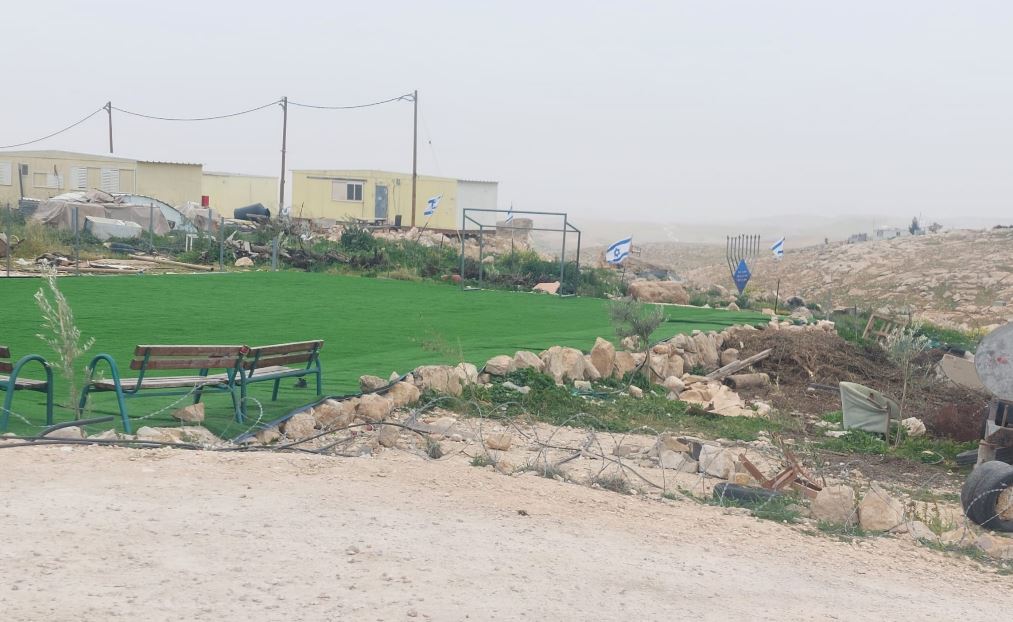 Michal TsadikFeb-17-2026Umm al-Khair: The soccer field for Palestinian children is surrounded by new trailers and lots of Israeli flags
-