
Hebron, South Hebron Hills, Wed 16.2.11, Morning
Translator: Charles K.
Before leaving for my shift today, I picked the paper as usual and the headline in Ha’aretz annoyed me very much: “Minister of Education Gid’on Sa’ar initiates a new program of school tours to the Cave of the Patriarchs.” The photo accompanying the headline shows the head of Anat Cohen, the settlers’ sweetheart, who attacks us verbally and physically. Which is nothing in comparison to what she does to Palestinians… What’s her connection to Israel’s heritage?! What connection is there between the delusional settlers and coexistence, living in peace…are they the representatives of Jewish and Israeli values?
It was only necessary to join my shift today to see just which “Jewish values” we’re instilling in the occupied land – in Palestine.
Sansana-Meitar crossing
Everyone is a potential enemy, so people with guns drawn stand everywhere. The architecture of ugliness and evil is expressed in the quantity of concrete that has been poured there and in all the pillboxes and fences. The behavior, on the other hand, tries to be as respectful as possible, and by 6:30, when we go by, all the Palestinian laborers are already on the Israeli side.
When we come back, two buses carrying relatives of prisoners are in the parking lot.
Route 60
A few of the almond trees are in bloom. Otherwise, children walk to school along the roadside, and there are very many military jeeps on the road and at the junctions – and in some places off-road as well.
A flying checkpoint at Kvasim junction: they’re stopping all cars. About ten cars are on line. The taxi drivers and passengers are happy to see us and ask me “why aren’t you writing this down?” It’s raining, the drivers and passengers have to get out, their IDs are taken, the trunk inspected. When we arrive they suddenly stop halting the taxis. So if they’re not stopping the taxis because of us, there was certainly no reason to have stopped them before we arrive, right?! From a security standpoint, it would be logical that if it’s necessary to guard Route 60, there should be a checkpoint there, not on the road between Yatta and Hebron! Two purely Palestinian towns. So it’s not security logic that’s at work here, just the need to demonstrate who’s in charge, who decides and who’s being ruled.
Another flying checkpoint has been set up at the junction of Route 60 and Route 356 – but there’s no line, because there’s almost no Palestinian traffic there.
Route 356
After Ohad Hemo’s televised report on the children scavenging garbage in Yatta we decided to go see them. It was shocking!! Very small children digging through the garbage to earn money. It’s Area C, a completely Palestinian area under Israeli control! How are we demonstrating Jewish values and Israel values when little children have to make a living from garbage?! Maybe that’s where we should bring Jewish heritage tours, rather than to the Cave of the Patriarchs, next to the grave of the “righteous” Baruch Goldstein.
Hebron
Today is a Moslem “exception day” – an “exception day” is a military term referring to prayer arrangements at the Cave of the Patriarchs – every year representatives of the waqf, the civil administration and the military rabbinate meet to decide which days members of the different religions can use the entire large hall in the Cave of the Patriarchs for worship. The days are set according to each religion’s holiday calendar. There are three Moslem exception days this week, because of the celebration of Muhammad’s birthday. The city fills with soldiers, police and Border Police on a Moslem exception day. They’re stationed in pairs, wearing berets and with weapons drawn, about 500 meters apart and on every possible rooftop. As if the army was protecting the worshippers from the settlers. No detainees at the checkpoints – some of the Palestinian men wear red kaffiyahs in honor of their holiday.
The main prayer is at noon, and the streets fill with men on their way to worship.
The army takes advantage of the presence of many soldiers and policeman to conduct an unannounced exercise “in case of Palestinian resistance and an uprising.” Many soldiers run through the streets, some disguised as Palestinians trying to go through the checkpoints – what a show! What’s not part of the show is the fact that no civilian traffic is allowed anywhere in the area of the exercise. Settlers and TIPH personnel pass, but Palestinians can’t. Only after we intervene with the officers are they allowed through. One Palestinian, an amiable older man, says: “We’re like guests in this country, not welcome citizens…” When one of those delayed tries to object and go through a Givati soldier blocks him physical: he raises the butt of his gun and pushes. My shouts bring the officer who calms the soldier and the Palestinian.
When the exercise is over we recognize the commander of the Judea brigade and approach him to say that they wouldn’t dare conduct such an exercise in Beersheba or in Tel Aviv without first informing the residents, and that there was no need to delay them – they should have been let through. “You’re right!” he says, it didn’t occur to us. And he gives us his card.
I wonder whether that brigade commander agrees with the Minister of Education’s delusional program for tours by pupils?! Of course he’ll agree, and also know that every such tour will rob Palestinians of additional human rights. But – you see – they’re transparent, they don’t exist. How did David Grossman put it – present absentees. That’s the face of Israel, 2011: Gid’on Sa’ar and Fa’ina Kirshenboim
Hebron
See all reports for this place-
According to Wye Plantation Accords (1997), Hebron is divided in two: H1 is under Palestinian Authority control, H2 is under Israeli control. In Hebron there are 170,000 Palestinian citizens, 60,000 of them in H2. Between the two areas are permanent checkpoints, manned at all hours, preventing Palestinian movement between them and controlling passage of permit holders such as teachers and schoolchildren. Some 800 Jews live in Avraham Avinu Quarter and Tel Rumeida, on Givat HaAvot and in the wholesale market.
Checkpoints observed in H2:
- Bet Hameriva CP- manned with a pillbox
- Kapisha quarter CP (the northern side of Zion axis) - manned with a pillbox
- The 160 turn CP (the southern side of Zion axis) - manned with a pillbox
- Avraham Avinu quarter - watch station
- The pharmacy CP - checking inside a caravan with a magnometer
- Tarpat (1929) CP - checking inside a caravan with a magnometer
- Tel Rumeida CP - guarding station
- Beit Hadassah CP - guarding station
Three checkpoints around the Tomb of the Patriarchs
 Raya YeorDec-18-2025Hebron - Yusri Jaber and part of his family
-
South Hebron Hills
See all reports for this place-
South Hebron Hills
South Hebron Hills is a large area in the West Bank's southern part.
Yatta is a major city in this area: right in the border zone between the fertile region of Hebron and its surroundings and the desert of the Hebron Hills. Yatta has about 64,000 inhabitants.
The surrounding villages are called Masafer Yatta (Yatta's daughter villages). Their inhabitants subsist on livestock and agriculture. Agriculture is possible only in small plots, especially near streams. Most of the area consists of rocky terraces.Since the beginning of the 1980s, many settlements have been established on the agricultural land cultivated by the Palestinians in the South Hebron Hills region: Carmel, Maon, Susia, Masadot Yehuda, Othniel, and more. Since the settlements were established and Palestinians cultivation areas have been reduced; the residents of the South Hebron Hills have been suffering from harassment by the settlers. Attempts to evict and demolish houses have continued, along with withholding water and electricity. The military and police usually refrain from intervening in violent incidents between settlers and Palestinians do not enforce the law when it comes to the investigation of extensive violent Jewish settlers. The harassment in the South Hebron Hills includes attacking and attempting to burn residential tents, harassing dogs, harming herds, and preventing access to pastures.
There are several checkpoints in the South Hebron Hills, on Routes 317 and 60. In most of them, no military presence is apparent, but rather an array of pillboxes monitor the villages. Roadblocks are frequently set up according to the settlers and the army's needs. These are located at the Zif Junction, the Dura-al Fawwar crossing, and the Sheep Junction at the southern entrance to Hebron.
Updated April 2022
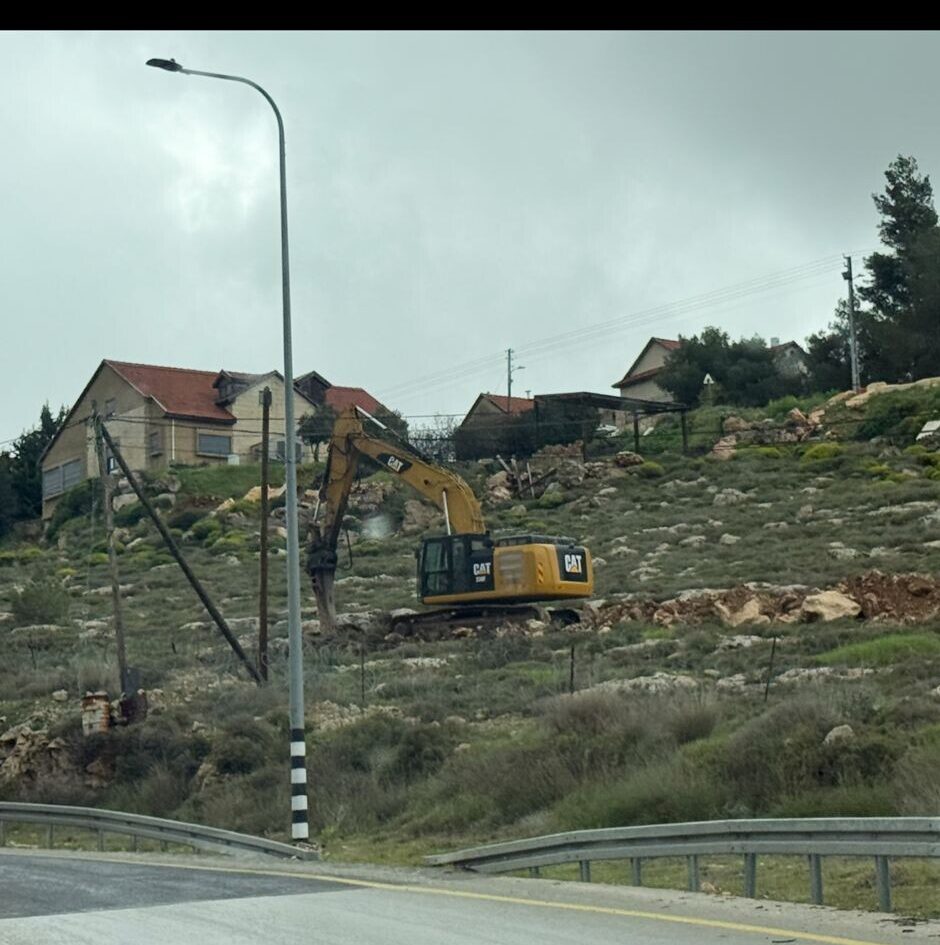 MuhammadFeb-24-2026South Hebron Hill, Beit Hagai: Paving an internal security road
-