
Hebron, South Hebron Hills, Wed 2.5.12, Morning
Translator: Charles K.
Tarqumiya
There’s no problem entering; let’s hope the same is true coming back…
Route 35
– few vehicles (the vineyards are blooming, lovely, well-tended, clean – a pleasure to see).
Route 60
– more traffic than on Route 35, mostly Israeli vehicles.
Giv’at Avichai is still empty, only rubble remaining.
Hebron
A new guard in the booth at the entrance to Kiryat Arba who doesn’t know we exist and detains us on the side of the road, it takes time, and as Raya gets out of the car he receives authorization by phone and releases us.
The booth at the entrance to the worshippers route is empty, but opposite, on the roof, three soldiers and camouflage netting.
Curve 160: Calm soldiers, quiet all around at the moment.
There’s a protest tent opposite “Beit HaMachpela” which is blocked by a barrier manned by the Border Police, and signs: “We bought it, we paid for it, it’s ours!”
Tarpat checkpoint: 6-7 youths detained, as well as some men and women. Two Kfir brigade soldiers inspecting IDs are talking to someone over the walkie-talkie.
An elderly man approaches to quietly tell us that these two soldiers stop people every day, detain them and cause difficulties.
But, at the same time, some go through without being delayed. The soldier explains: inspections are random.
Meanwhile, 12-13 people are already waiting.
Those arriving from the other direction go through the scanner as usual.
Question: Why is it necessary to detain and check people entering Palestinian Hebron??
Ten minutes later they receive authorization and release everyone.
A large sign at Tel Rumeida announcing that Jews may build on only 3% of Hebron’s area, compare to 97% for Palestinians! (What a terrible injustice!)
A tour guide from Bethlehem sits in ‘Abed’s shop (he speaks English, Spanish and Italian), recounting his troubles: Israeli tour guides work on the West Bank and in Jerusalem, taking work from local tour guides, who want to take tourists coming from Jordan to Israel as well (we suggested he try to get in touch with someone, an attorney or someone like that, perhaps through Hagit Beck).
Muhammad, at the Tarqumiya grocery, who’s active in the Israelis and Arabs Bereaved Families Forum, tells us to search Google for סדק בקיר [crack in the wall]. We haven’t yet done so.
There was a relatively nice guy at the Tarqumiya crossing who detained us nevertheless, but not very long.
Hebron
See all reports for this place-
According to Wye Plantation Accords (1997), Hebron is divided in two: H1 is under Palestinian Authority control, H2 is under Israeli control. In Hebron there are 170,000 Palestinian citizens, 60,000 of them in H2. Between the two areas are permanent checkpoints, manned at all hours, preventing Palestinian movement between them and controlling passage of permit holders such as teachers and schoolchildren. Some 800 Jews live in Avraham Avinu Quarter and Tel Rumeida, on Givat HaAvot and in the wholesale market.
Checkpoints observed in H2:
- Bet Hameriva CP- manned with a pillbox
- Kapisha quarter CP (the northern side of Zion axis) - manned with a pillbox
- The 160 turn CP (the southern side of Zion axis) - manned with a pillbox
- Avraham Avinu quarter - watch station
- The pharmacy CP - checking inside a caravan with a magnometer
- Tarpat (1929) CP - checking inside a caravan with a magnometer
- Tel Rumeida CP - guarding station
- Beit Hadassah CP - guarding station
Three checkpoints around the Tomb of the Patriarchs
 Raya YeorDec-18-2025Hebron - Yusri Jaber and part of his family
-
South Hebron Hills
See all reports for this place-
South Hebron Hills
South Hebron Hills is a large area in the West Bank's southern part.
Yatta is a major city in this area: right in the border zone between the fertile region of Hebron and its surroundings and the desert of the Hebron Hills. Yatta has about 64,000 inhabitants.
The surrounding villages are called Masafer Yatta (Yatta's daughter villages). Their inhabitants subsist on livestock and agriculture. Agriculture is possible only in small plots, especially near streams. Most of the area consists of rocky terraces.Since the beginning of the 1980s, many settlements have been established on the agricultural land cultivated by the Palestinians in the South Hebron Hills region: Carmel, Maon, Susia, Masadot Yehuda, Othniel, and more. Since the settlements were established and Palestinians cultivation areas have been reduced; the residents of the South Hebron Hills have been suffering from harassment by the settlers. Attempts to evict and demolish houses have continued, along with withholding water and electricity. The military and police usually refrain from intervening in violent incidents between settlers and Palestinians do not enforce the law when it comes to the investigation of extensive violent Jewish settlers. The harassment in the South Hebron Hills includes attacking and attempting to burn residential tents, harassing dogs, harming herds, and preventing access to pastures.
There are several checkpoints in the South Hebron Hills, on Routes 317 and 60. In most of them, no military presence is apparent, but rather an array of pillboxes monitor the villages. Roadblocks are frequently set up according to the settlers and the army's needs. These are located at the Zif Junction, the Dura-al Fawwar crossing, and the Sheep Junction at the southern entrance to Hebron.
Updated April 2022
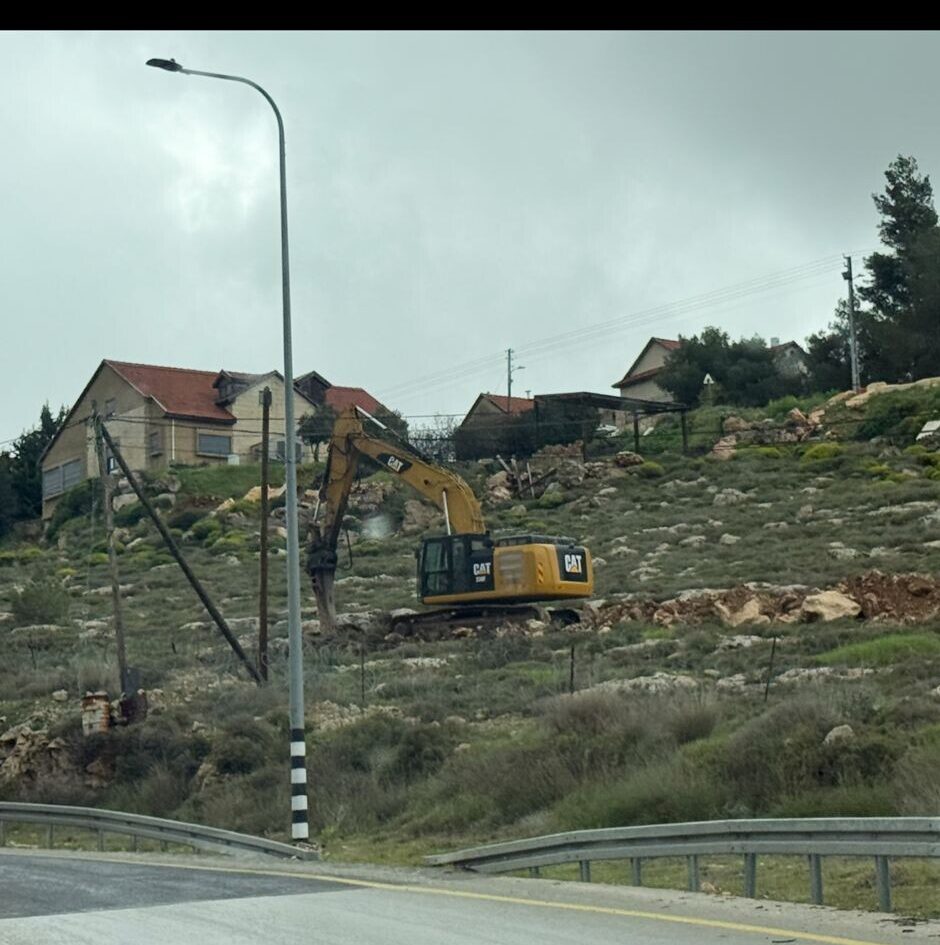 MuhammadFeb-24-2026South Hebron Hill, Beit Hagai: Paving an internal security road
-