
Hebron, South Hebron Hills, Wed 6.3.13, Morning
Translator: Charles K.
We entered through the Meitar crossing and drove to Umm Faqra to leave large sacks of clothing that had been collected, and candy for the children. We saw the progress Fadel had made constructing his house. One room is already being used; there are windows and mattresses along the walls. They’re still working on the second room. We gave M. an envelope with the money we’d all donated. Everyone’s invited to contribute, so that Fadel will be able to install windows and finish building. We drank tea, gazed at the lovely landscape and drove on.
While we were driving we received a call from Nasser, from Sussiya, who asked us to come visit and talk – so we drove back to Sussiya. Nasser, who works for B’Tselem and speaks Hebrew well, sat us down and told us about the problems:
The village of Halat-a-Daba, near Umm Faqra, received stop-work orders, which will be followed by demolition orders.
A month ago a court hearing took place regarding Sussiya; an outline plan was submitted and they’re waiting for approval. The army was given 90 days to explain why the residents should not be permitted to build. There are 60 cisterns belonging to Sussiya in the surrounding hills but the army has taken over the area and if anyone comes they’re arrested and bail is set at NIS 1000-NIS 10,000.
The European Union helps underwrite water purchases from contractors in Yata and in Hebron; it’s brought in tanks by truck or tractor. The price – NIS 35 per cubic meter – is very high! They asked the Civil Administration for access to their cisterns. The reply: “You’re illegal.” Nasser: But all the outposts around here are also illegal according to Israeli law.
Who helps them? Organizations like Rabbis for Human Rights, Machsom Watch, groups from abroad; the German Foreign Office donates money for construction.
The school building in Sussiya – grades 1-4 – received a demolition order.
The village appears well-organized, compared to what we’d seen in the past. There’s a building used as a clinic and for local municipal council meetings. All the rest are sheds of various kinds.
In the distance, on a hill outside the Jewish settlement of Susya, a new prefab was erected yesterday, illegally!
Hebron
See all reports for this place-
According to Wye Plantation Accords (1997), Hebron is divided in two: H1 is under Palestinian Authority control, H2 is under Israeli control. In Hebron there are 170,000 Palestinian citizens, 60,000 of them in H2. Between the two areas are permanent checkpoints, manned at all hours, preventing Palestinian movement between them and controlling passage of permit holders such as teachers and schoolchildren. Some 800 Jews live in Avraham Avinu Quarter and Tel Rumeida, on Givat HaAvot and in the wholesale market.
Checkpoints observed in H2:
- Bet Hameriva CP- manned with a pillbox
- Kapisha quarter CP (the northern side of Zion axis) - manned with a pillbox
- The 160 turn CP (the southern side of Zion axis) - manned with a pillbox
- Avraham Avinu quarter - watch station
- The pharmacy CP - checking inside a caravan with a magnometer
- Tarpat (1929) CP - checking inside a caravan with a magnometer
- Tel Rumeida CP - guarding station
- Beit Hadassah CP - guarding station
Three checkpoints around the Tomb of the Patriarchs
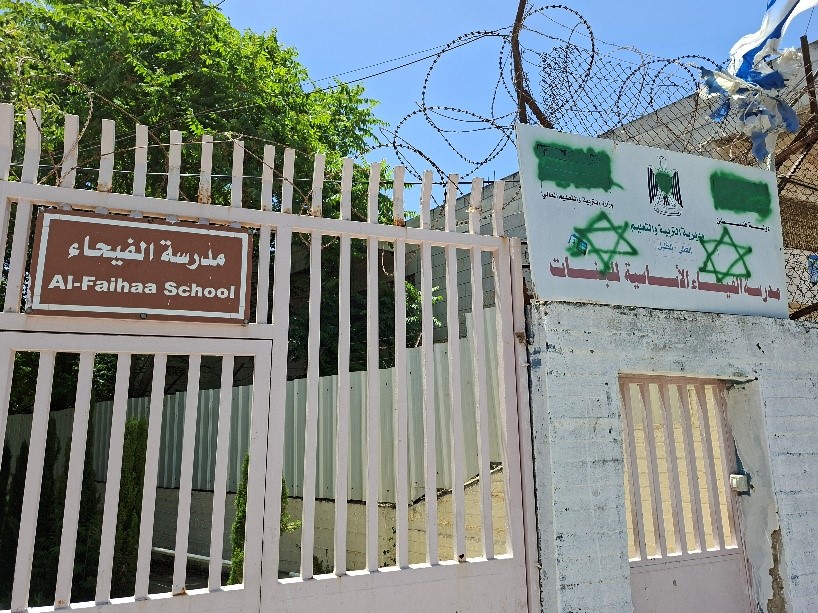 Lea ShakdielMay-27-2025Hebron, settlers vandalized the sign of the girls' school
-
South Hebron Hills
See all reports for this place-
South Hebron Hills
South Hebron Hills is a large area in the West Bank's southern part.
Yatta is a major city in this area: right in the border zone between the fertile region of Hebron and its surroundings and the desert of the Hebron Hills. Yatta has about 64,000 inhabitants.
The surrounding villages are called Masafer Yatta (Yatta's daughter villages). Their inhabitants subsist on livestock and agriculture. Agriculture is possible only in small plots, especially near streams. Most of the area consists of rocky terraces.Since the beginning of the 1980s, many settlements have been established on the agricultural land cultivated by the Palestinians in the South Hebron Hills region: Carmel, Maon, Susia, Masadot Yehuda, Othniel, and more. Since the settlements were established and Palestinians cultivation areas have been reduced; the residents of the South Hebron Hills have been suffering from harassment by the settlers. Attempts to evict and demolish houses have continued, along with withholding water and electricity. The military and police usually refrain from intervening in violent incidents between settlers and Palestinians do not enforce the law when it comes to the investigation of extensive violent Jewish settlers. The harassment in the South Hebron Hills includes attacking and attempting to burn residential tents, harassing dogs, harming herds, and preventing access to pastures.
There are several checkpoints in the South Hebron Hills, on Routes 317 and 60. In most of them, no military presence is apparent, but rather an array of pillboxes monitor the villages. Roadblocks are frequently set up according to the settlers and the army's needs. These are located at the Zif Junction, the Dura-al Fawwar crossing, and the Sheep Junction at the southern entrance to Hebron.
Updated April 2022
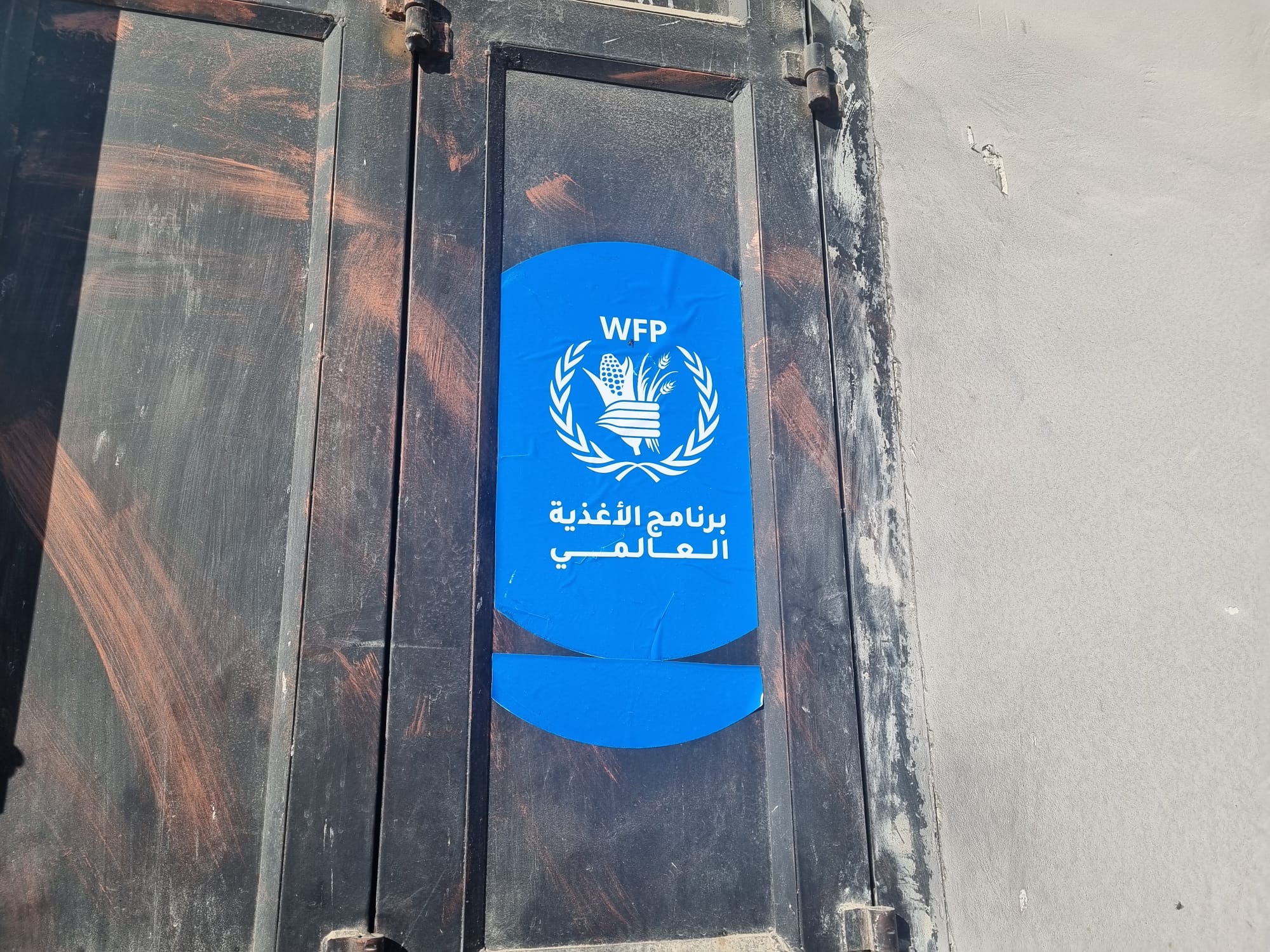 Smadar BeckerDec-14-2025A World Food Program (WFP) sticker at the entrance to a grocery store in Tuwani
-