
Hizma, Qalandiya, Sun 27.12.09, Afternoon
(from the end of the shift to its beginning)
Hizme Checkpoint:
When we arrived at the checkpoint, at the end of our shift, tiered and wound up, we passed by Hizme as usual. We were glad to find no ambulances there that would detain us, after all it is a settlers' checkpoint.
But the sight of a Palestinian child being held at the soldiers' post raised our suspicion that something wasn't right.
The child was the in our interest, but our attention was driven towards a dramatic occurrence that began to take place: an alarm was heard, the lights were blinking as a sign of warning, the bar of the checkpoint closed and a group of armed soldier arrived to the yelling of another soldier at the front post: "Blow his car up!"; they blocked the vehicles way. The doors of the car were opened, and the driver, a religious Jew was taken by force from his seat- as though they had found and escaped convict. His crime, in his words: "I bough gas containers from Arabs", and continued with a whisper: "I am an orthodox, but just so you know, you do a splendid job…"
The dramatic scène in the checkpoint continued: The keys to the vehicle were confiscated from the driver, his ID was taken from him and he was rebuked by a BP officer and a civil guard, saying he tried to barge through the checkpoint and run off with the forbidden merchandise.
-"I get a good price from the Arabs. They are poor. They have nothing to eat", he said and told us that for a gas container that costs 150 Shekels, a Palestinian from the neighboring village would take 60 Shekels.
His black clothes, long beard and large Kippah on his head made what he said much unexpected:
– "I was a soldier and used to serve at the checkpoint at Nablus. The checkpoint is for everyone. They only make matters worse."
We stood close to that man who is haunted by ghosts: as night was falling, the a slim body of that man roamed around us and wouldn't stop moving in his place, he circled around himself looking to his shoes so that his eyes won't meet ours. He mumbled something, cleared his throat, and then another short sentence, some memories, bits of life that had rose up to the surface with every step he made towards us and away from us: He told us about a commander in the army, his name was A.G:
–" He killed a Palestinian girl, over there, near Nablus…"
-"They've covered it all up… all of it… they did nothing about it… remember his name. Maybe you could do something… he is also responsible of the death of one of our soldiers…"
-"when I was there, at the checkpoint, I used to think you were in the wrong… I was a soldier…"
And then, while he was looking at the luminous checkpoint from the dark spot where we were, looking at the soldiers who were yelling at a Palestinian who had been there:
–" They are evil, they yell at Araba…"
-"They give an eighteen year old girl a rifle and a title and that's what comes out of her…"
-"I'm just trying to save some money. I don't have much and I help the Arab to make a living. Everything at their place is half price…"
Regarding his mother, who live in Beit Arye, he said: "It's a quiet place; they get no troubles from their neighbors… They built a separation wall near by. They put two villages inside an enclave… how do they think it's going to end? "
Y was held up for forty minutes. After which he was forced to go back to the salesman and hand the containers back. Only then would he be permitted to pass and head back to his home at Jerusalem. We couldn't help but wonder what would have happened to a Palestinian had he been caught with such merchandise in his car. But Y is also a sad and tormented man, who had had his share of suffering on that evening and whose torments will continue to agonize his soul.
And the child, the reason for which we stopped in the first place: he had been detained because he was caught at the checkpoint with his uncle (his father's brother) and didn't have his birth certificate (Kushan), which every Palestinian child must always have, with him. His father was sent for and he came from Anata with the document proving that his son had in fact been born.
Qalandya checkpoint or Golitas fight against David:
"They took a boy, he had been throwing stones from one of the roofs at the camp and the army took him away- help him, talk to them…"
That same old routine: a rifle comes after the stone which comes after the rifle which come after the stone…
During the whole time, two children got on top of the pile of rubbish behind the checkpoint, watch the road, and when a military vehicle approached they ran to the narrow passage, threw the stones that were in their hands and ran into the alleys of the camp…
Hizma
See all reports for this place-
Hizma
A checkpoint at the north-eastern entrance to the Jerusalem area which was annexed in 1967, at Pisgat Zeev. The passage is allowed to bearers of blue IDs only. Open 24 hours a day.
-
Qalandiya Checkpoint / Atarot Pass (Jerusalem)
See all reports for this place-
Click here to watch a video from Qalandiya checkpoint up to mid 2019 Three kilometers south of Ramallah, in the heart of Palestinian population. Integrates into "Jerusalem Envelope" as part of Wall that separates between northern suburbs that were annexed to Jerusalem in 1967: Kafr Aqab, Semiramis and Qalandiya, and the villages of Ar-Ram and Bir Nabala, also north of Jerusalem, and the city itself. Some residents of Kafr Aqab, Semiramis and Qalandiya have Jerusalem ID cards. A terminal operated by Israel Police has functioned since early 2006. As of August 2006, northbound pedestrians are not checked. Southbound Palestinians must carry Jerusalem IDs; holders of Palestinian Authority IDs cannot pass without special permits. Vehicular traffic from Ramallah to other West Bank areas runs to the north of Qalandiya. In February 2019, the new facility of the checkpoint was inaugurated aiming to make it like a "border crossing". The bars and barbed wire fences were replaced with walls of perforated metal panels. The check is now performed at multiple stations for face recognition and the transfer of an e-card. The rate of passage has improved and its density has generally decreased, but lack of manpower and malfunctions cause periods of stress. The development and paving of the roads has not yet been completed, the traffic of cars and pedestrians is dangerous, and t the entire vicinity of the checkpoint is filthy. In 2020 a huge pedestrian bridge was built over the vehicle crossing with severe mobility restrictions (steep stairs, long and winding route). The pedestrian access from public transport to the checkpoint from the north (Ramallah direction) is unclear, and there have been cases of people, especially people with disabilities, who accidentally reached the vehicle crossing and were shot by the soldiers at the checkpoint. In the summer of 2021, work began on a new, sunken entrance road from Qalandiya that will lead directly to Road 443 towards Jerusalem and Tel Aviv. At the same time, the runways of the old Atarot airport were demolished and infrastructure was prepared for a large bus terminal. (updated October 2021)
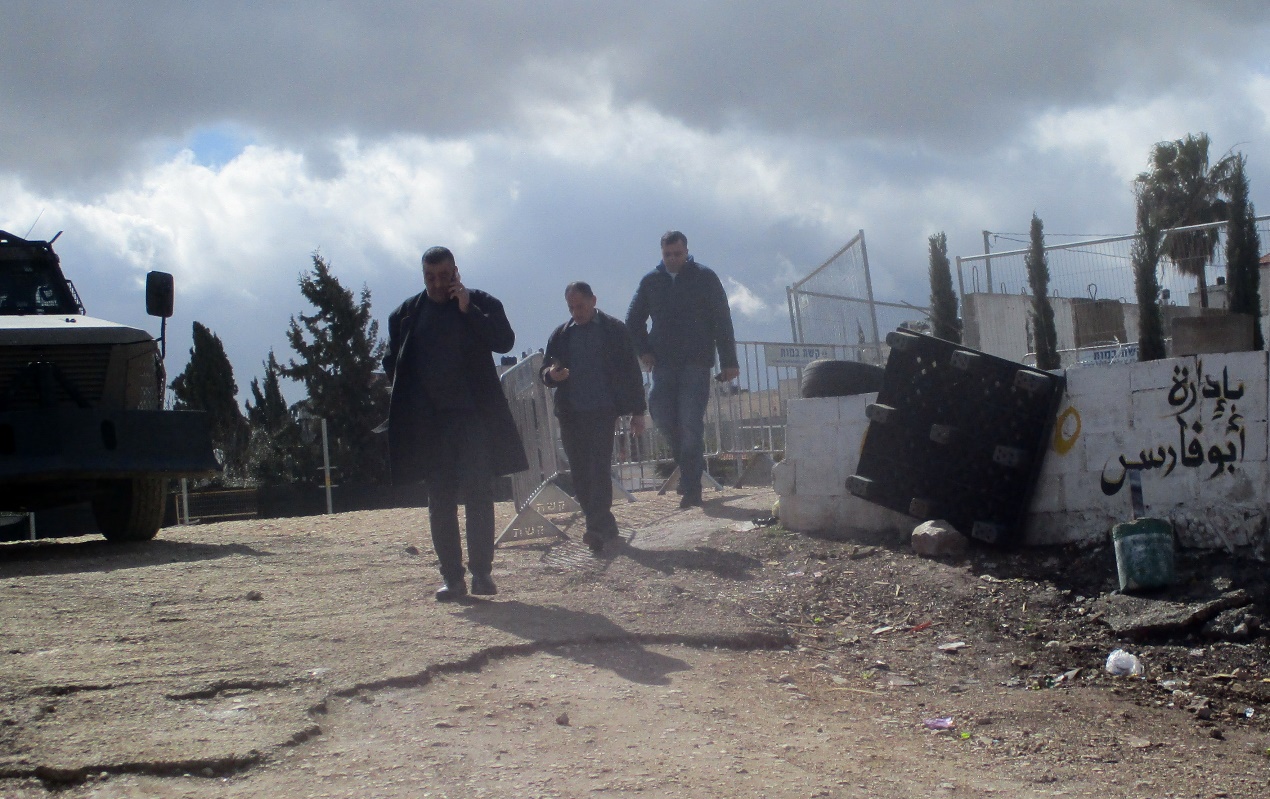 Tamar FleishmanFeb-27-2026Qalandiya: On the way to prayer
-