
Huwara, what was not burned - was closed
Almost all the entrances to the settlements have stations armed by the IDF. And, to continue, examinations of all people passing through. A new huge road has been paved which bypasses Huwara, intended for the settlers. (not clear why they need this road since Huwara itself will be flattened, according to Smotrich!)
We went out on road 55 in the morning; at the entrance to Kedumim there are armed stations, but also at the entrance to Sara – the village next to the road to Nablus at the junction of road 55 (next to Jit) and road 60, where there are also armed stations. On our way back, the stations were active and there was a long line from Sara in the direction of Jit (which is actually the exit from Nablus), in which all the vehicles were inspected.
At the entrance to Yitzhar, another armed post and at the entrance to Nablus from Huwara, where there was the notorious checkpoint; they are not stopping people but there are armed posts and there are now also huge yellow gates that can close off the entrance whenever necessary.


When we got to Huwara – silence. All the shops were tightly closed. There is a military order to close the shops for at least all day today. This (explained to us by the soldiers patrolling the area) was because a soldier was run over yesterday (luckily not seriously hurt) by a Palestinian who escaped in the direction of Nablus. What’s the connection of Shmita to Mount Sinai? It is not clear to us, since the residents did not do this, but there is a collective punishment. Why? So what!

We traveled to Tapuach Junction, which was quiet, and then we continued along the new settlers’ road – the Huwara bypass – which has been paved from there as far as ‘Awarta, the entrance to Nablus. The road is very wide with elaborate foundations, including bridges and cement walls. There is one passageway from Huwara to ‘Awarta under the bridge which also cuts Beita in half. Really scary to look at. And, of course, this is built within the fields and orchards of the Palestinians. We were told that it will be forbidden to build within 250 meters next to the road. There are houses in Beita that are exactly on the road which they did not destroy (what great consideration!), but it will be forbidden to add any floors or to enlarge the house, even though it is their land in area B.

On the way back, we stopped at Al-Funduq to meet up with Saker from Qaddum. This is his report:
Things are continuing as usual there, with a demonstration on every Friday and Saturday. However, now the soldiers enter the village first, stand on the roofs of the houses with drawn weapons during the demonstration and first smoke grenades from there and other things. Their entrance into the village is because the residents of Kedumim complain about the smoke which is blown over them from the smoke grenades and by the burning tires, so the soldiers try to prevent this. According to Saker, they only burn tires now when the wind is blowing from the village in the direction of Kedumim and that way they prevent their residents from suffering from the smoke of the tires. They had a truck designed to transport tires, but the soldiers came in during the night and stole it. About 3 years ago, there was an agreement to open the road for residents of Qaddum in the direction of Nablus, but it was never carried out and, in place of that, the residents of Kedumim enlarge their settlement in such a way that it will never be possible to open the road.
Israelis still arrive to support them, every Friday. So where are you, he asks?
No meetings with the IDF. There were a few, 3-4 years ago, they gave various promises but nothing was done. Lately, three youths were injured in the leg by soldiers’ fire. Those who were injured a few months ago are still in serious condition.
Huwwara
See all reports for this place-
The Huwwara checkpoint is an internal checkpoint south of the city of Nablus, at the intersection of Roads 60 and 5077 (between the settlements of Bracha and Itamar). This checkpoint was one of the four permanent checkpoints that closed on Nablus (Beit Furik and Awarta checkpoints to the east and the Beit Iba checkpoint to the west). It was a pedestrian-only barrier. As MachsomWatch volunteers, we watched therre since 2001 two shifts a day - morning and noon, the thousands of Palestinians leaving Nablus and waiting for hours in queues to reach anywhere else in the West Bank, from the other side of the checkpoint the destination could only be reached by public transport. In early June 2009, as part of the easing of Palestinian traffic in the West Bank, the checkpoint was opened to vehicular traffic. The passage was free, with occasional military presence in the guard tower. Also, there were vehicle inspections from time to time. Since the massacre on 7.10.2023, the checkpoint has been closed to Palestinians.
On February 26, 2023, about 400 settlers attacked the town's residents for 5 hours and set fire to property, such as houses and cars. Disturbances occurred in response to a shooting of two Jewish residents of Har Bracha by a Palestinian Terrorist. The soldiers stationed in the town did not prevent the arson and rescued Palestinian families from their homes only after they were set on fire. No one was punished and Finance Minister Smotrich stated that "the State of Israel should wipe out Hawara." Left and center organizations organized solidarity demonstrations and support actions for the residents of Hawara.Hawara continued to be in the headlines in all the months that followed: more pogroms by the settlers, attacks by Palestinians and a massive presence of the army in the town. It amounted to a de facto curfew of commerce and life in the center of the city. On October 5, 2023, MK Zvi established a Sukkah in the center of Hawara and hundreds of settlers backed the army blocked the main road and held prayers in the heart of the town all night and the next day. On Saturday, October 7, 23 The "Swords of Iron" war began with an attack by Hamas on settlements surrounding Gaza in the face of a poor presence of the IDF. Much criticism has been made of the withdrawal of military forces from the area surrounding Gaza and their placement in the West Bank, and in the Hawara and Samaria region in particular, as a shield for the settlers who were taking over and rioting.
On November 12, 2023, the first section of the Hawara bypass road intended for Israeli traffic only was opened. In this way, the settlers can bypass the road that goes through the center of Hawara, which is the main artery for traffic from the Nablus area to Ramallah and the south of the West Bank. For the construction of the road, the Civil Administration expropriated 406 dunams of private land belonging to Palestinians from the nearby villages. The settlers are not satisfied with this at the moment, and demand to also travel through Hawara itself in order to demonstrate presence and control.(updated November 2023)
. Shoshi AnbarMay-18-2025Huwara: The old houses in Area C
-
Jit Junction
See all reports for this place-
The checkpoint is located on Route 60 near at the junction with Route 55, near the village of Jit. There was a checkpoint for vehicles passing between the north and south of the West Bank, which was abolished towards 2010. Since then, surprise checkpoints have been set up there from time to time with a police or Border Police vehicle, and vehicles and their passengers are inspected.
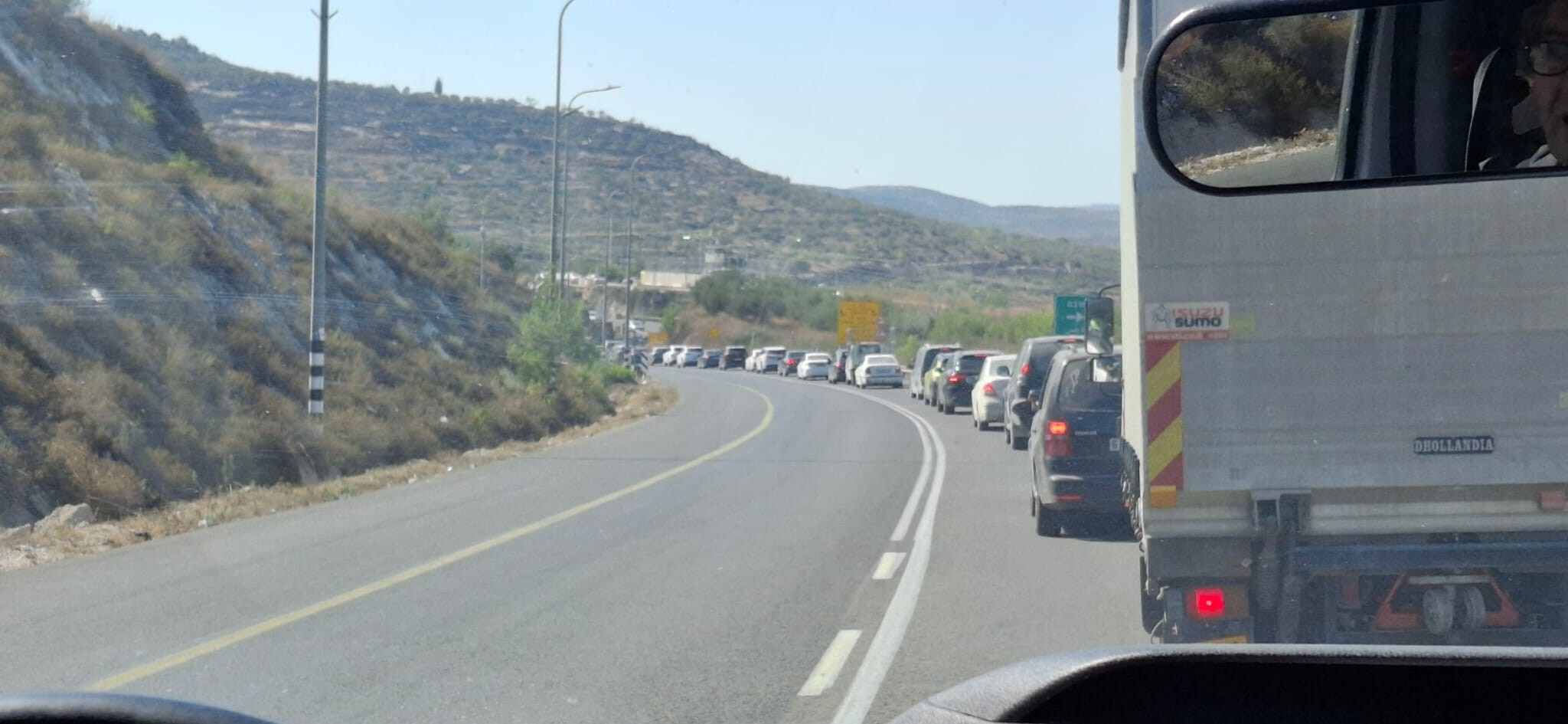 Anat PolakJul-17-2025Yitzhar Road, Jit Junction: traffic jam
-
Qaddum
See all reports for this place-
Qaddum
The village of Qaddum dates back approximately 4,000 years. Today’s villagers mostly work in agriculture and cultivae olive groves. The hilly landscape is covered with olive trees and are dotted with patches of green fields.
Qaddum was attached to the district of Nablus until 1994 at which time it joined the Qalqiliya district. The village is home to 4,000 inhabitants (2013), with 22,000 dunams (5,400 acres) of which 11,000 dunam (2700 acres) are in Area C*. Access to Area C requires coordination with the Israeli army, which means that access is almost non-existent.
The settlement of Kedumim was founded in 1975 on lands belonging to the ancient the village of Qaddum. Since then, Kedumim has expanded to include 5 settlements. The Kedumim settlements separate Qaddum village from its lands and from access to the main road. The road connecting Qaddum village to Route 55 was closed to its residents in 2003. The short ride (1.5 km or less than a mile) between Qaddum and a neighboring village - Jit, turned into a 12 km (7.5 miles) bumpy ride on an unpaved gravely road. Since 2004, residents of the village of Qaddum have been submitting requests to the authorities to reopen the old road leading to Route 55.
On July 2011, the villagers began holding weekly demonstrations in protest of the road closure and of the theft of their lands. They march to the edge of the village and there they stop. There is a regular routine to the demonstration which always follows with a confrontation with the army when it enters the village at the end of the blocked road. The army reacts to the demonstrations with sharp weapons, rubber bullets, tear gas and lately also live ammunition. Villagers are injured and hurt each week and often, dozens are arrested by the army. Young people and children are intimidated by the army when they photos are posted in the village streets.
On 12/7/19 a 10 year old boy was criticaaly wounded after he was shot in the head by live ammunition while standing at the entrance to his home in Qaddum during a demonstration.*Area C is an administrative division of the West Bank established by the Oslo II Accords in 1995. The Palestinian Authority is responsible for medical and education services and Israel is responsible for infrastructure and administration.
-
Za'tara (Tapuah)
See all reports for this place-
Za'tara (Tapuah) Za'tara is an internal checkpoint in the heart of the West Bank, at the intersection of Road 60 and Road 505 (Trans-Samaria), east of the Tapuah settlement. This checkpoint is the "border" marked by the IDF between the north and south of the West Bank, in accordance with the policy of separation between the two parts of the West Bank that has been in place since December 2005. At the Za'tara checkpoint, there are separate routes for Israelis and Palestinians. In the route for Israelis, there are no inspections and the route for Palestinians inspects. The queue lengthens and shortens suits. The checkpoint is open 24 hours a day. The checkpoint is partially staffed and the people who pass through it are checked at random.
 Shoshi AnbarSep-27-2023Za'atra (Tapuah Intersection). Signs
-