
Huwwara, Jit Junction , Yasuf, Za’tara (Tapuah)
9:15 on the way to the Za'atara CP (Tapuach Junction) we pass by Harriss in order to be sure that the CPs that were set up there in the middle of the holiday (E'id el Fitr) were really taken down. At the Tapuach Junction, in the spirit of the peace talks, there are now signs: "New Settlements – A New Policy". That is certainly a fitting Zionist response from the group called "Nachala – the Movement for [Furthering] Settlement".
9:45 Yasuf Village. Driving through deserted streets we reach the building of the Town Council and there we meet two members of the Council and the Treasurer. From the beginning of the meeting until the end, our hosts tell us story after story of events of cruelty that have been going on since the days of the Intifada. They consistently mix events that happened in the past with those that take place now every day. Even though the village is surrounded on three sides by colonies — Rechelim, Ariel and Tapuach – most of the victimizing originates in Tapuach with the full backing of the army.
Breaking trees and throwing stones at the villagers are daily events. About 300 dunams of land were stolen from the village and their trees were uprooted for the convenience of Tapuach which recently began work on expanding its residential area. The village has 1500 dunams that are defined as Area B. Another area, between Yasuf and the village of Ikaka is defined as Area C. The Tapuach colonists wanted one house, that was built ten years ago by a family in the village, and they demanded that it be handed over to them. The case of the people of Yasuf against the colony has been 'rolling around' in the courts for two years, and there has not yet been a decision.
How is it that the Civil Government and the Law join hands with the people of Tapuach?
In order to cultivate the lands where the villagers raise wheat and chickpeas, and in order to pick the olives in the area that is near Tapuach, the people need 24 days at a minimum. The Civil Government allows them four days per year [!] – two for the regular work, and two for picking olives. (The villagers' appeal to the courts to allow them additional workdays was simply deleted as if it had not been registered.) On those four days the agricultural gate is opened only between 9:00 and 15:00, but the Civil Government generously allows even those who are by decree not allowed to move freely to go out to work during those hours.
When village people go out to work their land, the colonists go into action: they throw stones at the workers, shoot in their direction. Three people were injured as a result of the shooting and had to spend a few weeks in the hospital. And what do the soldiers do when they hear the shots? They stand at the side and do not interfere.
The colonists do not rest even during the night: Then they go out for "regular" attacks. They burn cars in the village, steal goats, steal the olives that the villagers haven't succeeded in picking yet. The colonists also have their own "creative" way of attacking: They spill flour on the lands that belong to the village.
A most serious criminal event that was carried out by the Tapuach colonists a few years ago, was the attempt to poison the well that supplies water to the village. They tied a bottle that dripped poison into the well. Luckily the bottle was found and the poisoning was prevented.
The worst and most injurious of the attacks from the point of view of the villagers occurred in 2009. Then the colonists burnt the mosque and scribbled "price tag" all over the remains. Photographs of the burnt mosque are hanging on the wall of the Town Council.
What is good for the evildoer, is evil for his neighbor.
11:50 Leaving the village in the direction of the Tapuah Junction. On the way we see signs that announce the construction of new villas in the village of Tapuach. The early bird will catch the worm. Mocking the poor victim!
The village of Huwwara is lively as usual. The CP is still surrounded by barbed wire on all sides, as was observed in former reports. The way back through the Jit Junction is calm; no military vehicles or soldiers are seen in the region.
12:15 Return to the railroad station at Rosh Ha'Ayin. Because of a problem with Nadim's car, we shortened our visit this time.
Huwwara
See all reports for this place-
The Huwwara checkpoint is an internal checkpoint south of the city of Nablus, at the intersection of Roads 60 and 5077 (between the settlements of Bracha and Itamar). This checkpoint was one of the four permanent checkpoints that closed on Nablus (Beit Furik and Awarta checkpoints to the east and the Beit Iba checkpoint to the west). It was a pedestrian-only barrier. As MachsomWatch volunteers, we watched therre since 2001 two shifts a day - morning and noon, the thousands of Palestinians leaving Nablus and waiting for hours in queues to reach anywhere else in the West Bank, from the other side of the checkpoint the destination could only be reached by public transport. In early June 2009, as part of the easing of Palestinian traffic in the West Bank, the checkpoint was opened to vehicular traffic. The passage was free, with occasional military presence in the guard tower. Also, there were vehicle inspections from time to time. Since the massacre on 7.10.2023, the checkpoint has been closed to Palestinians.
On February 26, 2023, about 400 settlers attacked the town's residents for 5 hours and set fire to property, such as houses and cars. Disturbances occurred in response to a shooting of two Jewish residents of Har Bracha by a Palestinian Terrorist. The soldiers stationed in the town did not prevent the arson and rescued Palestinian families from their homes only after they were set on fire. No one was punished and Finance Minister Smotrich stated that "the State of Israel should wipe out Hawara." Left and center organizations organized solidarity demonstrations and support actions for the residents of Hawara.Hawara continued to be in the headlines in all the months that followed: more pogroms by the settlers, attacks by Palestinians and a massive presence of the army in the town. It amounted to a de facto curfew of commerce and life in the center of the city. On October 5, 2023, MK Zvi established a Sukkah in the center of Hawara and hundreds of settlers backed the army blocked the main road and held prayers in the heart of the town all night and the next day. On Saturday, October 7, 23 The "Swords of Iron" war began with an attack by Hamas on settlements surrounding Gaza in the face of a poor presence of the IDF. Much criticism has been made of the withdrawal of military forces from the area surrounding Gaza and their placement in the West Bank, and in the Hawara and Samaria region in particular, as a shield for the settlers who were taking over and rioting.
On November 12, 2023, the first section of the Hawara bypass road intended for Israeli traffic only was opened. In this way, the settlers can bypass the road that goes through the center of Hawara, which is the main artery for traffic from the Nablus area to Ramallah and the south of the West Bank. For the construction of the road, the Civil Administration expropriated 406 dunams of private land belonging to Palestinians from the nearby villages. The settlers are not satisfied with this at the moment, and demand to also travel through Hawara itself in order to demonstrate presence and control.(updated November 2023)
. Shoshi AnbarMay-18-2025Huwara: The old houses in Area C
-
Jit Junction
See all reports for this place-
The checkpoint is located on Route 60 near at the junction with Route 55, near the village of Jit. There was a checkpoint for vehicles passing between the north and south of the West Bank, which was abolished towards 2010. Since then, surprise checkpoints have been set up there from time to time with a police or Border Police vehicle, and vehicles and their passengers are inspected.
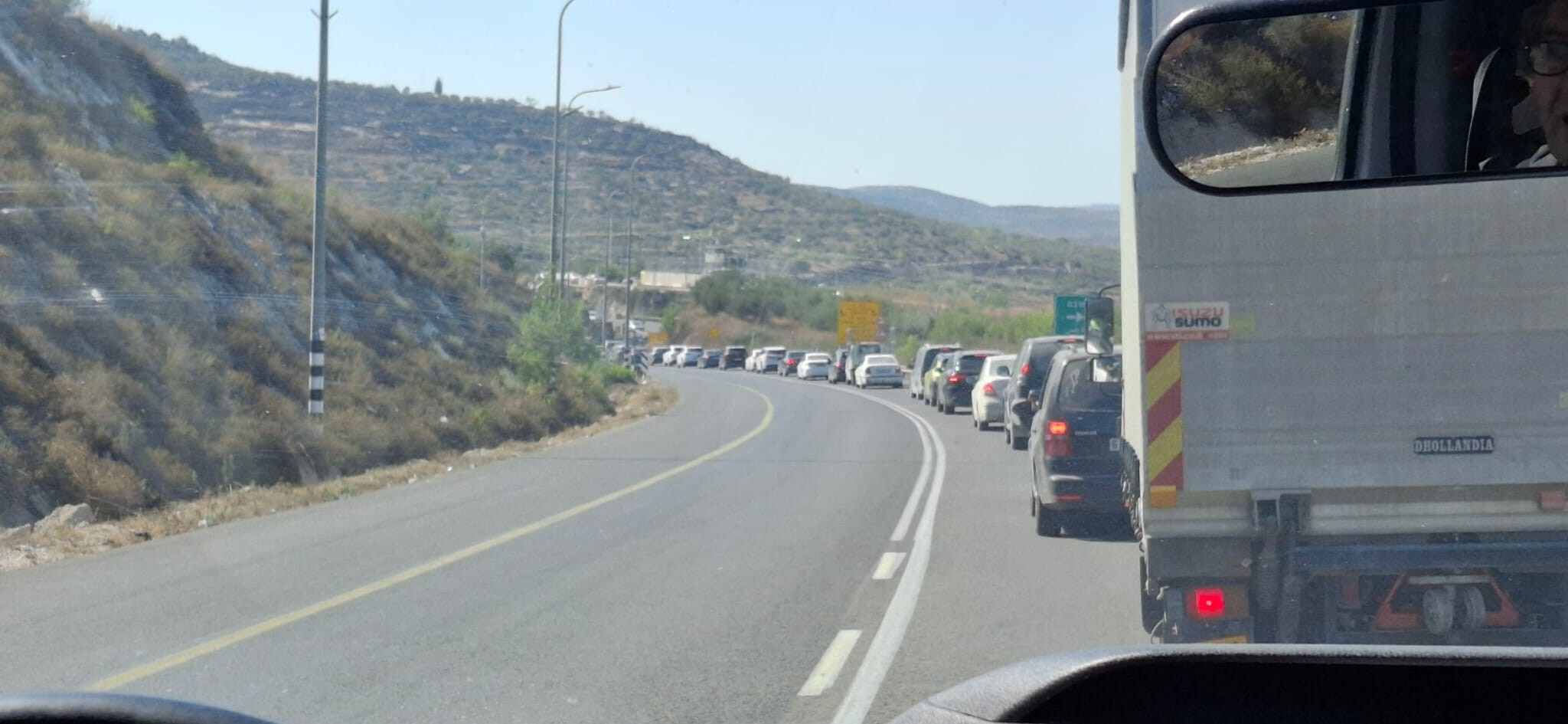 Anat PolakJul-17-2025Yitzhar Road, Jit Junction: traffic jam
-
Yasuf
See all reports for this place-
Yasuf The village numbers 2,500 residents, and in the neighboring village of Iskaka about 1,500. Yasuf suffers from low water supply and intermittent flow - although the population has more than doubled since the Oslo Accords, the 12 cubic meters set in 1996, sometimes even less, are alternated between the two villages, summer and winter .Permits to complete the harvest are only given for a few days, and there are often roadblocks on the way to the groves and the settlers, mostly fr/om Tapuah, try to drive the harvesters away. Since 2006, the settlements have been expanded threefold from their original location, and the harassments are numerous - including vandalism of cars and spraying of hate-inscriptions on the mosque. The settlers from Kfar Tapuach took control of land belonging to the residents and planted their own trees, and the army does not allow the villagers to approach these plots.
-
Za'tara (Tapuah)
See all reports for this place-
Za'tara (Tapuah) Za'tara is an internal checkpoint in the heart of the West Bank, at the intersection of Road 60 and Road 505 (Trans-Samaria), east of the Tapuah settlement. This checkpoint is the "border" marked by the IDF between the north and south of the West Bank, in accordance with the policy of separation between the two parts of the West Bank that has been in place since December 2005. At the Za'tara checkpoint, there are separate routes for Israelis and Palestinians. In the route for Israelis, there are no inspections and the route for Palestinians inspects. The queue lengthens and shortens suits. The checkpoint is open 24 hours a day. The checkpoint is partially staffed and the people who pass through it are checked at random.
 Shoshi AnbarSep-27-2023Za'atra (Tapuah Intersection). Signs
-