
Immatin, Far’ata, ‘Izbet alTabib, Habla, Nabi Elias
There’s a huge contrast between how happy and gay we are after our meetings with the Palestinian women and what we know and learn about the actions of the occupation. At least we can take some comfort in the fact that we’re undermining the occupier’s efforts to isolate Israelis from Palestinians.
09:00 Immatin. Four of the regulars arrived today. They said the others didn’t come due to the cold. The room we were in was truly freezing despite the small electric heater the women had put there.
Nurit led the class, assisted by Dafna. Though the temperature was low the atmosphere in the class was warm and happy, filled with joy and laughter.
09:15 Far’ata. Nirit, Sara'leh and Dvorka went to meet S., the Far’ata village head, and Rula, a member of the village council who’d asked us a few weeks ago to come there also to teach women. She was to present them with the alternatives we proposed and let us know.
We learned from S. that despite the fact that Immatin and Far’ata were combined into a single municipality administered from Immatin, some activities are still carried out in the Far’ata municipal building. The village head serves without pay. They collect payments from the residents for water and electricity and transfer them to the Palestinian Authority. The Health Services meet there every three weeks.
S. described again the harassment they’re subjected to by the settlers of Gil’ad's ranch who cut down trees and burn trees and cars; they’re not allowed to cultivate their olive trees, and when they do receive permission to access their lands they find half the crop has been stolen by the robbers from Gil’ad's ranch.
This time we also learned that when villagers gather where settlers had attacked and call the army for help, the usual response is “first leave the area.” When they disperse the army simply doesn’t show up. When the police and army do come they have no intention of catching the hoodlums, and they don’t, of course.
The Far’ata municipal building is built on a hillside overlooking the hills around Nablus, Awarta, Beita and other villages. The lovely, snow-capped peaks of the hills are also visible. Our hosts showed us photographs they’d taken of snow in the village, the children and youths happily playing outside. The sight of the little village, the narrow, picturesque lanes reminded me of ancient villages elsewhere in the world. We all thought about tourism and about how good life could be here were it not for Israel and the conflict.
10:30 We picked up Nurit and Dafna and drove to Nabi Elias.
A few women already waited at the club for Sara'leh and Dafna. They explained that others didn’t come because of the cold.
The meeting here was also warm, cheerful and filled with laughter. The women and Sara'leh, Dafna and Nurit greeted each other happily. It was also enticing to see all the colorful socks and other items they’d made at home and brought with them. Again we met the volunteer coordinator who’d hadn’t come since she’d given birth. Dafna and Sara'leh also made a condolence call to one of the women whose husband had died after a long illness.
11:45 Izbet Tabib. The roadblock at the entrance was open. Our friends weren’t in the village. We sat in the school courtyard and spoke to the principal. The school is very small, only 51 pupils. We had the impression that all was calm there, that the principal even had time to sit outside and enjoy the winter sun. The children continue to high school in a neighboring village. We met the younger brother of the youth who’d been arrested a few days ago; after being interrogated he’d been stabbed by the two soldiers who were to have released him and left on the road, far from home (according to news reports). The boy said that after the soldiers abandoned his brother on the road at 2 in the morning near the Qalqiliya DCO he’d been picked up by a passing taxi, brought home, and taken from there for treatment to the hospital in Qalqiliya.
Nadim, as usual, was very helpful, not only translating but in making contact with the village residents, finding our way through the alleys and with good advice about how to behave.
13:20 Habla. The gates were open when we arrived; few people were there.
'Izbet a-Tabib
See all reports for this place-
'Izbet a-Tabib
-
A-Nabi Elias
See all reports for this place-
A-Nabi Elias this is a Palestinian village in the northern West Bank, east of Qalqilia on Road 55, north-east of Alfei Menashe colony and west of Karnei Shomron colony and the Palestinian city of Nablus. As of 2016, the village was populated by 1,458 inhabitants.
Near the village is a maqam (holy site memorializing a sanctified person) - the prophet Elisha. Until 2021 Road 55 crossed the village. Then a bypass road was paved through olive groves that were sequestered from the villagers. Consequently, the farmers were left with small olive groves that they could not access nor cultivate. Inhabitants protested against the road for weeks, supported by peace activists, but nothing helped and the road is now a given fact.
The village's main street had been a shopping center for all residents, including colonists. We even saw a Kashrut (kosher food) inspector in a butcher shop close to the falafel stand… The bypass road, according to tradesmen, has impacted their businesses and clients, while others claim that there are customers now for parking has become easier.
Alfei Menashe and Tzofim colonies nibble at the village lands from the north and south and get closer to it all the time. Colonists of Alfei Menashe have outdone themselves, sending their surplus sewage from the oxygenation pools toward a-Nabi Elias land, even reaching the houses.
The villagers are known as seekers of peace. For years there was no hostility towards Israelis. On the contrary, we were always welcomed warmly and stopped there to enjoy their delicious, inexpensive falafel.
-
Far'ata
See all reports for this place-
Far'ata
-
Habla
See all reports for this place-
Habla CP (1393)
The Habla checkpoint (1393) was established on the lands of the residents of Qalqilya, on the short road that
connected it for centuries to the nearby town of Habla. The separation barrier intersects this road twice and cut off the residents of Qalqilya from their lands in the seam zone.(between the fence and the green line).
There is a passage under Road 55 that connects Qalqilya to the sabotage This agricultural barrier is used by the farmers and nursery owners established along Road 55 from the Green Line and on both sides of the kurkar road leading to the checkpoint.
This agricultural checkpoint serves the residents of Arab a-Ramadin al-Janoubi (detached from the West Bank), who pass through it to the West Bank and back to their homes. The opening hours (3 times a day) of this agricultural checkpoint are longer than usual, about an hour (recently shortened to 45 minutes), and are coordinated with the transportation hours of a-Ramadin children studying in the occupied in the West Bank.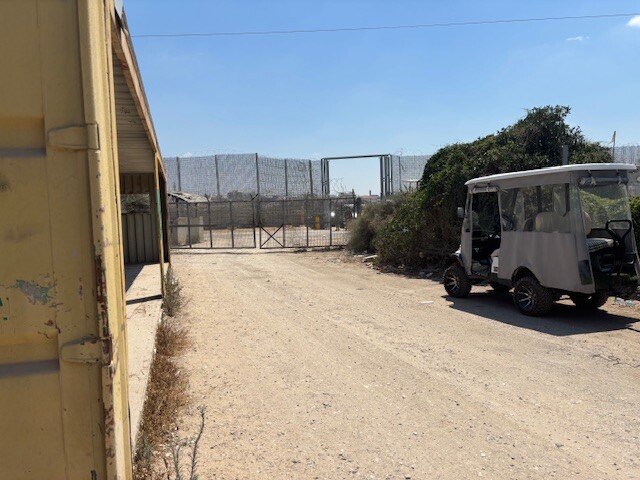 Nina SebaAug-18-2025Habla: The gate is in the process of closing
-