
Jaba (Lil), Qalandiya
That’s what life here is like.
“That’s what life here is like,” said an acquaintance who told us about the man from the Qalandiya refugee camp whom soldiers killed a few days earlier and also told us about three others wounded in the same incident and are now hospitalized in Ramallah, “in serious condition, very serious condition,” he said and grew silent, like someone seeing images in his mind, and said again, “Yes, that’s what life here is like.”
Others also spoke, told us of the arrests and about those jailed, about Ibrahim, the child, “The one who sells Buza here,” who was 15 when he was arrested and will soon be 16 and is now at Ofer, “He’ll get out in two months,” and also told of Sayf, his brother, who is also now at Ofer, “Already in jail three months," they said, “His trial is tomorrow.”
– I no longer ask why or for what or what they’re accused of, because the reality of their life is that no one’s innocent and there’s no “Not Guilty” option.
The account of one arrest led to a second and a third, each person’s own experience and that of his friends and relatives. They talked of a man who had dreamed a few years ago he was carrying out an attack and when the dreamer woke in the morning, agitated, he hurried to recount the night’s event, and soon found himself on trial and convicted. “He got twenty months inside.”
– Dreaming is bad for a Palestinian. And if he dreams, he’d better shut his mouth. Not tell anyone. And it’s even better for a Palestinian to forget about dreams. Dreams are a refuge from the present and represent hope for the future. What present has a Palestinian, what future can he expect?
Between one tale and another, between one encounter and the next, we received a phone call from Fatma, ‘Im’ad el-Bitran’s wife, who told us her husband has again been placed in administrative detention and again is on a hunger strike, now in its tenth day.
Three years ago, after ‘Im’ad had been on a hunger strike for 105 days, after his health had been damaged and he’d been close to death, the state reached an agreement with him that ‘Im’ad would stop his hunger strike and in return his administrative detention would not be extended.
‘Im’ad had been released on the date agreed upon, but the harassment of him and his family continued, including threats, frequent arrests, interrogations accompanied by torture, night raids on his home and confiscation of his car which he needed in order to earn a living.
His hopelessness and inability to see any future made him decide again to endanger his health and his life.
‘Im’ad, who knows the walls of the jail cell better than his home and his children, wants us to treat him justly so that he may live freely, if only in a relative sense, like his countrymen.
Fatma asked on behalf of ‘Im’ad and the attorney representing him that we also tell the story of his hunger strike to Jews.
We’re grateful to Vivi Tzuri for helping to be in contact with Fatma.
With respect to the Supreme Court’s collaboration with the military system, we recommend this article by Anat Matar: http://www.haaretz.co.il/opinions/.premium-1.2874140
Photos from Qalandiya:


A selfie at Qalandiya:

Jaba checkpoint: Policemen, policewomen and soldiers in panic lest WAZE again cause Jewish drivers to lose their way:
-“Did you end up at Qalandiya because of WAZE?!” asked/stated the policewoman
– No, I got to Qalandiya without using WAZE.
– “What did you do there?”
– We had coffee with friends (that’s the honest truth).
But despite the irate tone and the angry expression she didn’t have time for us; she and her colleagues were busy with a Palestinian family from Hebron, parents and two toddlers, aged two and three, who had been detained in their car by the roadside for more than two hours.

The babies, who hadn’t yet learned to shut up when they’ve been stopped and detained for an unlimited period of time by armed people, cried and wailed while the mother and father sat helplessly without knowing why they’re being detained and how much longer it will take. That sat waiting in a car that had become their cage.
Though they might have made an effort, and certainly were looking, no suspicious black marks were found in the family’s past, not in the police computer and not at secret service headquarters, and after more than two hours they were released, but not before the man, who doesn’t know Hebrew, was given a police report in Hebrew which they made him sign, and he did, and the policeman who returned his car keys and his ID and handed him the report said only, “Within two weeks. 2000 shekels.”
So we read it, and what was written is that they were fined one thousand shekels because of an infant’s seat that doesn’t meet the required standards.
– All, of course, according to the standards. Only according to the standards, and only according to the law.
Jaba' (Lil)
See all reports for this place-
Jaba' (Lil) In fact, the Jaba checkpoint is east of the Qalandiya checkpoint. Its declared purpose is the prevention of Israeli citizens from entering Area A. A road checkpoint for vehicles, located on Road 65, borders the southern fence of Kfar Jaba, about three kilometers east of the Qalandiya checkpoint, on the road leading to the settlement of Adam on Road 60. Archaeological excavations within the village found the remains of a cloth house from the First Temple period. The events that led to the construction of the checkpoint are precisely here: on the day of the abduction of Gilad Shalit and before the outbreak of the Second Lebanon War, a 17-year-old man from one of the settlements was abducted by a Palestinian cell. His body was found several days later at the entrances to Ramallah. A military investigation revealed that his abductors had taken him along this route. The checkpoint was set up to prevent future kidnappings and to warn settlers from traveling to Ramallah and entering Area A (which is forbidden for Israelis). The checkpoint that operates around the clock. Usually only vehicles traveling in the direction of Ramallah are inspected. (November 2016): Every morning, when the settlers en masse travel to Jerusalem on Route 60 and every afternoon they return from Jerusalem on Route 60, the army initiates a traffic jam at the entrance to the Jaba checkpoint and stops the movement of Palestinians traveling toward Route 60. (February 2020): In the last two years the checkpoint has not always been manned. Sometimes the soldiers come and just stand, sometimes they come and stop and check those who enter the village, sometimes they patrol the alleys of the village, sometimes they fire stun grenades and gas and sometimes they invade houses and stop young people, say those passing through the Hazma checkpoint. (Updated February 2020)
-
Qalandiya Checkpoint / Atarot Pass (Jerusalem)
See all reports for this place-
Click here to watch a video from Qalandiya checkpoint up to mid 2019 Three kilometers south of Ramallah, in the heart of Palestinian population. Integrates into "Jerusalem Envelope" as part of Wall that separates between northern suburbs that were annexed to Jerusalem in 1967: Kafr Aqab, Semiramis and Qalandiya, and the villages of Ar-Ram and Bir Nabala, also north of Jerusalem, and the city itself. Some residents of Kafr Aqab, Semiramis and Qalandiya have Jerusalem ID cards. A terminal operated by Israel Police has functioned since early 2006. As of August 2006, northbound pedestrians are not checked. Southbound Palestinians must carry Jerusalem IDs; holders of Palestinian Authority IDs cannot pass without special permits. Vehicular traffic from Ramallah to other West Bank areas runs to the north of Qalandiya. In February 2019, the new facility of the checkpoint was inaugurated aiming to make it like a "border crossing". The bars and barbed wire fences were replaced with walls of perforated metal panels. The check is now performed at multiple stations for face recognition and the transfer of an e-card. The rate of passage has improved and its density has generally decreased, but lack of manpower and malfunctions cause periods of stress. The development and paving of the roads has not yet been completed, the traffic of cars and pedestrians is dangerous, and t the entire vicinity of the checkpoint is filthy. In 2020 a huge pedestrian bridge was built over the vehicle crossing with severe mobility restrictions (steep stairs, long and winding route). The pedestrian access from public transport to the checkpoint from the north (Ramallah direction) is unclear, and there have been cases of people, especially people with disabilities, who accidentally reached the vehicle crossing and were shot by the soldiers at the checkpoint. In the summer of 2021, work began on a new, sunken entrance road from Qalandiya that will lead directly to Road 443 towards Jerusalem and Tel Aviv. At the same time, the runways of the old Atarot airport were demolished and infrastructure was prepared for a large bus terminal. (updated October 2021)
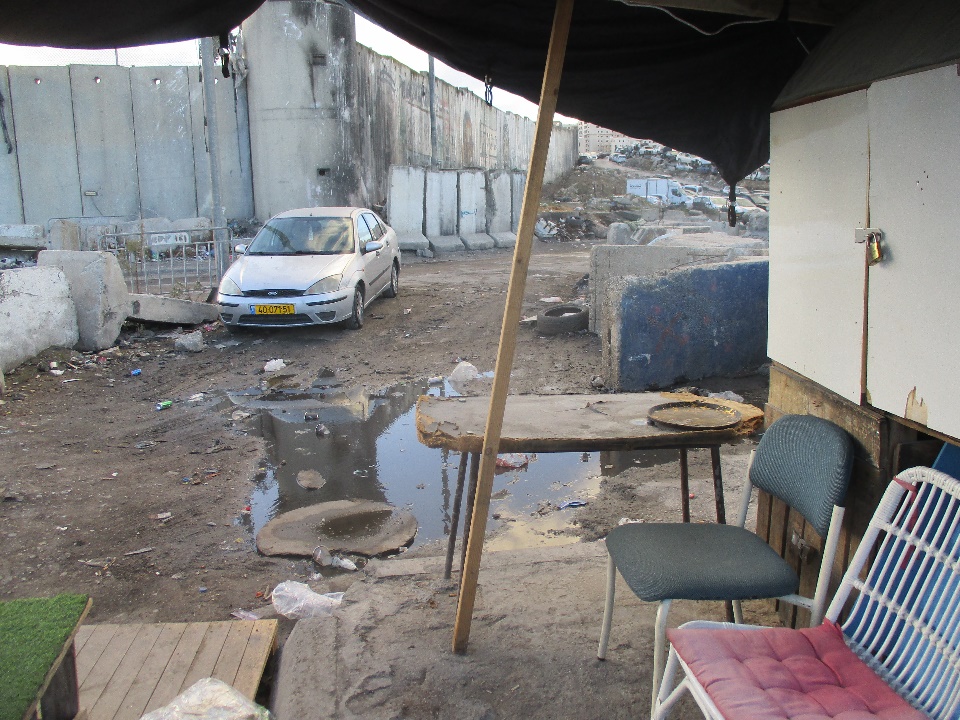 Tamar FleishmanNov-30-2025Qalandiya: Puddles and dirt after the rain
-