
Jaba (Lil), Qalandiya, יום ד’ 15.4.09, אחה”צ
According to section 27 in the Geneva Convention: "Women shall be especially protected against any attack in their honor, in particular against rape, enforced prostitution, or any form of indecent assault".
They are young, hansom, smart, they love each other and they are married. The future seems positive for them. But they are Arabs, and even worse: they are Palestinians- That what destroys their opportunity for a pink future and their and all their chances.
P has a blue ID and is a resident of Jerusalem, and A is a resident of the Occupied Territories. Neither of them is permitted by the "Israeli Civil Law", which is discriminatory, to live under the same roof. They were arrested at Hizmee Checkpoint, in P's car, when they were trying to get to the eastern side of the city, where their home is.
A' was arrested and taken away in a BP jeep. A soldier entered P's car and sat in the driver's seat (an illegal act) and took A under arrest under pretext that he had an person that wasn't allowed in Israeli territory, in his car- although, from this aspect, A' didn't make it into the Israeli territories, and therefore P' wasn't doing anything illegal. It was the foresight of the BP soldiers that got them arrested.
Both vehicles arrived at the BP base at Ar-Ram with both A and P. For some unexplainable reason, the soldier driving P' car bumped in to the base gate from the inside, on the side of the passenger by the driver. The gate was uprooted and P' got hit in the chest while the driver hurt his head.
The whole group stood by both side of the road leading to the base, and waited for the ambulance: A' stood by her husband who was in agony , lying on the right side of the road, the injured soldier sat on the other side with his head between his hands. In spit of the fact that is was clear which of the two was more severely hurt, when the ambulance arrived, it was the soldier that was first attended to. Afterwards they came to help P and both men were taken to the hospital.
These are the facts that we gathered while there. In the meanwhile the IDF was already working on its cover story: "the soldier stepped on the gas instead of the breaks because the Palestinian made a suspicious move, and the driver thought he was about to attack him".- Ruti heard the soldiers getting their stories straight.
A' wasn't allowed to join her husband: "She's not going to a place where she will be out of your reach", we said to the men in uniforms. But the detective (so we were told) wouldn't allow it, and she was escorted by a female soldier to the interrogation room.
The soldier told her to take off all her close and run a physical inspection on her. When she was sure A' didn't have any explosives in her vagina and that there were no grenades up her bra, she told her she could get dressed. The soldier left the room and the detective entered, he didn't have a uniform on, nor did he had a tag with his name (we know his first name). Isn't it obligatory to have a woman present when another woman is being interrogated? Isn't it possible that her honor might be attacked?
The interrogator asked A' about what had happened that day and accused her of misbehaving in Hizmee. While conducting the investigation, the detective started telling A' sex stories: he let her know just how good he was in bed, that women stand in line for him, and then offered A' to come with him to a hotel. After all, her husband was in hospital, he wouldn't find out.
After a three hour interrogation during which she went through harsh verbal assault, A' was released, not before she was told to sigh a document, that a copy of which she didn't receive (which is bound by law). Her husband was at Hadasa Ein Karem. The doctors said he might have rapture in his lungs, but his wife couldn't sit by his side.
Doesn't the IDF ethical code, which was composed by prop. Asa Kasher, specify anything about sexual conduct?
And now, the report from our shift
Qalandia Checkpoint: Three patrol vehicles of the artillery corps, with the deputy commander as their leader, headed for an armored tour of the refugee camp.
Until that moment the soldier at the top of the pillbox was silent. With all the officers gone, he turned on the loudspeaker and said to Ivon: "right this down".
The bus drivers at the checkpoint wondered by all passenger were taken off, including the elderly and the invalid.
Some passengers in a UN vehicle, refused to step out of the car as they were ordered by the soldiers at the vehicle checkpoint (since this conduct was in contradiction with their work regulations), they weren't allowed to pass and so they were sent back.
Jaba/Leel Checkpoint: The soldiers had lists in their hands and checked the passengers in the transits and cabs (they were probably looking for a Bingo)- this caused a delay of 10 minutes in average
Jaba' (Lil)
See all reports for this place-
Jaba' (Lil) In fact, the Jaba checkpoint is east of the Qalandiya checkpoint. Its declared purpose is the prevention of Israeli citizens from entering Area A. A road checkpoint for vehicles, located on Road 65, borders the southern fence of Kfar Jaba, about three kilometers east of the Qalandiya checkpoint, on the road leading to the settlement of Adam on Road 60. Archaeological excavations within the village found the remains of a cloth house from the First Temple period. The events that led to the construction of the checkpoint are precisely here: on the day of the abduction of Gilad Shalit and before the outbreak of the Second Lebanon War, a 17-year-old man from one of the settlements was abducted by a Palestinian cell. His body was found several days later at the entrances to Ramallah. A military investigation revealed that his abductors had taken him along this route. The checkpoint was set up to prevent future kidnappings and to warn settlers from traveling to Ramallah and entering Area A (which is forbidden for Israelis). The checkpoint that operates around the clock. Usually only vehicles traveling in the direction of Ramallah are inspected. (November 2016): Every morning, when the settlers en masse travel to Jerusalem on Route 60 and every afternoon they return from Jerusalem on Route 60, the army initiates a traffic jam at the entrance to the Jaba checkpoint and stops the movement of Palestinians traveling toward Route 60. (February 2020): In the last two years the checkpoint has not always been manned. Sometimes the soldiers come and just stand, sometimes they come and stop and check those who enter the village, sometimes they patrol the alleys of the village, sometimes they fire stun grenades and gas and sometimes they invade houses and stop young people, say those passing through the Hazma checkpoint. (Updated February 2020)
-
Qalandiya Checkpoint / Atarot Pass (Jerusalem)
See all reports for this place-
Click here to watch a video from Qalandiya checkpoint up to mid 2019 Three kilometers south of Ramallah, in the heart of Palestinian population. Integrates into "Jerusalem Envelope" as part of Wall that separates between northern suburbs that were annexed to Jerusalem in 1967: Kafr Aqab, Semiramis and Qalandiya, and the villages of Ar-Ram and Bir Nabala, also north of Jerusalem, and the city itself. Some residents of Kafr Aqab, Semiramis and Qalandiya have Jerusalem ID cards. A terminal operated by Israel Police has functioned since early 2006. As of August 2006, northbound pedestrians are not checked. Southbound Palestinians must carry Jerusalem IDs; holders of Palestinian Authority IDs cannot pass without special permits. Vehicular traffic from Ramallah to other West Bank areas runs to the north of Qalandiya. In February 2019, the new facility of the checkpoint was inaugurated aiming to make it like a "border crossing". The bars and barbed wire fences were replaced with walls of perforated metal panels. The check is now performed at multiple stations for face recognition and the transfer of an e-card. The rate of passage has improved and its density has generally decreased, but lack of manpower and malfunctions cause periods of stress. The development and paving of the roads has not yet been completed, the traffic of cars and pedestrians is dangerous, and t the entire vicinity of the checkpoint is filthy. In 2020 a huge pedestrian bridge was built over the vehicle crossing with severe mobility restrictions (steep stairs, long and winding route). The pedestrian access from public transport to the checkpoint from the north (Ramallah direction) is unclear, and there have been cases of people, especially people with disabilities, who accidentally reached the vehicle crossing and were shot by the soldiers at the checkpoint. In the summer of 2021, work began on a new, sunken entrance road from Qalandiya that will lead directly to Road 443 towards Jerusalem and Tel Aviv. At the same time, the runways of the old Atarot airport were demolished and infrastructure was prepared for a large bus terminal. (updated October 2021)
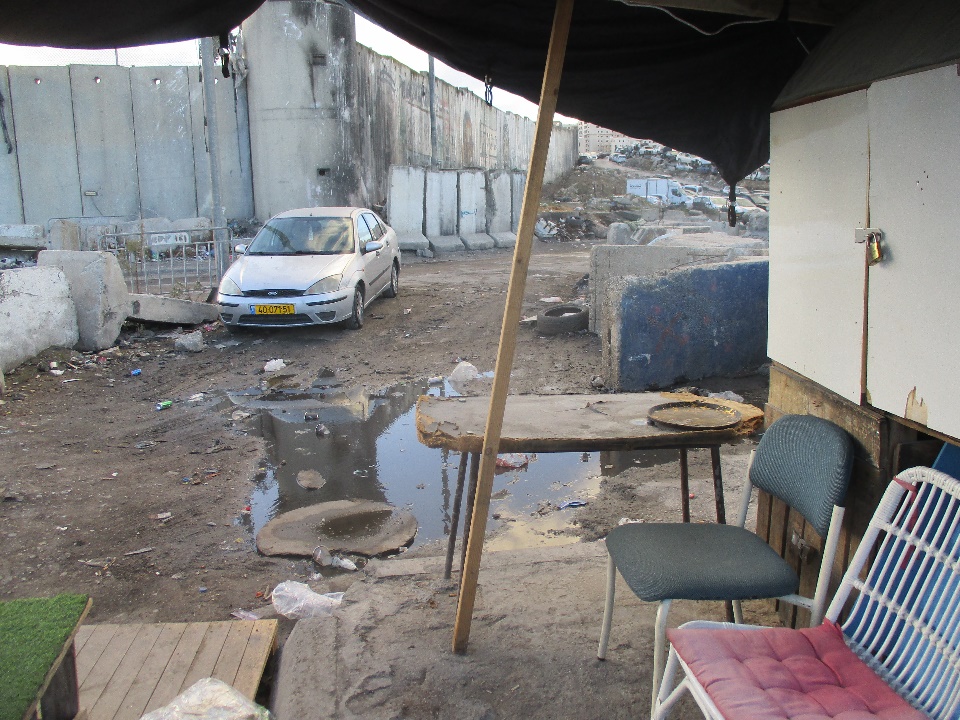 Tamar FleishmanNov-30-2025Qalandiya: Puddles and dirt after the rain
-