
Jordan Valley: Settlers destroy equipment and intimidate herding communities, while the army blames the shepherds for throwing stones.
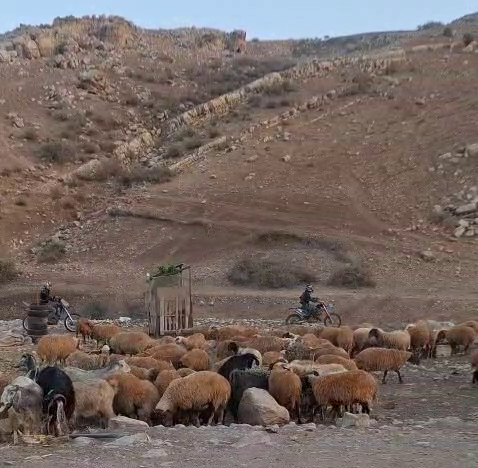
Most of the herds’ grazings passed without disturbance in the morning, since settlers usually rest at home at that hour. Thus, accompaniment went smoothly with the herds of al-Farisiya, who stay during the summer months at Ein al-Sakut; as well as with the watering of three different herds at the Ein al-Hilweh spring. Also, M. was accompanied while gathering the remnants of a cornfield harvest, loading the stalks onto a cart and taking them to Ein al-Hilweh as fodder for the cows.
There was, however, one exception. In Bardala, while accompanying the farmer M. to open and close irrigation valves in his field—and to check whether settlers had intentionally opened valves where they shouldn’t, M. and the escorts saw two settlers who had driven their cattle into his pepper field and were grazing there. M. and the escorts confronted the settlers and demanded they leave the field. Eventually, they did, and M. continued checking the irrigation with the escorts.
In al-Farisiya itself, the “protective presence” (continuous 24-hour stay with the shepherd families at their encampments) continued with coffee drinking and conversations about current affairs, in our broken Arabic and what Hebrew they picked up from us…
In the afternoon, the picture changed—this time, the settlers were bolder and launched serious attacks.
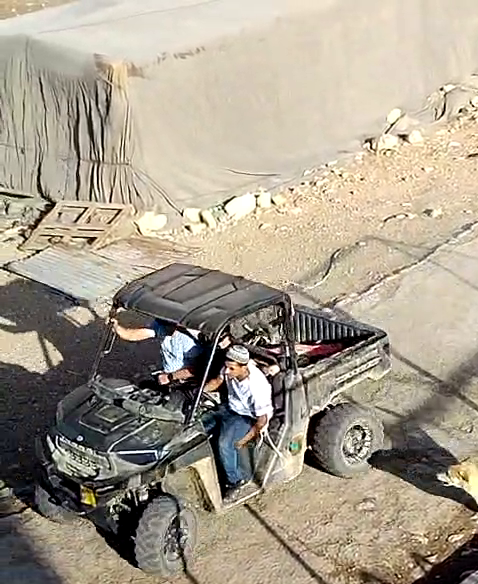
At Ein al-Hilweh, settlers entered the compound of F. with two ATVs and began intimidation rounds. They opened the gate of the cattle pen, and the cows started to get out; had his daughter not called us for help, the herd would have dispersed. Then the ATVs drove into the tents of S. and K., but thanks to five escorts who were there, the settlers were expelled and seemed to return home to their outpost near the Tayasir checkpoint.
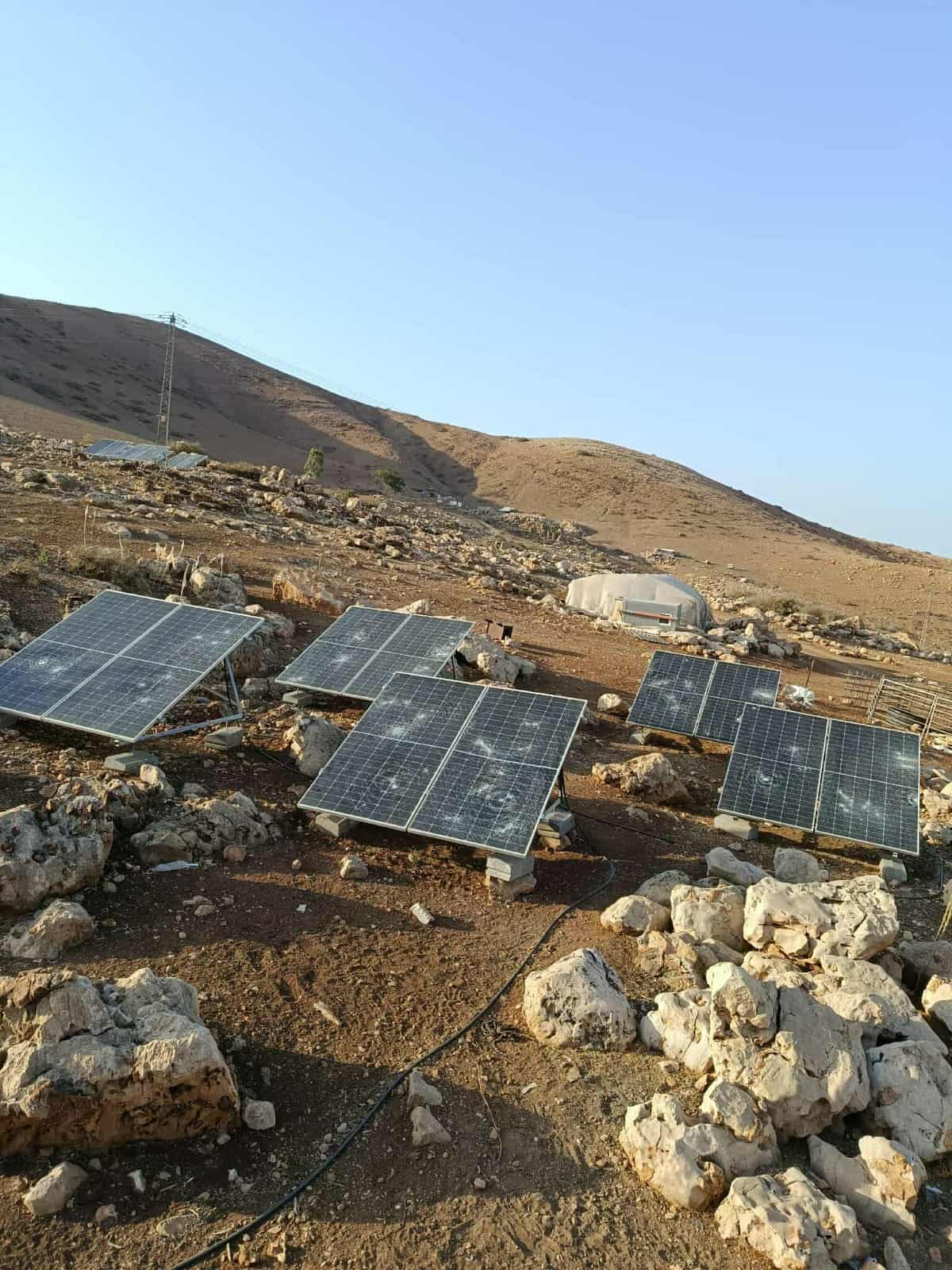
We were wrong. Half an hour later, two shepherds from Ein al-Hilweh received word that the settlers had violently broken into Hammam al-Malih (about half a kilometer from Ein al-Hilweh) and carried out a pogrom before the helpless residents: smashing solar panels and air conditioners, breaking cameras, and then returning to their outpost.

The Palestinians called the police, but the army arrived instead. The soldiers did nothing—did not search for the rampaging settlers, neither on the way nor at the nearby Tayasir outpost. The residents of Hammam al-Malih therefore decided not to bother filing a police complaint; they have no faith it would be addressed in any way. They asked us to stay overnight for protection, but unfortunately, due to a shortage of escorts that night, we couldn’t provide that help. We agreed that they would call us immediately if anything developed, and we would arrive as quickly as possible.
Then we received a call from Bardala. M. reported that settlers were once again entering his field near the outpost. The escorts drove there immediately and indeed saw a herd of cattle in the field. The settlers, armed with iron rods, physically prevented M. and the escorts from approaching. A call for help was sent to the police—but again, the army arrived instead. The commander of the military patrol conferred privately with the settlers, watched videos of the attack filmed by the shepherds, spoke over the radio with her superiors, and finally was “convinced” by the settlers’ version: that M. and the escorts had thrown stones at them, and that the settlers had entered the field “by mistake”… She therefore let them go.
The incident ended as it usually does: in most complaints, the Palestinians come out on the losing side. The army, the police, and the settlers work hand in hand—even when there are clear videos showing settler violence. Somehow, it’s always the Palestinians’ fault, because settlers are allowed to rampage, destroy equipment, and “accidentally” enter fields that aren’t theirs.
Night fell. The night-shift escorts arrived. A military vehicle parked for about an hour near K.’s destroyed home, then left.
At 22:00, two ATVs were seen speeding across the area near F., passing by his sister’s house and heading down toward the spring. The rest of the night throughout the northern Jordan Valley passed quietly.
Location Description
'Ein al-Hilwe
See all reports for this place-
Ein al-Hilwe is a natural spring and a Palestinian grazing area in the Jordan Valley that was used by the Palestinian shepherd communities for watering their flocks and for daily use. As of 2021, settlers from the Maskyot settlement took control of the spring: they fenced it off, built a wading pool and a mikveh, and installed flags and recreational facilities.
Palestinians are effectively denied access to the spring, and are forced to make do with running water in a remote wadi or, when the road is blocked, buy water from vendors at high prices.
The spring is located in the heart of an area where illegal outposts are being established, as part of a broader trend of pushing Palestinian communities away by denying them access to essential resources. Neighboring communities such as Umm Jamal and Khirbet Samra have already left due to the pressure.
Over the years, MachsomWatch members have reported arrests on false claims by settlers, harassment and violence, including damage to herds, intrusion into homes, and the intimidation of children. MachsomWatch volunteers participate in a protective presence in areas around the spring to prevent harassment of shepherds due to the presence of settlers.
-
Al-Farisiya / 'Ein a-sakut
See all reports for this place-
Al-Farisiya / 'Ein a-sakutA community of shepherds in the Jordan Valley opposite the settlement of "Rotem". Making a living from grazing sheep, the residents are exposed to harassment, abuse and theft from settlers who come to them from outposts and settlements in the area, and their grazing area is shrinking due to settler takeovers, fire zones and declared nature reserves.Machsom Watch companies participate in shepherd escort activities and provide a 24/7 protective presence, and there is continuous and warm contact with the community.
-
Bardala
See all reports for this place-
A relatively large township in Area B in the northern part of the Valley, home to about 300 families of farmers and other families. The villages of Bardala and Kardala, located nearby, sit on a very large reservoir of groundwater. In 1968, an "agreement" was signed between the occupier (represented by the Mekorot water company) and three villages (including Ein al-Bida), stipulating that in exchange for their agreement to stop pumping water their wells, Mekorot would establish its own pumping stations on their land and allocate them a "generous" quota of waterinfo-iconfor at the cost of pumping only (a few cents per cubic meter). Over the years, Mekorot violated the agreement, decreased the quotas drastically (from 240 cubic meters per hour to 100 and sometimes 40 cubic meters), and quadrupled the price. The residents refused to pay, and the PA paid for them. In late 2024, the army began paving a new road around Karbala and Bardala. According to the plan, the road will surround and Karbala from the south and Bardala from north and west, and finally turn east to Highway 90. The road will completely surround Bardala on all sides, cutting off the village from all its lands and imprisoning the village within its boundaries. The residents will no longer be able to come and work their lands freely. Our friends were unable to see the roadworks because the army had set up a checkpoint on the road to the new route.
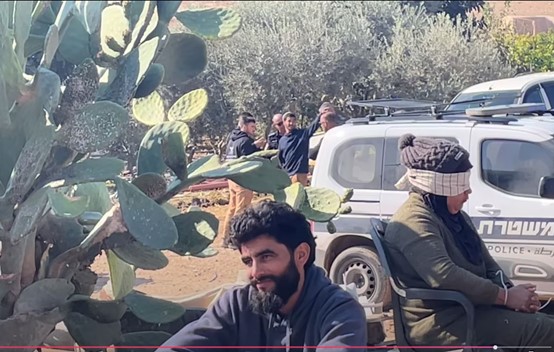 Rachel AfekDec-18-2025Hadidiya: On the right, the woman accused of throwing stones; on the left, the man accused of "something"; in the background, the settler is hanging out with soldiers and police officers
-