
Jordan Valley: Settlers murder Palestinian residents, burn homes, and uproot trees with the blessing of the State of Israel



We sat in Yusef’s garden, overlooking a broad valley planted with ancient olive trees and colonist vineyards. A nice breeze was blowing at this noon hour and Yusef served us tiny sweet cucumbers and bitter coffee. We were surrounded by a vine, plum and apricot trees. Paradise. Suddenly Yusef’s son arrived. Upset – the colonist is on his way here! We all got up to defend this 8-person family (including 14-month-old and 2-month-babies), but midway the colonist turned around and left. It was just a threat. Such is the life of this family, whose small home is cut into the hill on the outskirts of Jaljiliya. Every day, several times, he or his cohorts arrive all the way to the house itself or at times just part of the way. He threatens Yusef not to cross some imaginary line near the house, but Yusef’s cucumber plot stretches about 50 meters out of that line. It is fenced in, and Yusef asks us to help him buy a higher fence. The truth is that no fence could stop these criminals. They will continue to harass and abuse this charming family whose sole wish is to tend their little plot and live in their home. Until the colonists manage to make them leave…
A beautiful road (some of whose houses are under construction) connects Yusef’s home to the center of Jaljiliya. This is a tiny village west of Sinjil, and one can see each of the houses marked for an attack by colonists 2 days ago, on Saturday, July 5th – shattered glass windows and doors, stones and bricks that the pogromists threw and are scattered around the houses. Worst of all – signs of burning on one of the doors and window sills on the ground floor of the houses. The colonists threw bricks to break the glass windows, and then through the broken windows threw incendiary bombs to burn the houses down. The did not succeed this time, but they will return and try again until they do, as in Kufr Malek 2 weeks ago, and in Duma 8 years ago when they incinerated a mother, father and their year-old baby as they slept. The inhabitants had summoned the police. Did the police heed them and come? Of course not…
Earlier we drove to A.’s house. We reached a boulder blockage on the road, parked the car and walked to his house to drink tea. The house is situated on the street that used to pass through the village area. Now this street has been confiscated in favor of Ma’ale Levona and Gov’at Har’el colonies. Needless to say, A. is prohibited from driving along the road or to his fields that lie beyond it.
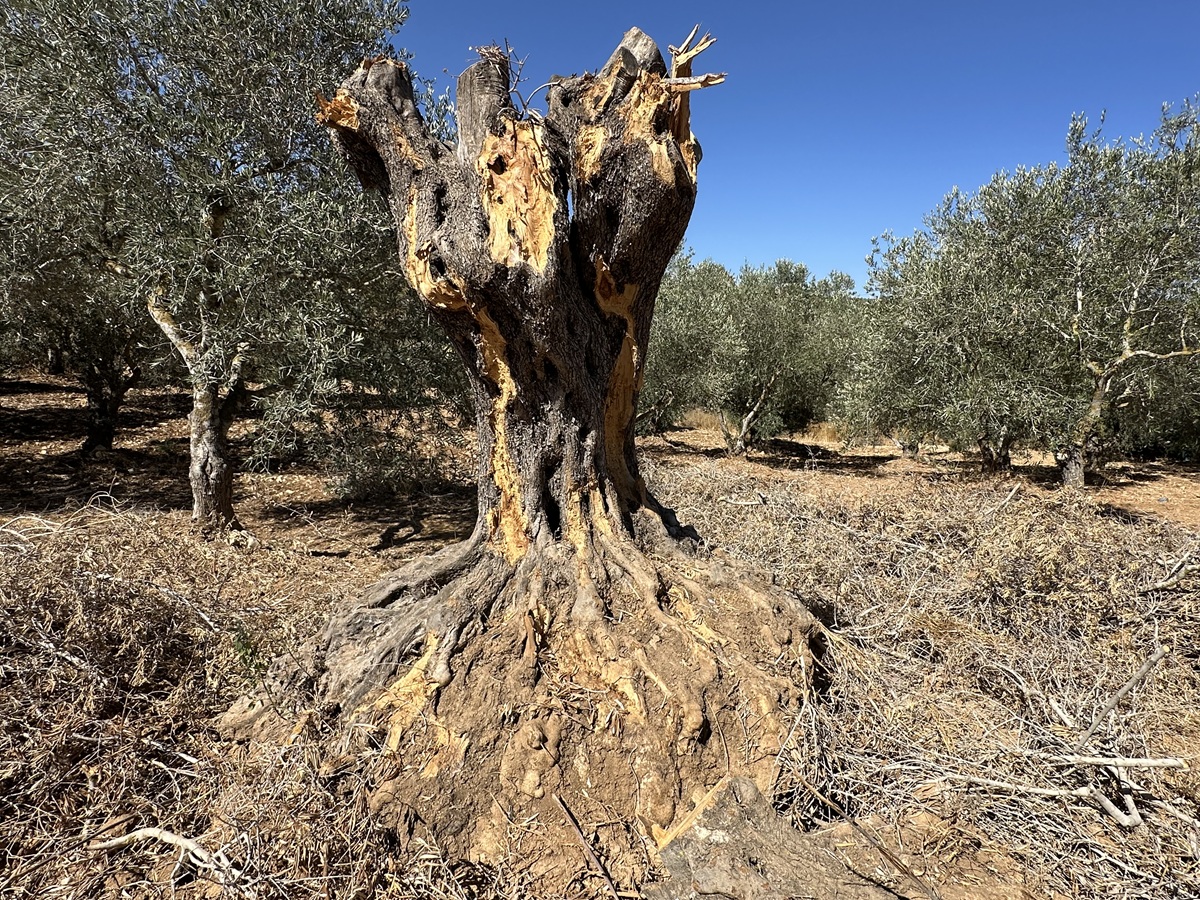
Along the road we see piles of cut down olive trees, some of them hundreds of years old (one of them 700-years-old!). The Civil Administration cut them down in order to widen the street or surround the village with a barbed wire fence 5-meters-high. Some of it already separates the village from Road 60. We look sadly at the evil deeds of the Israeli occupier who came here 58 years ago, destroyed and annihilated nature and culture that had managed to survive in this part of the world for thousands of years. Shame!
Note: Four days after our visit, colonists from the nearby outpost murdered two inhabitants of Sinjil during a protest against the outpost taking place near Yusef’s home. One of them was killed simply by beatings. Not a colonist was arrested. Two Israeli activists who took part in the protest demonstration were.
Location Description
Sinjil
See all reports for this place-
Singil
A town with a Maqam
The origin of the town's name is Raymond IV of Saint-Gilles, nicknamed the Count of Toulouse who established a Crusader fortress there in 1198. There is evidence of a settlement in the place as early as the Early Bronze Age.
On the mountain across from the town of Singil, east of Ramallah, the agricultural lands of its ten thousand residents spread out – The beautiful built-up terraces were renovated during the quiet period of the Corona pandemic. Each person and his fields on the way to the hilltop, location of the holy site, Maqam Abu Al ‘Uf, one the prophet Mohammad’s companions. Singil lands amount to 18 thousand dunams. Of these, 9,500 dunams are area C - where the Civil Administration forbids digging a water hole, laying pipes or building a shed to protect against the heat of the day or rain.
Maqam Abu Al ‘Uf stands in the heart of Singil's agricultural lands, on a hill from which the entire town is overlooked. It is an ancient and beautiful place that contains all the elements of Palestinian life in the past, which they embrace with longing. But they are afraid to repair and clean the site with a double fear of the settlers and the civil administration, since the site is in area C, the settlers are trying to appropriate the Muslim site to the Jewish narrative and transfer it to their control. They come and litter site with ship excrement or set up tables for a parties there.
Everything is beautiful, but there is a thorn in it: the Israeli occupation! In January 1978, a group of settlers settled near the village lands, under the guise of an archaeological dig camp in the nearby Tel Shiloh. Today Singil and its lands are surrounded by the huge settlements: Shiloh, Eli, Ma'ale Levona and their outposts: Giv’at Har’el, Giv’at Ha-Ro’eh (which the government approved to become a settlements) that more and more of the lands of Singil are annexed by one trick or another to the settlements. Another addition is the violent outpost called "Nahal Shiloh" from which a settler to attacks the Palestinian farmers, attempts to destroy terraces and send his herds to the Palestinian fields. Adjacent to the outpost is an Israeli army.
Of the 10,000 residents who live in the town, 400 people work in Israel and depend on work permits. They leave at three in the morning through four exits manned by soldiers from the nearby army camp who are held up by ID checks. 12,000 residents left over the years to other countries, mainly to the United States.
As part of the Israeli-Palestinian conflict, over the years there have been dozens of incidents of mutual violence between the residents of the village and Jewish residents of the area and the IDF forces. Including a settlers’ pogrom in May 2023.
Immediately after the horrific massacre carried out by the Hamas organization in the Gaza Strip on October 7, 2023, all the village entrances were blocked with stones and piles of dirt. There is no going out and no coming except for one checkpoint in the direction of Ramallah where a military guard allows one out of ten applicants to leave.
Updated October 2023
-