
Jordan Valley: Terror Celebrates Victory


Ein Rashash
We met Nawal and her daughter Anwar in the tent. The men were grazing their flock outside, near the tents. We were told that because of the “Angels of Peace” Jewish settler-colonists’ harassments and the Israeli army, they no longer dare to go out to pasture unless they are accompanied by Israeli activists. Terrorism rules the day! Now it’s winter, the ground is covered by green growth and grazing close to home is not bad – there’s enough grass. But in 3 months’ time it will be gone. Namely – a death sentence for 6 families numbering about 50 people. This is how the Palestinians are being expelled from the land they have populated for at least 50 years.
We drove the track leading to Al Hadidiya and Homsa – 2 communities numbering over 20 families. A gate has been placed on this track, preventing the Palestinians from accessing their homes or the tents across the road connecting them to the world. The gate was closed, but an army jeep came from the east and summoned the Roi settler-colony’s security official who opened the gate. This man, Yaacov Berman (he says), could not tell us why the track was blocked. He yelled us as soon as he got there and threatened to sue us (“you’ll be paying dearly for this!”) if we photograph.
We told him we were passing to the other side and asked him not to lock the gate so we could get back. He said it’s not up to him but to security official Sagiv. On our way back, about an hour later, the gate was locked and we had to drive very muddy, potholed tracks. Luckily we were on a 4-wheel drive vehicle and after several days without rain.
At 1 p.m. 6 little children disembarked from a minibus near the entrance to the track. The youngest was a 6-year old girl, the oldest about 11. They would walk about 10 minutes to the gate and on the other side someone would come to pick them up. Until the gate was placed there, the brother would pick them up from the road. Now these kids have to walk along in an uninhabited area, all the way to the gate.
We reached the encampment of the Salamin family. It was nearly deserted. We found 3 women there. The entire family, over 20 people originally from the South Hebron Hills but living in this region for the past 30 years, has decided to go back to the South Hebron Hills because of the hardships they have encountered here. Except the 3 women, 2 family members remained, one seriously retarded. They say that on rainy days they cannot come out of the tent at all, and are caged in among the mud furrows behind gates.
We tried to reach Homsa as well, to the southeast, but because the track was too muddy, we only made it to the first family on the western side.
We drove to Umm Jamal, at En Al Hilwa. Because of the stream we decided to leave the vehicle by the roadside and a family member drove us to the encampment. In spite of the poverty and the rain that penetrated the tents, the encampment was wondrously clean and the children spick and span. I had a moving meeting with Sara with whom I have had a special bond since she was a 6-year old. I have not seen her for 2-3 years, and this meeting was especially touching. Towards the end of the visit she handed me a gift – a jewel that she holds especially dear, and this brought tears to my eyes.
At Ras Al Ahmar we visited an elderly couple whom I used to know at Makhoul. 4 years ago they left there because the Gokhia gate blocked their way to get to Tamoun, the nearest village, to see a doctor, get any kind of services or see their grandchildren. They moved to the west of the gate. They live there alone, under harsh conditions, with their 40 sheep. The woman suffers from knee problem and must undergo surgery but has not the 2500 shekels needed. She cannot do any farm work, and only sits and makes chees which they sell to a merchant. The husband takes the flock to graze and milks them as well. What a struggle for survival under these harsh Jordan Valley conditions, in humiliating poverty and under an occupation closing in on them from every direction – these 70-year olds!
Hamra Checkpoint at 11:30 and 16:00, and Maale Efrayim Checkpoint at 16:20 were unmanned.
On our way home we got a phone call from Mahmoud who lives above the Hamra checkpoint. He sounded stressed and scared – Civil Administration personnel visited his home today and all the structures there, his home (inhabited by him and his wife and their 3 young daughters), sheep pens, and olive tree grove all were issued demolition orders because they constitute … “destruction of antiquities”. People live on their officially-privately-owned land, and one day the authorities come and tell them that their existence constitutes destruction of antiquities.
The next day, our activists accompanied shepherds at En Rashash: the Jewish settler-colonists galloped wildly into the flock and hurt sheep. One of them also pepper-sprayed our friend Omer’s eyes from about 20 cm.
'Ein al-Hilwe
See all reports for this place-
Ein al-Hilwe is a natural spring and a Palestinian grazing area in the Jordan Valley that was used by the Palestinian shepherd communities for watering their flocks and for daily use. As of 2021, settlers from the Maskyot settlement took control of the spring: they fenced it off, built a wading pool and a mikveh, and installed flags and recreational facilities.
Palestinians are effectively denied access to the spring, and are forced to make do with running water in a remote wadi or, when the road is blocked, buy water from vendors at high prices.
The spring is located in the heart of an area where illegal outposts are being established, as part of a broader trend of pushing Palestinian communities away by denying them access to essential resources. Neighboring communities such as Umm Jamal and Khirbet Samra have already left due to the pressure.
Over the years, MachsomWatch members have reported arrests on false claims by settlers, harassment and violence, including damage to herds, intrusion into homes, and the intimidation of children. MachsomWatch volunteers participate in a protective presence in areas around the spring to prevent harassment of shepherds due to the presence of settlers.
-
A-Rashash
See all reports for this place-
A-Rashash was founded by the patriarch of the family, Haj Suleiman, who fled in 1948 from Tel Amal near Tivon. He leased land around the valley from one of the Palestinian residents and raised a glorious family that today consists of three family heads numbering about 100 people, with electricity from solar panels and water that they bring in trailer tanks from Ein Samia. There is no school there and the children attend an elementary school in the village of Duma, which is over the mountain at a distance of about 5 kilometers, and leave when they reach high school.
The daily life of the residents of the place consists of trying to avoid the machinations and damage of the settlers of the settlements and outposts that surround their village, and to protect the grazing lands of the sheep that remain in their possession. At the same time there is the constant threat of the orders of the civil government carried out by the army. About 3 years ago the residents decided to give up the extensive grazing areas and the access to the Ein Rashash spring and they graze around the encampment and buy feed for the sheep for a lot of money.
After the outpost hooligans managed to drive out the residents of Ras a Tin, Ein Samia and Kaboun, hence began the severe day-and-night harassment of of A Rashash. Since August 2023, the Jordan Valley activists have been holding 24/7 vigils in the pastoral communities to protect them and encourage them to stay on their land. There are refreshing responses, but not enough to provide the residents with long-term protection. You are Welcome to join.
-
Huwwara
See all reports for this place-
The Huwwara checkpoint is an internal checkpoint south of the city of Nablus, at the intersection of Roads 60 and 5077 (between the settlements of Bracha and Itamar). This checkpoint was one of the four permanent checkpoints that closed on Nablus (Beit Furik and Awarta checkpoints to the east and the Beit Iba checkpoint to the west). It was a pedestrian-only barrier. As MachsomWatch volunteers, we watched therre since 2001 two shifts a day - morning and noon, the thousands of Palestinians leaving Nablus and waiting for hours in queues to reach anywhere else in the West Bank, from the other side of the checkpoint the destination could only be reached by public transport. In early June 2009, as part of the easing of Palestinian traffic in the West Bank, the checkpoint was opened to vehicular traffic. The passage was free, with occasional military presence in the guard tower. Also, there were vehicle inspections from time to time. Since the massacre on 7.10.2023, the checkpoint has been closed to Palestinians.
On February 26, 2023, about 400 settlers attacked the town's residents for 5 hours and set fire to property, such as houses and cars. Disturbances occurred in response to a shooting of two Jewish residents of Har Bracha by a Palestinian Terrorist. The soldiers stationed in the town did not prevent the arson and rescued Palestinian families from their homes only after they were set on fire. No one was punished and Finance Minister Smotrich stated that "the State of Israel should wipe out Hawara." Left and center organizations organized solidarity demonstrations and support actions for the residents of Hawara.Hawara continued to be in the headlines in all the months that followed: more pogroms by the settlers, attacks by Palestinians and a massive presence of the army in the town. It amounted to a de facto curfew of commerce and life in the center of the city. On October 5, 2023, MK Zvi established a Sukkah in the center of Hawara and hundreds of settlers backed the army blocked the main road and held prayers in the heart of the town all night and the next day. On Saturday, October 7, 23 The "Swords of Iron" war began with an attack by Hamas on settlements surrounding Gaza in the face of a poor presence of the IDF. Much criticism has been made of the withdrawal of military forces from the area surrounding Gaza and their placement in the West Bank, and in the Hawara and Samaria region in particular, as a shield for the settlers who were taking over and rioting.
On November 12, 2023, the first section of the Hawara bypass road intended for Israeli traffic only was opened. In this way, the settlers can bypass the road that goes through the center of Hawara, which is the main artery for traffic from the Nablus area to Ramallah and the south of the West Bank. For the construction of the road, the Civil Administration expropriated 406 dunams of private land belonging to Palestinians from the nearby villages. The settlers are not satisfied with this at the moment, and demand to also travel through Hawara itself in order to demonstrate presence and control.(updated November 2023)
. Shoshi AnbarMay-18-2025Huwara: The old houses in Area C
-
Jordan Valley
See all reports for this place-
Jordan Valley The Jordan Valley is the eastern strip of the West Bank. Its area consists of almost a third of the West Bank area. About 10,000 settlers live there, about 65,000 Palestinian residents in the villages and towns. In addition, about 15,000 are scattered in small shepherd communities. These communities are living in severe distress because of two types of harassment: the military declaring some of their living areas, as fire zones, evicting them for long hours from their residence to the scorching heat of the summer and the bitter cold of the winter. The other type is abuse by rioters who cling to the grazing areas of the shepherd communities, and the declared fire areas (without being deported). The many groundwaters in the Jordan Valley belong to Mekorot and are not available to Palestinians living in the Jordan Valley. The Palestinians bring water to their needs in high-cost followers.
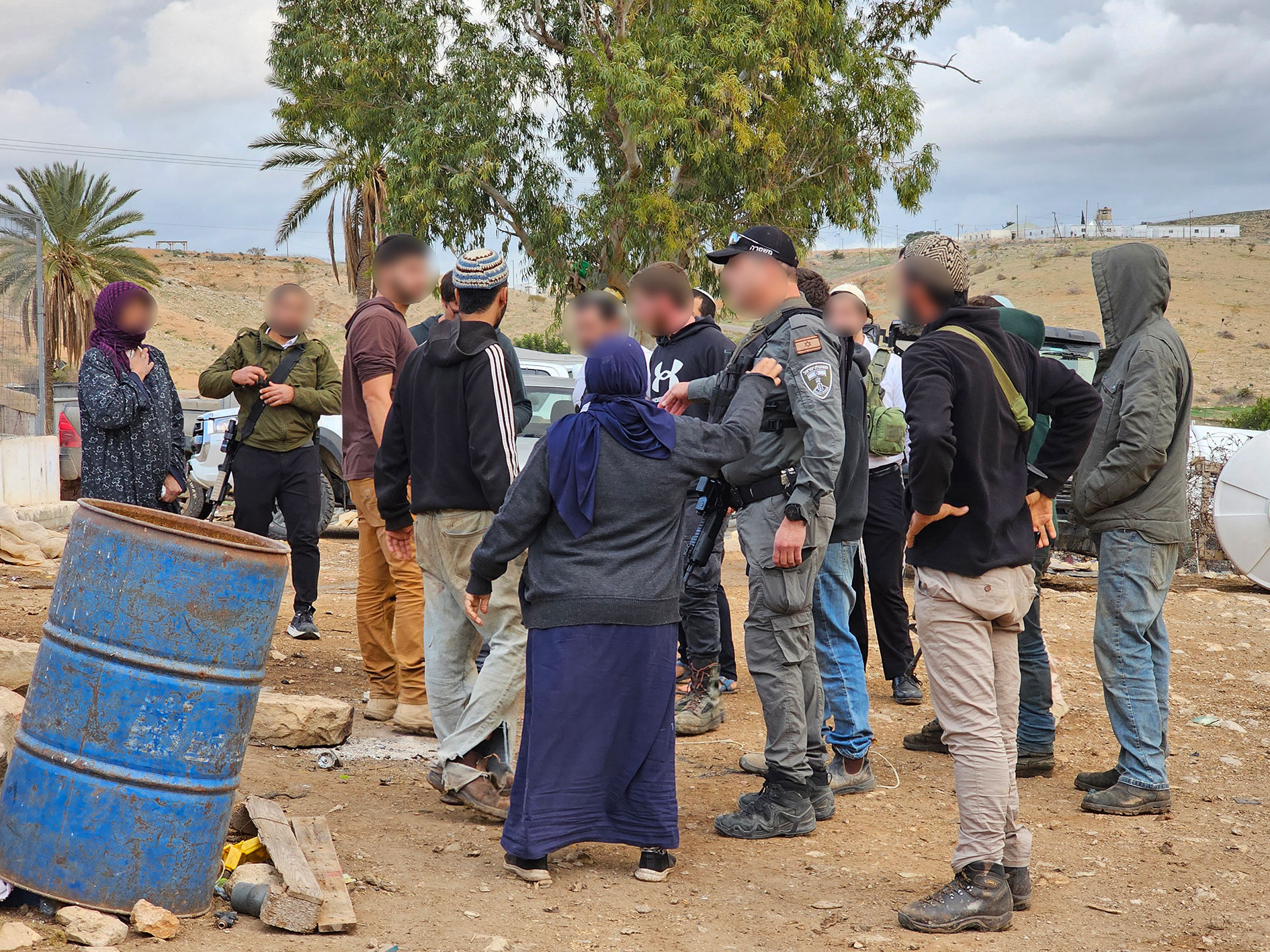 Sarah PostecDec-27-2026Hammam al-Malih: Border Guard and settlers in the compound
-