
Life is blocked in the West Bank
Ibrahim left his home with his 4-year-old son to visit the family doctor who lives in the neighboring village of al-Mughayir, just 4 km from his home in Duma. When he reached the road out of the village, he found soldiers who had blocked the village. They did not open the roadblock until noon. No one could leave or enter. Not even to see the doctor. He returned home with his sick son. When the army finally removed the roadblock, Ibrahim and his son set out again for al-Mughayir. This time it only took 5 minutes, but now al-Mughayir was blocked with a gate, and it was impossible to reach it via the main road. Ibrahim had to drive all the way to Za’atara Junction (Tapuah), turn left onto Highway 60, head south to Turmus Ayya, and from there reach al-Mughayir. In total: about 70 km. And all of this by taxi, because Ibrahim has no car of his own.
This is not a one-time event but an example of how life in the West Bank has been since October 7.
Let us recall: Palestinians had no connection whatsoever to Hamas’s brutal attack on the Israeli border communities, yet they have been paying an extremely high price ever since—in the denial of their freedom and their ability to earn a living with dignity. Not only are tens of thousands of workers banned from working in Israel, but in every village and town a gate has been placed, preventing them from entering or leaving their community. In some villages, the gate opens and closes intermittently, but in most villages it remains permanently shut.
Some examples:
The main gate to Nablus on the highway, which cost taxpayers millions and bypasses Hawara, has been closed for two years now. Everyone entering or leaving the big city must squeeze through Awarta, a tiny village southeast of Nablus.
Qusra and al-Mughayir – their gates have been locked since October 7 and never opened. How do residents live in such conditions? About a year ago we saw how a doctor and two nurses arrived by taxi to the locked gate to give vaccinations to village children. The council head waited for them on the other side with a car to take them into the village, which is quite far from the gate—not a walking distance. On another day, I saw an elderly woman carrying a six-pack of water bottles on her head as she walked across the checkpoint. A relative waited for her with a car on the other side.
One can drive a very long and winding route through the village of Jurish to leave, but even here there is a problem: the army destroyed the last kilometer leading to the main road, leaving it bumpy and difficult to drive (and it ruins the car).
Another way to prevent movement is the full or partial destruction of roads.
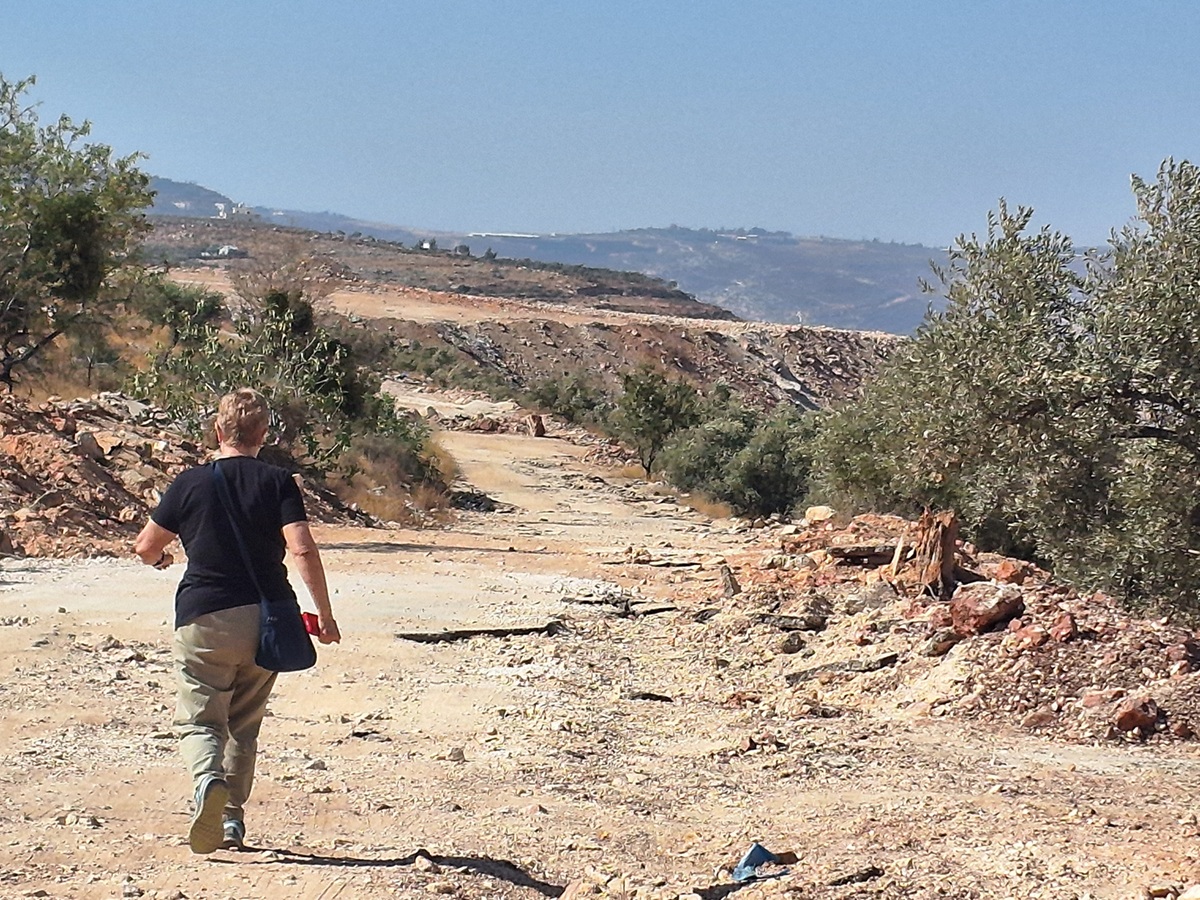
Another example, Aqraba and Majdal Bani Fadil are just 2 km apart. Aqraba is a town with services that no nearby villages have, so the road to it is vital. The army completely destroyed the road from Majdal Bani Fadil and, to be sure, piled up rocks so that there was no way to travel between the two places (see photo). What does this mean? Majdal, a small village, has no shops. To buy milk, residents must go out to the main road, drive west, and loop back on an internal road to Aqraba. Instead of 2 km—it becomes 8 km. This is no longer a walkable distance. And if that weren’t enough, from time to time, suddenly, the army also closes the entrance gate to Aqraba. Then people must travel via Beita, through Za’atara (Tapuah) and Highway 60—about 30 km.
This is daily life, every single day. People struggle to reach work, shops, doctors. Social and family ties unravel due to the inability to meet regularly, tearing apart the fabric of human society.
And above all: the checkpoints. Those that had been eased in the past decade are now back, operating in the harshest way:
For example, in the Jordan Valley, two checkpoints prevent any connection between the Valley (where residents barely have services) and their lives in the West Bank.
The Tayasir checkpoint is closed almost all the time. Doctors cannot enter, so the regional clinic is mostly shut, leaving the entire area without medical care.
Teachers cannot reach the only school in the northern Jordan Valley. Children there have already been told that classes will, inshallah, take place only three days a week.
The second checkpoint, near Hamra, opens and closes arbitrarily. An hour open, two hours closed. Two weeks ago, we passed through the checkpoint and counted 62 cars waiting three hours in 40-degree heat just to cross from the West Bank into the Valley.
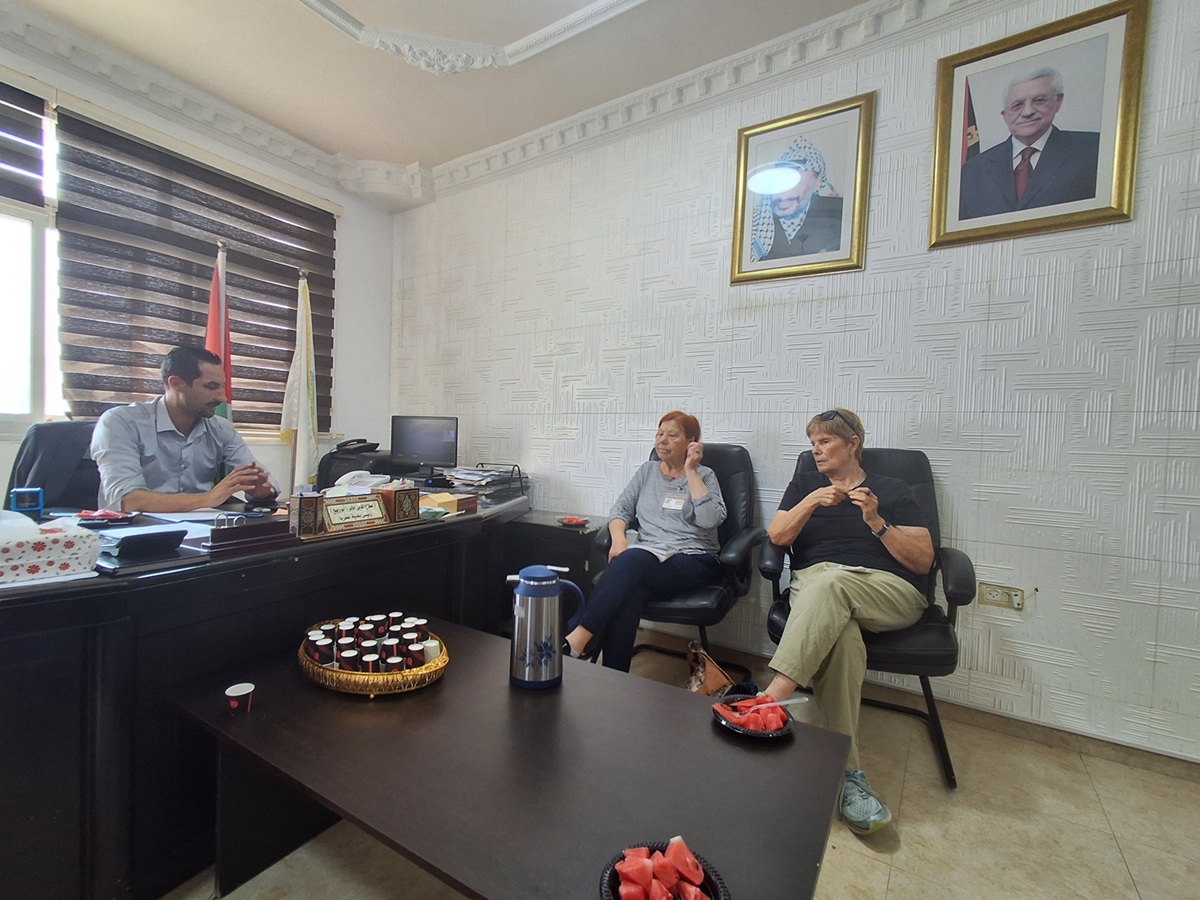
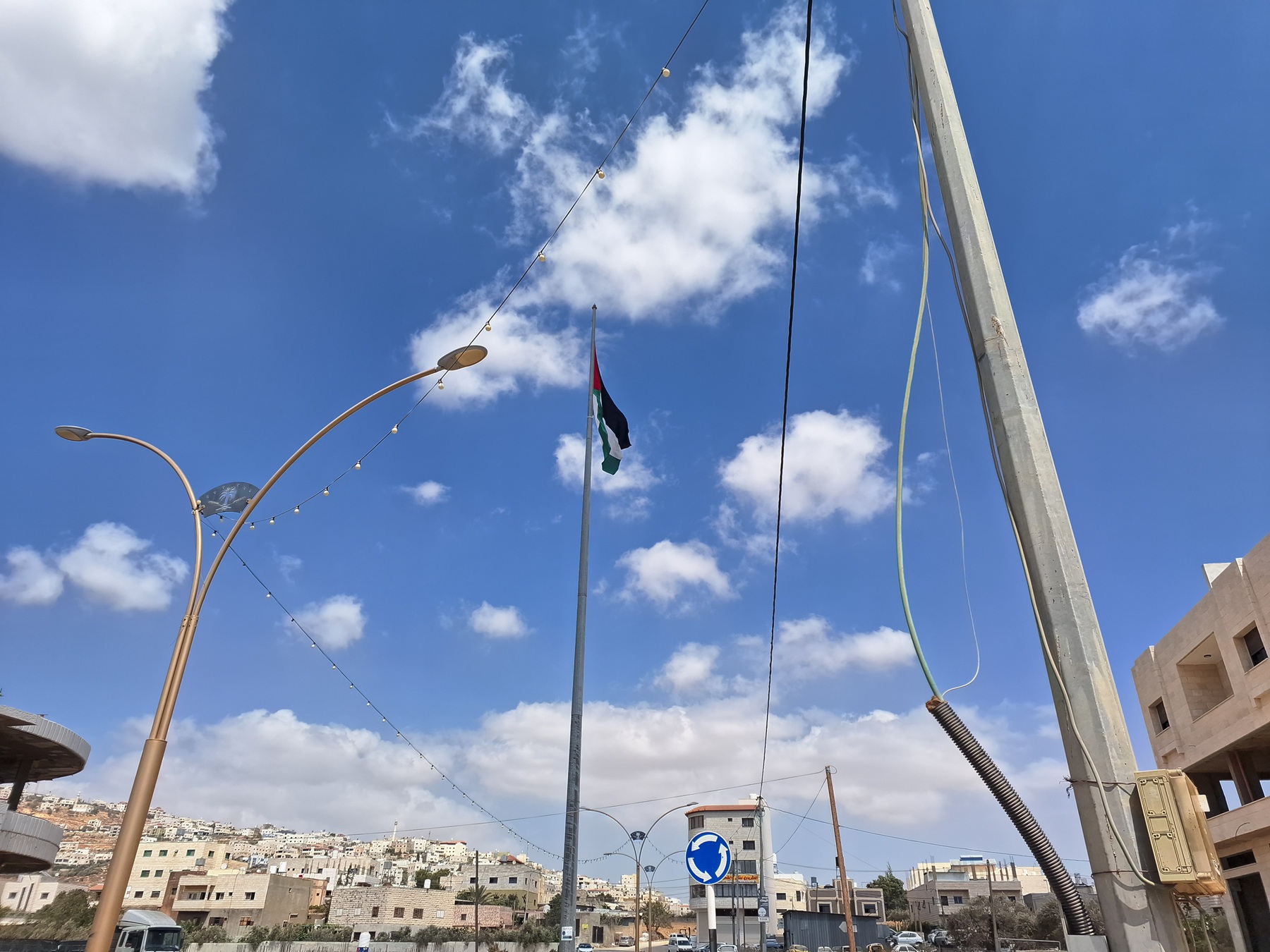
We met with the mayor of Aqraba, who told us the story of the flag. Everyone driving along Highway 505 sees a giant Palestinian flag flying above the houses of Aqraba. Naturally, the flag was an eyesore to the hilltop gangs, who themselves planted thousands of Israeli flags all over the West Bank. Two weeks ago, they arrived with army accompaniment (or settlers in uniform—it’s impossible to tell anymore, and in truth it makes no difference). All of them armed, they ordered the mayor to remove the flag. The mayor, backed by residents, refused. The army threatened to shoot them if they didn’t remove it. They stood their ground. The flag still flies proudly. One can understand the need of a people fighting for their identity and freedom to hold onto national symbols, and the occupier’s urge to plant flags everywhere, like a dog marking territory. I loathe it.
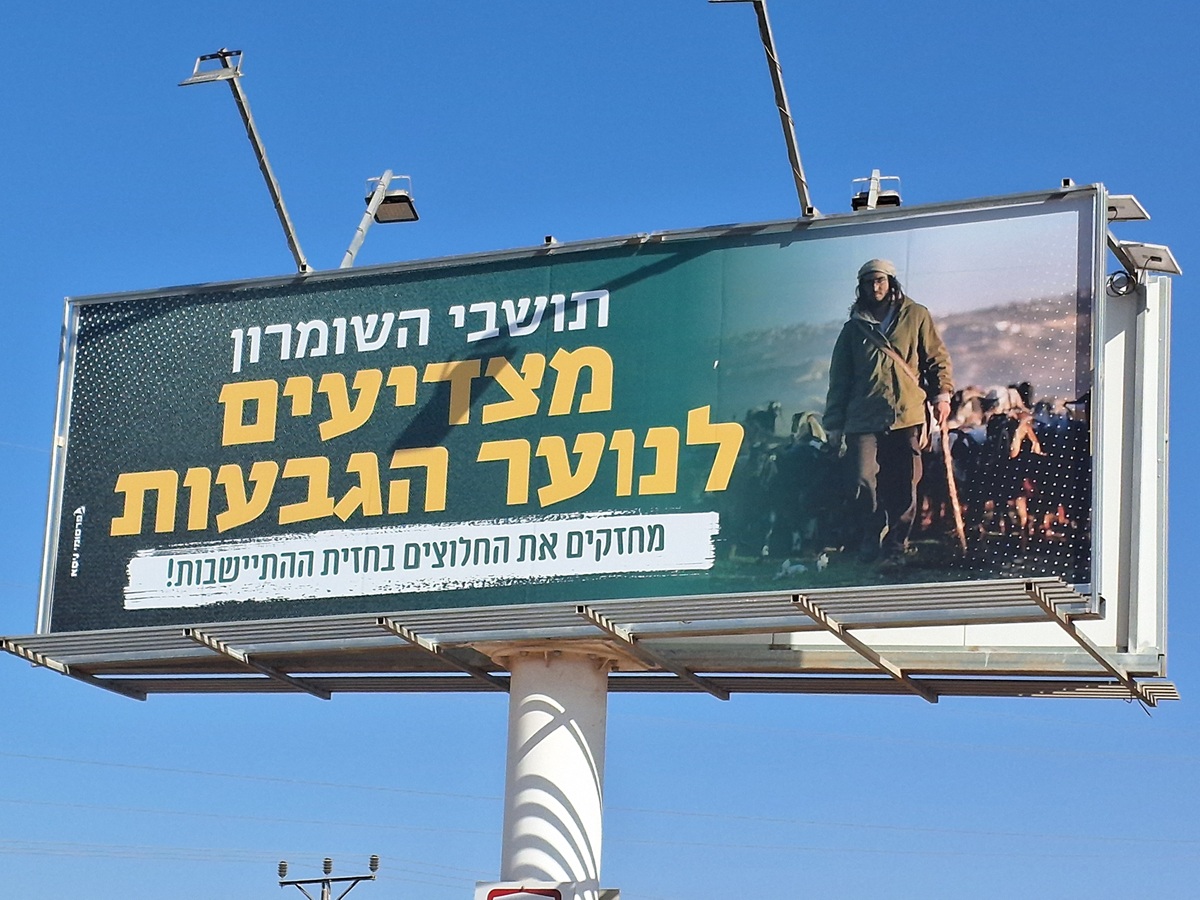
He also told us about new outposts recently established: one between Aqraba and the main road (the oldest of the three), another across the road near Jurish, and a third to the east, near the entrance to Majdal Bani Fadil. All sit atop hilltops overlooking the entire area, and all are violent. A few days ago, Jewish extremists from one of these outposts attacked a group of young men on the edge of town. One youth was killed and three injured.
We then visited the head of Duma’s council—he received us at his home since the offices were already closed. For years Duma has suffered settler violence. About 10 years ago, the Dawabshe family was burned alive in their sleep. A year and a half ago, settlers tried to burn a two-story house while the terrified family hid upstairs as the ground floor burned. On that occasion, dozens of cars were also torched.
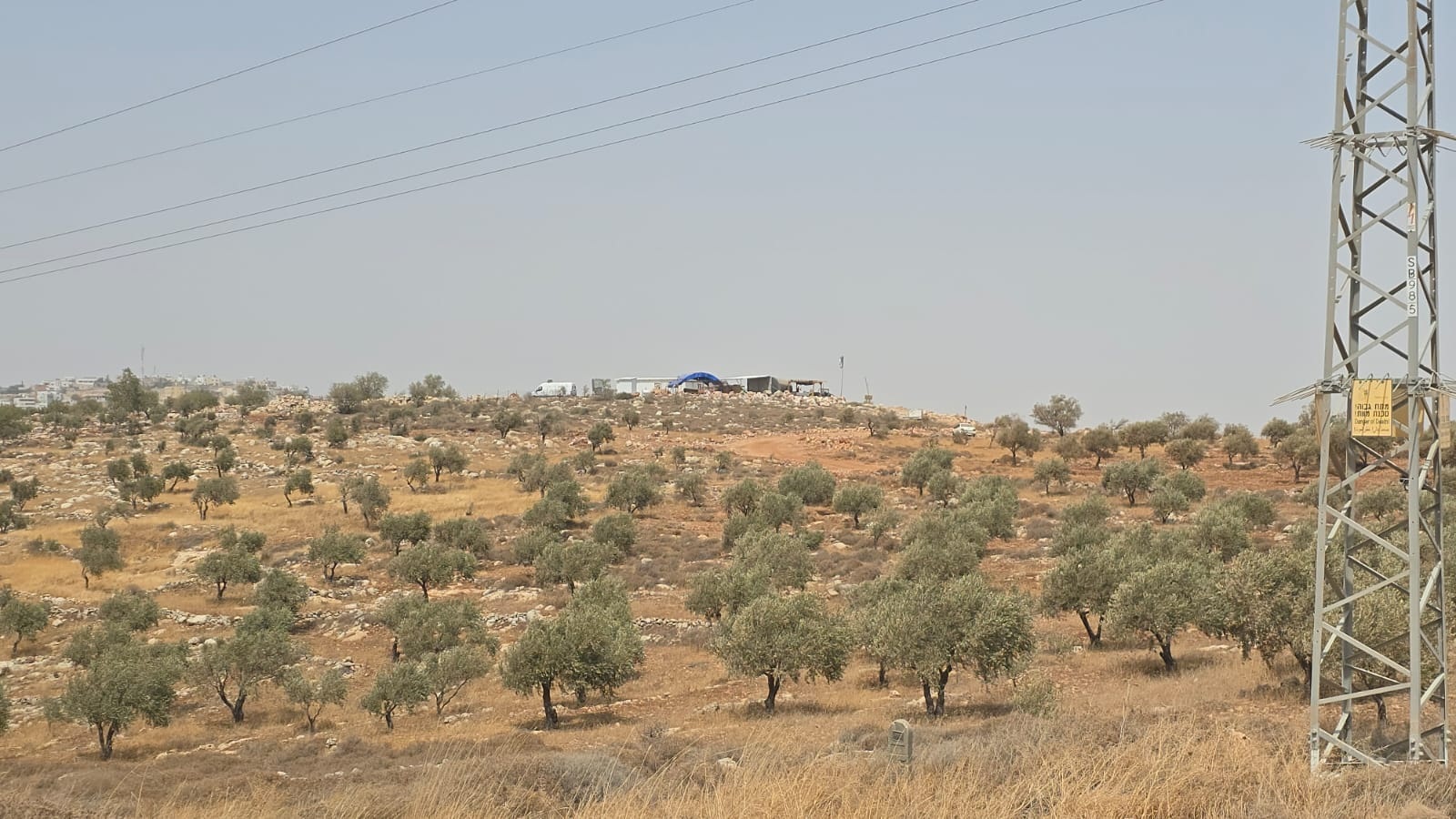
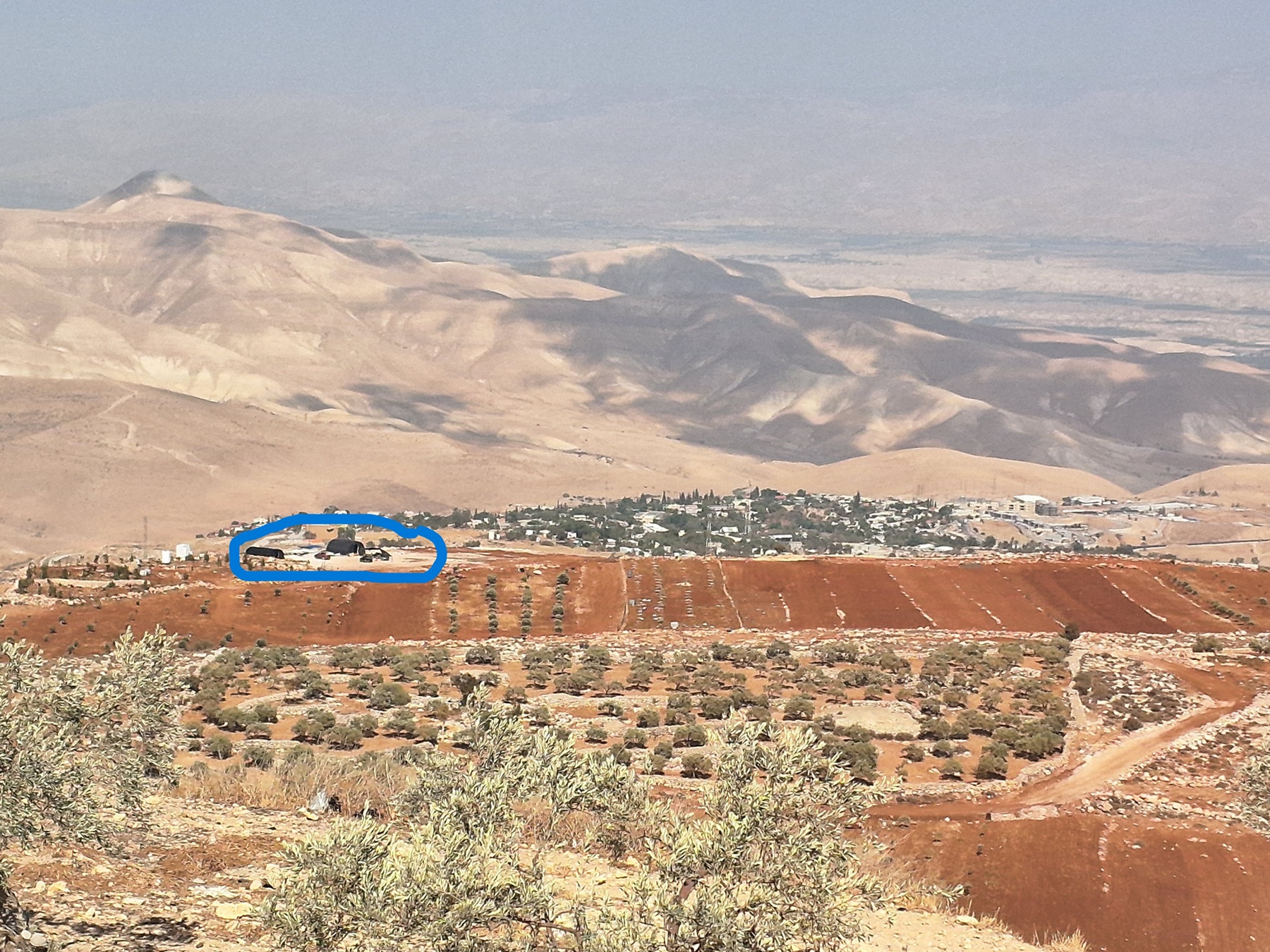
Two years ago, Duma absorbed residents from Ein Rashash, who had been expelled from their village by settlers from “Malachei HaShalom.” Now their situation has worsened further. To the north, a new outpost was built a month ago, in the middle of a private olive grove belonging to a Duma resident. Ten days ago, another outpost was established northeast of the village. These days, a road is being cut around the village, connecting the outposts to their “parent” settlement, Malachei HaShalom. In effect, the settlement completely encircles the village, cutting its residents off from their plowed lands and olive groves. As usual, the criminals enter the village with their ATVs, terrorizing the residents.
In a few days, school is supposed to start, and parents fear sending their children to school, afraid that settlers will harm them. The council head reports that settlers or the army (recently it’s entirely unclear who is who) have blocked access to most of his farmland and orchards. How is he supposed to make a living? This morning, the exit from the village to the main road was blocked by the army.
Location Description
Duma
See all reports for this place-
Duma
A village in the Nablus governorate, with 3,000 residents. They owned some 18,000 dunams, 500 dunams of which the village itself was built. However, after the settlement of Migdaleim annexed a large part of their land, their area was reduced to only 2,000 dunams.On July 31, 2015, two houses in the town were torched with petrol bombs. Sa'ad and Riham Dawabsha, and their infant, Ali Sa'ad Dawabsha, were burned to death. Another son was seriously injured. "Revenge" and "King Messiah" were spray painted on the walls of the house. The trial of the arsonist, the settler Amiram Ben Uliel, is still underway (2019), and a plea bargain was signed in May 2018 with the minor who participated in the planning of the arson.
The closure imposed by the army, the poor roads that they are forced use due to the lack of paving permits from the Civil Administration, along with the lack of public transportation, all these difficulties cut off the village from nearby Nablus and Ramallah.
-
Qusra
See all reports for this place-
Qusra
This village is located in the Nablus district, about 28 kilometers south-east of the city. Its population numbers 4,310 as of 2007 (according to the Palestinian census). After the Oslo Accords, 50% - most of the village’s built-up area – was categorized Area B, and about 70 homes as well as the rest of its land are inside Area C.
In 1983, 177 dunams of the village lands were confiscated by Israel to build a ‘Nahal’ stronghold, turned civilian in 1985 and named Migdalim settler-colony, east of the village itself. To the north-east is a gas station and a leather plant, as well as a studio producing wood ware, all of which are a branch of the settler-colony. Dozens of additional farmland were confiscated from Qussra and Jaloud in order to erect the settler-colonies Esh Qodesh and Ahiya.
“The villagers point to the settler-colonists of Esh Qodesh as the source of their problem. Qussra villagers were forbidden to tend their lands located a kilometer away from the Esh Qodesh fence, and about 20 meters from the area declared military zone. What about the ‘legitimate’ plots? Their crops are regularly destroyed by the settler-colonists. Fires break out in wheat fields, olive trees are cut down, wells are destroyed – these have all become routine events. In spite of all of this, the head of the local council sees the Israeli army as the main source. He says that the settler-colonists could not have harassed the villagers without the army backing them up…”
(From a MW report, August 3, 2015)
In 2001, the Israeli army evacuated its intelligence base “Kida”. In 2003, the settler outpost Kida was established, a quick attempt was made to evict the newcomers, but they were eventually allowed to remain.
For further information: http://vprofile.arij.org/nablus/pdfs/vprofile/Qusra_vp_en.pdf
-