
Nabi Samwil: A Visit Following the Declaration of a “Seam Area” in Northern Jerusalem
In early September 2025, an area in north Jerusalem — 15 square kilometers stretching between Ramot and Givat Ze’ev — was declared a Seam Area. The area includes the villages Beit Iksa, Nabi Samwil and Khallayleh. It borders the Bir Nabala enclave, which was separated from the Jerusalem periphery in 2006, and the Bidu enclave, (which includes seven villages).
The checkpoint that controls Palestinian movement in the area is the al-Jib checkpoint, located at the exit from the Bir Nabala enclave, opposite Givat Ze’ev and the village of al-Khalayleh. Until this new declaration, only those listed at the checkpoint could pass through it to and from the West Bank.
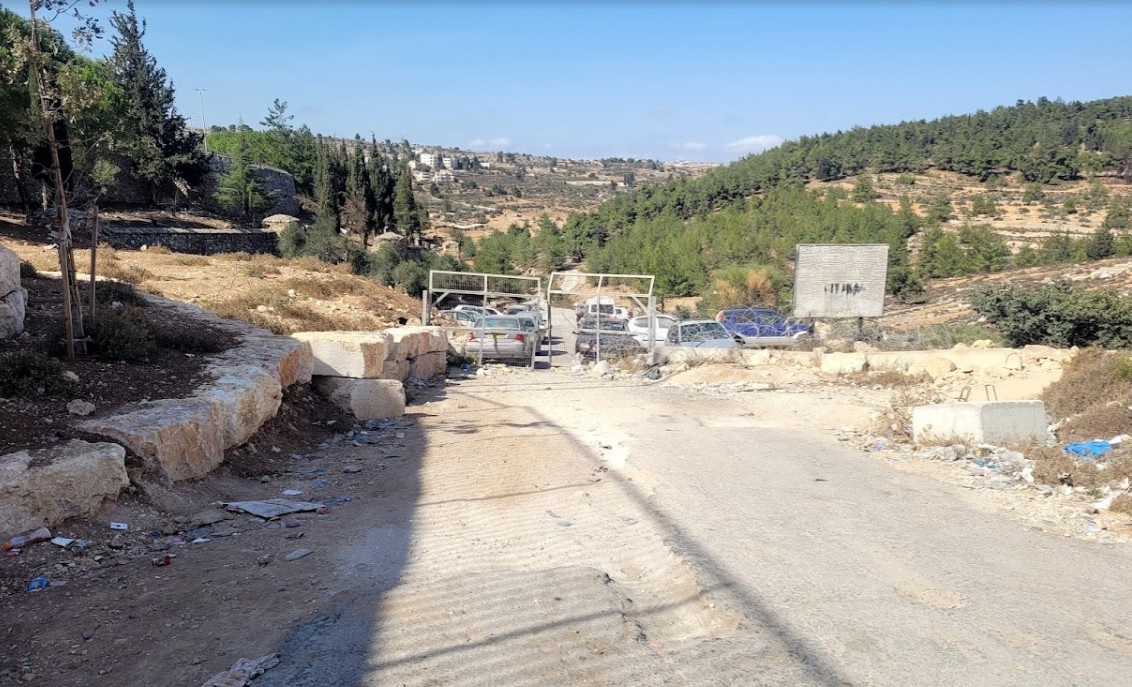
We toured the area and several familiar checkpoints — Har Samual checkpoint, Bidu checkpoint, Beit Iksa checkpoint — all of which suddenly assumed a new, ambiguous status, lacking a separation wall, yet carrying an air of de facto annexation. Our main purpose was to visit our acquaintances in the village of Nabi Samwil: Eid Barkhat and Hana, the wife of his brother Amar.

We came in order to learn what had changed in their lives following the granting of the special status of “new resident of the Seam Area.” They began by saying that the legal situation is still unclear and nobody has explained what it entails. They were told the new regulations would come into effect only in a month — on November 9. But as the wise Eid says:
“Since ’67 until today there hasn’t been a single day that was better than the previous one. It’s always harder. They’re always trying to make our lives here more difficult.”
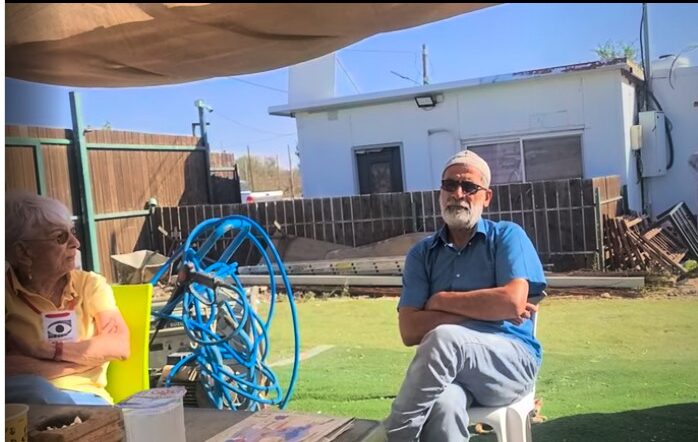
They discovered immediately that all the names of Nabi Samwil residents had been deleted from the crossing lists at the al-Jib checkpoint. As a result, residents can no longer enter from the West Bank — including from nearby Bir Nabala — to return to their village. Hana, who holds a blue ID card and Israeli citizenship, returned to her home yesterday by a long and expensive route — a taxi took her from the Bir Nabala enclave along the “Lower Fabric-of-Life Road” (a road leading to the Bidu enclave), and from there she walked on foot through two internal checkpoints up a grueling ascent.
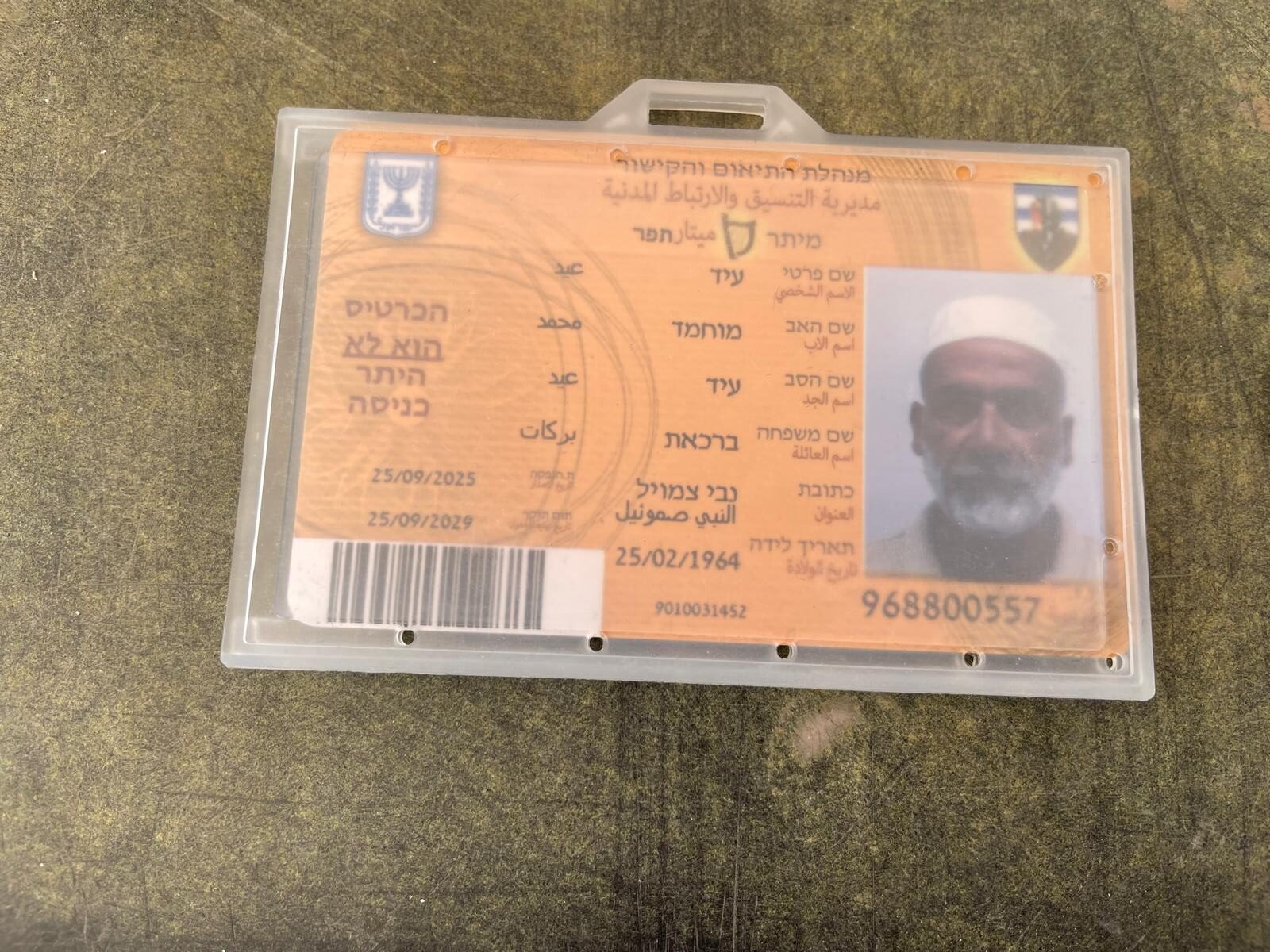
Eid received a new yellow magnetic card — “New Resident in the Seam Area” — different from all the familiar magnetic cards. Nobody understands the significance of the different color or the definition “new resident.” He, his family and the other residents are inhabitants of an ancient village.
Hana and Amar, whose home was demolished in December 2024, remain uncertain about their future. The Civil Administration informed them after the demolition that they have no address in Nabi Samwil, and therefore their status is unclear. It has also come to light that their complaint to the Police Internal Investigations Department (Machash) was recently deleted — although the demolition was carried out without a warrant and with considerable violence, and included the theft of large sums of money and personal belongings.
Their two children, who hold blue ID cards and work in Israel, also cannot pass through the al-Jib checkpoint now. They live with their parents inside a storage room in squalid conditions. The family cannot live together anywhere because there is no family reunification — Amar cannot reside in Israel, while Hana and their Israeli children (one of whom served in the Air Force) cannot live in the Palestinian territories.
They said that many residents who were born and raised in the old village left Nabi Samwil because of the hardships of isolation, demolitions and attacks by yeshiva students from the Tomb of the Prophet Samuel. Most moved to live in the Bir Nabala enclave, but kept their home address in the village. Some of them, who will not be included in the village residents’ registry, will no longer be eligible to enter it.
Eid still owns 15 dunams of land from what was once a much larger family holding, most of which was confiscated to build surrounding settlements. He fenced the remaining plot and planned to open a nursery there, but never received the required permit.
We asked if he still cultivates the plot, and he replied that Har Samuel settlers destroy everything he installs and plants. “Under these circumstances”, he said, “there’s no point in trying anymore.”
We could not reassure them: if their fate follows that of other Palestinians living in other Seam Areas in the West Bank, family members and friends from the West Bank will not be able to visit them at home and they will not be able to enter Israel. The Seam Area is not defined as belonging to the West Bank or to Israel, but in practice it is an in-between area de facto annexed to Israel according to the formula of the Israeli occupation: the land is ours, and the expectation –- actively enforced — is that the Palestinians will disappear from it.
Location Description
Al-Jib CP Givat Zeev (Jerusalem)
See all reports for this place-
Al-Jib CP GivatZeev (Jerusalem)
It is located on the separation fence, west of the al-Jib enclave. The checkpoint is regularly manned by Border Police and private security companies. Palestinians are not allowed to cross except for residents of the al-Khalaila neighborhood of the village of al-Jib, residents of al-Jib who own land on the western side of the fence, residents of a-Nabi Samuel, which is their only access road to Ramallah and the villages in northwest Jerusalem, as well as Palestinians with work permits in the Givat Zeev settlement and UN workers passing through UN vehicles.
(Updated January 2020)
-
Beit Iksa
See all reports for this place-
Beit Iksa is a village in Area C on the border of the Ramot neighborhood, to which access is blocked from both Israel and the surrounding villages, as in his hand, Beit Ijaza. The Beit Iksa Ramot checkpoint is located down the internal road that connected Road 436 to the Iksa House. Only local residents and their verified guests can enter the Iksa House.
-
Nabi Samwil
See all reports for this place-
Nabi Samwil - a village literally placed in a transparent cage.
This Palestinian village is 800 years old. It is located on top of a hill, its altitude 890 meters above sea level, and overlooks the entire area. According to Jewish, Christian, and Muslim traditions, the Prophet Samuel was buried here. In recent years the mosque has been turned into a popular Jewish prayer site. Jews use the basement for prayer, and Muslims the upper part of the mosque. New signs are placed here, containing verses from the Jewish scriptures and mention of exclusively Israeli historical times. The nearby spring has become a popular site of ritual bathing. On Iyar 28th, every year, a mass-celebration is held in memory of the Prophet Samuel.
Until 1967 this was a well-off village that developed around the mosque, with a population of 1,000 owning thousands of dunams of farmland. In 1967 most of the villagers fled, and only 250 remained. In 1971 Israel expelled them, and until the 1990s completely razed its houses that were sitting on a Crusader and Hellenist archeological stratum, without any kind of compensation for the expelled inhabitants. Parts of the village lands are at present used for the settler-colony of Har Shmuel, another part has been declared a national park. Villagers have tried to restore their lives on their remaining lands, a short distance from their original homes, in an area that formerly held structures to house the village’s livestock.
Then the Separation Fence was erected in the West Bank, the village remained an enclave caught between the Green Line and the Fence, and its inhabitants were torn away from other West Bank villages. Any exit to the West Bank requires crossing the distant Jib checkpoint, with a permit. The movement to Israel inside the Green Line is forbidden as well. In 1995 the entire village area was declared a national park – not only around the mosque and antiquities around it which take up about 30 dunams, but an area of no less than 3,500 dunams including the new village and all of its land. Any additional construction is forbidden: any room, caravan, fence, a newly planted tree. Work permits are issued sparingly. There is a tiny school made up of several caravans.
Watch the movie by Eran Turbiner and MachsomWatch: NABI SAMWIL 1099-2099, a film by Eran Torbiner
-