
Northern checkpoints: loopholes in fences and unlocked gates
15:30-17:00
After a long break (Covid-19 pandemic and the violence in the streets of Umm Al Fahm) we visited once more the agricultural checkpoint Tayibe-Roumana (154) below this Arab city.
The steep downhill road to the checkpoint is still filled with obstacles such as branches, pipes, stones, all radiating animosity and power-play. A few months ago we were familiarized with a local ‘militia’, youngsters who blocked this way for work-seekers from the West Bank through this area to Umm Al Fahm specifically, and into Israel in general. These youngsters do not want West Bank Palestinians to pass by their homes and even dare to sleep here overnight, but still demand passage fees (50 shekels) which they pocket. There was a smell of violence in the air which we wished to avoid until today. Their activity appears to take place in the morning hours, so today we came in the afternoon and may have missed it.
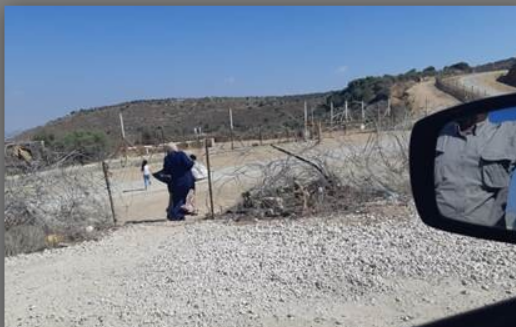
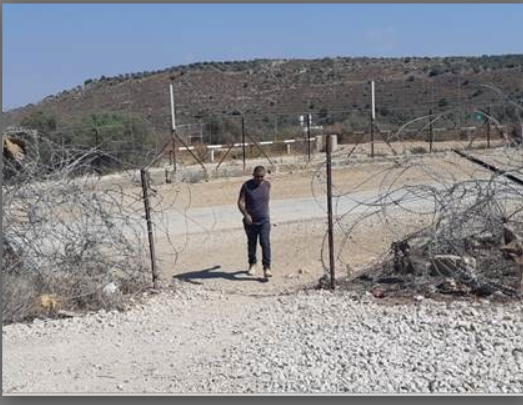
What we did see at the checkpoint: 2 farmers on tractors waiting for the checkpoint to open so they could get back home. One is from Tayibe village, the other from Roumana. Old acquaintances of ours. The soldiers were late as always, over half an hour. During that time about 15 people (including a woman and a girl) had no problem arriving and running across the opening near the checkpoint gate, and from there through a small opening in the Separation Fence, and from there through the half-open checkpoint gate and home. All this happened before the soldiers arrived. But it was clear to everyone, as well as to the Israeli army, that people cross here at all hours of the day and night. And still the soldiers arrive twice a day because tractors cannot deal with these openings. So order is kept…
Finally, the Military Police arrive – two men- and two women-soldiers. Long sleeves in this heat, bullet-proof vests, helmets – the works – and began organizing the crossing of the two Palestinian farmers on their tractors. The women-soldiers went to open the gate but apparently had no key. One of the men-soldiers went back to the vehicle, to get the key? But no, the women shook the chain a bit and the gate proved not to be locked at all. One of the farmers said this to them in English but they did not understand him. So everyone went through. Where is Chanoch Levin when we need him? (Deceased Israeli highly popular and critical playwright).
We hurried on to Anin Checkpoint (214) to witness a similar version of crossing an agricultural checkpoint with a locked gate and a huge opening at its side. One’s mind simply cannot grasp this idiocy. We missed it. The army came first.
At Toura-Shaked checkpoint, often deserted and filthy, our eye caught a new yellow chain wrapped around one of the gates. How thrilling…
At Barta’a checkpoint we crossed the large car-park in our car and discovered all the Palestinians who choose to cross not holes in the fence but a real checkpoint as befits the rules of occupation.
At East Barta’a junction there was no longer any activity past 5 PM.
On our way home we crossed the town of Est Barta’a’s main street, a huge colorful market filled with cheap and superfluous wares, and didn’t see too many customers. Too hot…
The age of the Absurd.
'Anin checkpoint (214)
See all reports for this place-
'Anin checkpoint (214)
'Anin checkpoint is located on the Separation Fence east of the Israeli community Mei Ami and close to the village of Anin in the West Bank. It is opened twice a week, morning and afternoon, on days with shorter light time, for Anin farmers whose olive groves have been separated from the village by the fence it became difficult to cultivate their land. Transit permits are only issued to those who can produce ownership documents for their caged-in land, and sometimes only to the head of the family or his widow, eldest son, and children. Sometimes the inheritors lose their right to tend to the family’s land. The permits are eked out and are re-issued only with difficulty. 55-year-old persons may cross the checkpoint (into Israel) without special permits. During the olive harvest season (about one month around October) the checkpoint is open daily and more transit permits are issued. Names of persons eligible to cross are held in the soldiers’ computers. In July 2007, a sweeping instruction was issued, stating that whoever does not return to the village through this checkpoint in the afternoon will be stripped of his transit permit when he shows up there next time. Since 2019, the checkpoint has not been allways locked with the seam-line zone gate (1 of 3 gates), and the fence around it has been broken in several sites.
-
East Barta'a Junction
See all reports for this place-
East Barta'a Junction
The main station at the eastern Barta'a junction (Roads 611/6115).
A junction without special activities became about April 2020 a bustling center of transportation to workplaces in Israel, following the free passage through loopholes in the nearby separation fence.
Palestinian workers from all over the West Bank gather here every morning, without transit permits and often without masks. The army is turning a blind eye and the occupation is losing control.
There is also no shortage of coffee and pastry stalls.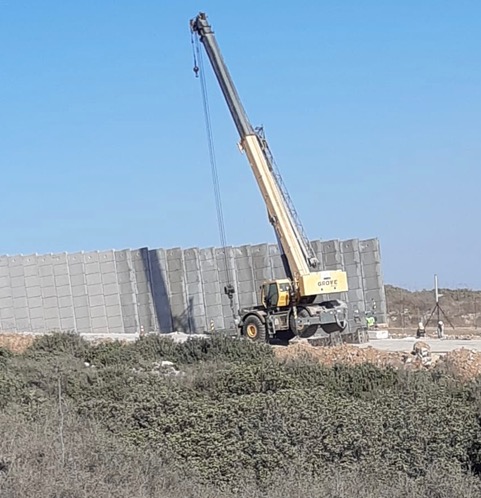 Hagar DrorSep-26-2023Barta'a: rapid construction of the separation fence
-
Tayba-Rummana
See all reports for this place-
Tayba-Rummana is an agricultural checkpoint. It is located in the separation fence in front of the eastern slopes of the Israeli city of Umm al-Fahm. The Palestinian villages next to the checkpoint are Khirbet Tayba and Rummana. Dozens of dunams of olive groves were removed from their owners, the residents of these villages on the western side of the separation fence. The Palestinian villages next to the checkpoint are Khirbet Tayba and Rumna. Dozens of olives dunams were removed from these villages' residents and swallowed up in a narrow strip of space, on the western side of the separation fence. The checkpoint allows the plantation owners who have permits to pass. Twice a week, the checkpoint opens for fifteen minutes in the morning and evening. During the harvest season, it opens every day for fifteen minutes in the morning (around 0630) and fifteen minutes in the afternoon (around 1530). (February 2020).
-
Tura-Shaked
See all reports for this place-
Tura-Shaked
This is a fabric of life* checkpoint through which pedestrians, cabs and private cars (since 2008) pass to and from the West Bank and the Seam-line Zone to and from the industrical zone near the settler-colony Shaked, schools and kindergartens, and Jenin university campuses. The checkpoint is located between Tura village inside the West Bank and the village of Dahar Al Malah inside the enclave of the Seam-line Zone. It is opened twice a day, between 7 a.m. and 10 a.m., and from 12 noon to 7 p.m. People crossing it (at times even kindergarten children) are inspected in a bungalow with a magnometer. Names of those allowed to cross it appear in a list held by the soldiers. Usually traffic here is scant.
- fabric of life roads and checkpoints, as defined by the Terminals Authority in the Ministry of Defense (fabric of life is a laundered name that does not actually describe any kind of humanitarian purpose) are intended for Palestinians only. These roads and checkpoints have been built on lands appropriated from their Palestinian owners, including tunnels, bypass roads, and tracks passing under bridges. Thus traffic can flow between the West Bank and its separated parts that are not in any kind of territorial contiguity with it. Mostly there are no permanent checkpoint on these roads but rather ‘flying’ checkpoints, check-posts or surprise barriers. At Toura, a small (less than one dunam) and sleepy checkpoint has been established, which has filled up with the years with nearly .every means of supervision and surveillance that the Israeli military occupation has produced. (February 2020)
 Mar-21-2022Anin Checkpoint: A magnificent breach in the center of the checkpoint
-