
Plowing in Farsiya that went without interference from settlers


We arrived at Farsia in the morning. Our task was to escort T. while he plowed his land near the settlement of Maskiot. Until recently T., his brother, and their families had been living at a tent site near the road. T. surrounded their tent site with tires so that the settlers will not come and urinate near their tents. The settlers did not relent, and Uri from the outpost of Um Zuka arrived with a rifle and youths came with clubs. They threatened the Palestinians that if they did not leave they would burn the place. According to T., Uri beat him bloody with the butt of his rifle. T. called the police, who came and arrested him and his brother for no reason and took them to be interrogated at Mateh Binyamin hear Jerusalem. They were released that night and escorts collected them and took them back to their tent site. While they were being held another settler named Oz from Maskiot arrived who serves in the Jordan Valley in the integrated police force. Oz also demanded that they leave. HE went as far as to return to the place several times to ensure that they left. T. and his brother had no choice but to move to another place near Tubas, where the pasture is very sparse.
T. did not give up and insisted on planting his land. The land is registered in his name and the day we arrived he returned to plant barley so that he would be able to feed his sheep in the spring.
It was a sunny winter day and it seemed to us that the plowing would proceed without interference. Two settlers passed in the area driving an ATV, stopped, and returned on the path leading to the settlement on the other side of the hill.
The Palestinians have a different method of plowing than we do. First they scatter the barley seeds by hand or by using a rotating container attached to a tractor. Then they go over the ground with a plow attached to a tractor that turns over the ground and buries the seeds. When he had finished after about three hours T. asked us to escort him while he finished plowing in another area that belongs to him that was about 200 meters away. On the way there we were stopped by soldiers who wanted to know what we were doing there. Before they left us they warned us that it was dangerous to be in the area without an escort.
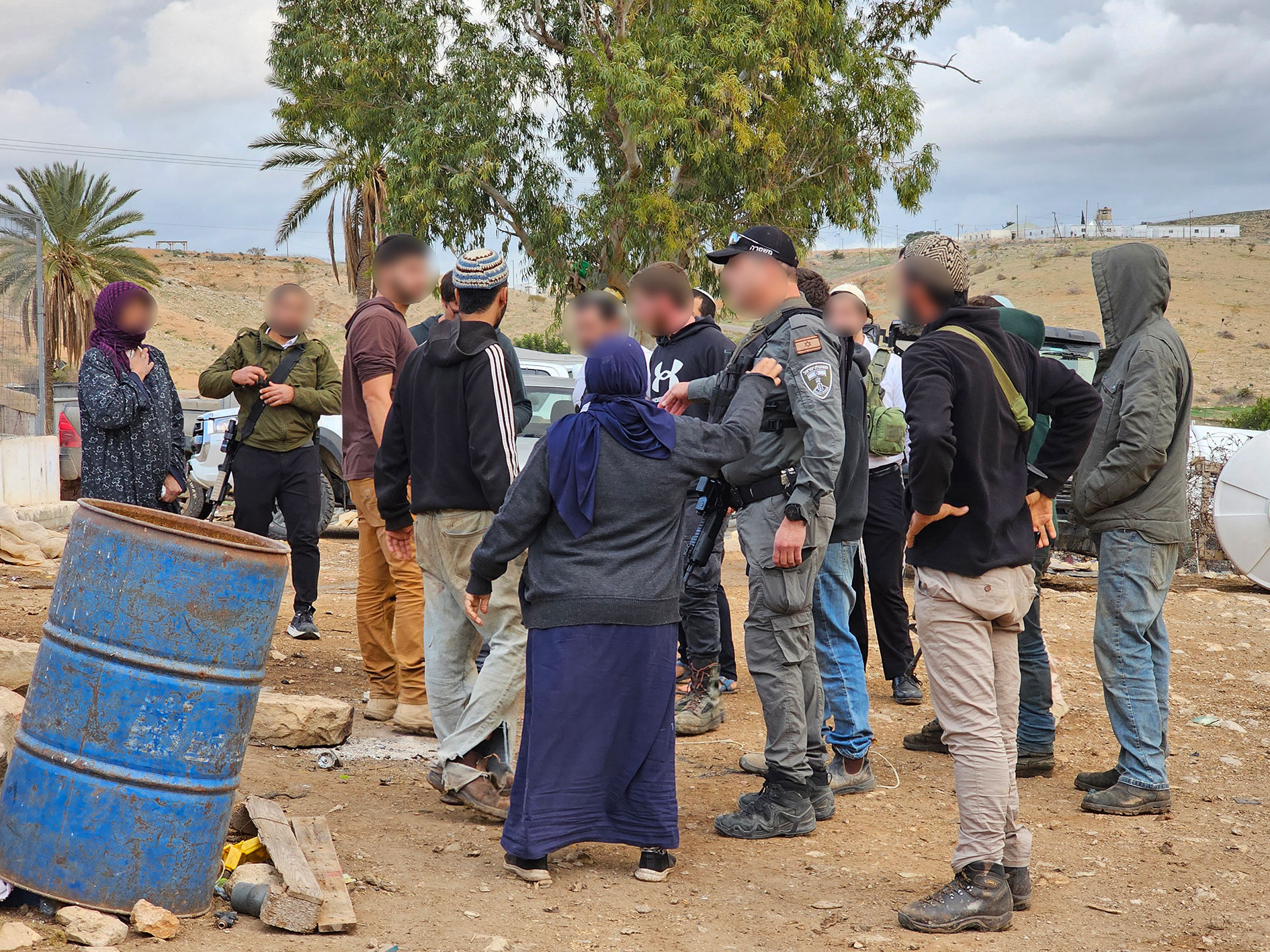
When we reached T. we were surprised when the same soldiers approached him and asked him to show a certificate of registration showing that he owned the land. The person who was their officer (named Moshe Bachar) was dressed in field uniform without any ranks and claimed that he was in charge of security in the valley. The police were called and the tractor driver was ordered to stop. Meanwhile we called the District Coordination and Liaison Office who said they had never heard of a soldier by that name. We presumed that they were reservists who were bored and disappointed that they had not been sent to Gaza, and had instead decided to guard the country and look for some challenging task to perform instead.
The community policeman in the valley arrived whose name was Arik. Orli warned him that T. had ownership of the land and has hired a tractor driver to seed and plow it. Meanwhile M. from the Palestinian Authority who was in charge showed T.’s certificate of registration. The tractor driver received the license for his tractor on his phone and the policeman put things in order and solved the problems. We heard him talking to a woman settler who claimed that the land belonged to her. She was told that since she had no papers she could not prevent the Palestinian farmer from plowing his land. He then spoke to the soldiers and sent them off to do their original tasks. He then verified the tractor driver’s identity and permitted him to continue with his job.
We stayed with him for another hour until he had finished plowing to make sure there would be no more interference. Then we went to visit the families in Farsia who offered us coffee. I spent the night there and then returned to Haifa the next morning and to Tel Aviv.
It was a day in the occupation that ended successfully. Sometimes that happens.
Al-Farisiya / 'Ein a-sakut
See all reports for this place-
Al-Farisiya / 'Ein a-sakutA community of shepherds in the Jordan Valley opposite the settlement of "Rotem". Making a living from grazing sheep, the residents are exposed to harassment, abuse and theft from settlers who come to them from outposts and settlements in the area, and their grazing area is shrinking due to settler takeovers, fire zones and declared nature reserves.Machsom Watch companies participate in shepherd escort activities and provide a 24/7 protective presence, and there is continuous and warm contact with the community.
-
Jordan Valley
See all reports for this place-
Jordan Valley The Jordan Valley is the eastern strip of the West Bank. Its area consists of almost a third of the West Bank area. About 10,000 settlers live there, about 65,000 Palestinian residents in the villages and towns. In addition, about 15,000 are scattered in small shepherd communities. These communities are living in severe distress because of two types of harassment: the military declaring some of their living areas, as fire zones, evicting them for long hours from their residence to the scorching heat of the summer and the bitter cold of the winter. The other type is abuse by rioters who cling to the grazing areas of the shepherd communities, and the declared fire areas (without being deported). The many groundwaters in the Jordan Valley belong to Mekorot and are not available to Palestinians living in the Jordan Valley. The Palestinians bring water to their needs in high-cost followers.
 Sarah PostecDec-27-2026Hammam al-Malih: Border Guard and settlers in the compound
-