
Qaddum
Asking the obvious – what are soldiers doing in the public and private space of a peaceful Palestinian village whose inhabitants want one thing only: to have opened the road that accesses their village to the main road. Is this justification enough for the army to enter the village every single week, take over private homes and fire in all directions?
We reached Qadoum at 13:00, as planned. This is when the Friday prayers at the mosque are over and people get organized for their protest demonstration. Up the road, somewhat further away from the assembly spot, people are already present. They all take care to stand close to the walls that surround the yards in order not to serve as targets for the army snipers. We understood that we could not park our vehicle at its usual place. While disembarking, we heard a boom. That was a stun grenade going off. After a few seconds – another went off. And so, every minute or two more booms were heard. It felt like a battlefield. The locals told us that the soldiers have been staked out since that morning on the roofs of houses overlooking the way to and from the mosque, and preventing people from passing safely.
We decided to reach the mosque by an alternative route. There too we met a similar sight. On the roofs children and adults looked down at the goings-on. Soldiers clad in black, armed, wearing helmets were clearly seen on a porch of the top floor of one of the houses. We stood facing the mosque, near the gate to a large, well-tended yard. Adults and children crowded near the main entrance, shaded by a pergola. Someone invited us in to sit in the shade. We smiled at the kind offer. At some other time it would be nice to a guest there. Booms resonated from all directions.
We walked down the street and stood next to a thorny field. At its edge we saw an ancient sheikh’s tomb, and next to it a stone structure. Children and adults arrived at the stone-strewn field from time to time and filled buckets with stones. They also kept moving very close to stone walls in order to avoid the snipers. There were donkeys grazing in this field. A white-haired man, introducing himself as old, nearly 70, speaking Hebrew, told us how the army harasses him in a plot of land that belongs to him. His regard of the stone-throwers is permissive. He realizes they are not useful. The donkeys around us are his own. At some moment he decided to look out for them and bring them into the stone structure. And indeed, about 5 minutes later we saw jets of teargas rising precisely in front of the field, and then a canister landing and setting the thorn field afire. Luckily, the donkeys are safe. Very quickly people arrived with a garden hose to try and quench the fire.
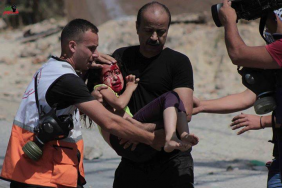
All of a sudden we heard an especially strong boom and saw people running on the parallel road. From the roof of one of the buildings overlooking the area we heard cries: “Small child!” We understood that a child was hurt. An ambulance arrived. We heard talk of shots taken at the ambulance, perhaps in order to prevent safe evacuation. Later we learned that a little girl looking out over the street from her home window was shot with a ‘rubber’ bullet and was hit in the face. Her father, commander of the Nablus Palestinian Police, was wounded as well.
The photo was taken from the Qadoum Facebook page also See link for the Palestinian television item
Qaddum
See all reports for this place-
Qaddum
The village of Qaddum dates back approximately 4,000 years. Today’s villagers mostly work in agriculture and cultivae olive groves. The hilly landscape is covered with olive trees and are dotted with patches of green fields.
Qaddum was attached to the district of Nablus until 1994 at which time it joined the Qalqiliya district. The village is home to 4,000 inhabitants (2013), with 22,000 dunams (5,400 acres) of which 11,000 dunam (2700 acres) are in Area C*. Access to Area C requires coordination with the Israeli army, which means that access is almost non-existent.
The settlement of Kedumim was founded in 1975 on lands belonging to the ancient the village of Qaddum. Since then, Kedumim has expanded to include 5 settlements. The Kedumim settlements separate Qaddum village from its lands and from access to the main road. The road connecting Qaddum village to Route 55 was closed to its residents in 2003. The short ride (1.5 km or less than a mile) between Qaddum and a neighboring village - Jit, turned into a 12 km (7.5 miles) bumpy ride on an unpaved gravely road. Since 2004, residents of the village of Qaddum have been submitting requests to the authorities to reopen the old road leading to Route 55.
On July 2011, the villagers began holding weekly demonstrations in protest of the road closure and of the theft of their lands. They march to the edge of the village and there they stop. There is a regular routine to the demonstration which always follows with a confrontation with the army when it enters the village at the end of the blocked road. The army reacts to the demonstrations with sharp weapons, rubber bullets, tear gas and lately also live ammunition. Villagers are injured and hurt each week and often, dozens are arrested by the army. Young people and children are intimidated by the army when they photos are posted in the village streets.
On 12/7/19 a 10 year old boy was criticaaly wounded after he was shot in the head by live ammunition while standing at the entrance to his home in Qaddum during a demonstration.*Area C is an administrative division of the West Bank established by the Oslo II Accords in 1995. The Palestinian Authority is responsible for medical and education services and Israel is responsible for infrastructure and administration.
-