
Qalandiiya - a winter's tale. What does it contribute to security??
-
“It was a winter’s tale, no more”
A tale about people not seen as human and procedures that inhuman people have created.
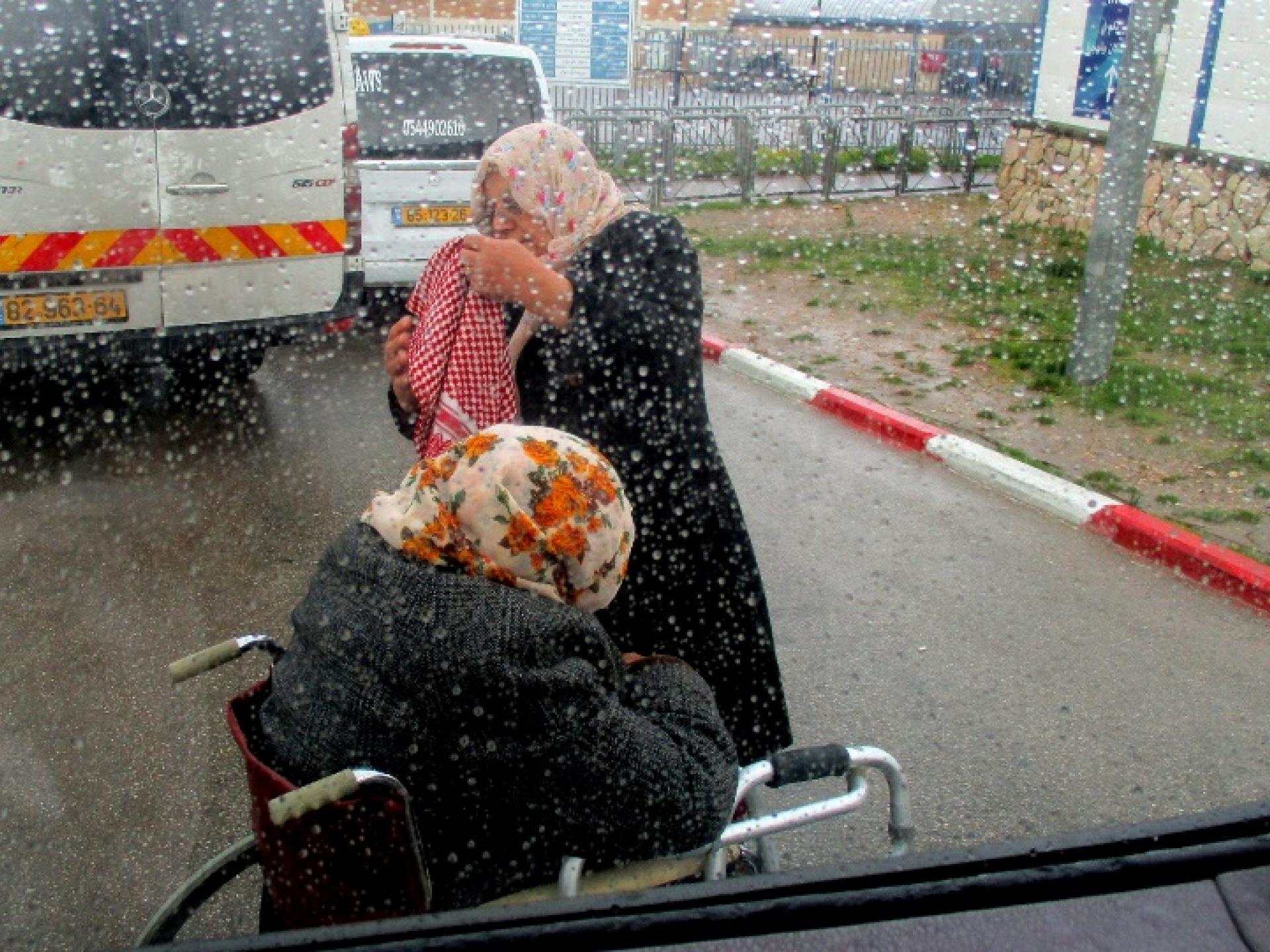
A tale of a man in a wheelchair not yet recovered from his surgery, in whose designated transport vehicle back to Gaza there was no longer sufficient room for him and his wife.
They were waiting for a taxi. Not a regular one, but one whose driver is trusted by the occupation authorities to keep a watchful eye, lest the two escape on their way home.
They were instructed to wait for it – not at the side, sheltered from the rain – but next to the transport vehicle. Why? So as not to be able to escape…
“As the rain kept falling” the woman covered her husband’s head with a kerchief she took out of her bag.
A tale about Maram who arrived at the checkpoint in a group of six patients who had been treated in Hebron, and were there to receive a permit to continue home to Gaza.23-year old Maram suffers from thyroid cancer.
She directed my attention to the woman weeping on the Palestinian side of the checkpoint, a Gazan woman whose son is hospitalized in East Jerusalem, and has requested to be permitted to his bedside and was refused. The West Bank – yes, she may enter. But not her son in his hospital bed in East Jerusalem.
Since it was already past 3 p.m. and since I saw the Gaza transport on the other side of the checkpoint ready to leave, and since I feared that they who came all the way from Hebron may not be able to continue home, I urged Maram and the others and joined them.
At the DCO she was told, as were the others, that “the transport was already gone”.
One man who collected everyone’s papers and presented them to the officer behind the glass window also heard that “the bus was gone”.
Do me a favor, he begged.
I don’t do favors, the officer replied.
The man held up his hands and moved away. Then I came to the window and said, yes – the bus was gone and it was full and there are two leaving separately so perhaps another vehicle could be summoned from the same company?
I’ll explain this to you, said the officer, and proceeded to inform me that all the way from Qalandiya to Gaza, the representative of the Gazan DCO holds responsibility for the passengers so that no one would escape and remain in Israel unlawfully. He also did not fail to add the golden phrase: “Let them come tomorrow.”
Where will they go? Where will they sleep? I asked
Wherever they came from, he replied.
A hospital is no hotel, so where?
The officer shrugged and said no more.
After an hour of standing around facing the offices, a bunch of people, confused and desperate, stood outside the checkpoint, as each and every one of them tried to improvise a place to spend the night.
Taking leave was not easy. There were many words of thanks and hugs that felt more bitter than sweet.
The patients and their accompaniers went wherever they had improvised as a solution to pass the night, until morning comes and they would return to that same office, those same windows, and wait hours until receiving permission to go home to Gaza.
I went to a place where hot tea is served, but “the night was freezing” and the vendors, old and young alike, stand there as though the rain does not strike their faces with icy arrows.
“It was a winter’s tale, no more”
Qalandiya Checkpoint / Atarot Pass (Jerusalem)
See all reports for this place-
Click here to watch a video from Qalandiya checkpoint up to mid 2019 Three kilometers south of Ramallah, in the heart of Palestinian population. Integrates into "Jerusalem Envelope" as part of Wall that separates between northern suburbs that were annexed to Jerusalem in 1967: Kafr Aqab, Semiramis and Qalandiya, and the villages of Ar-Ram and Bir Nabala, also north of Jerusalem, and the city itself. Some residents of Kafr Aqab, Semiramis and Qalandiya have Jerusalem ID cards. A terminal operated by Israel Police has functioned since early 2006. As of August 2006, northbound pedestrians are not checked. Southbound Palestinians must carry Jerusalem IDs; holders of Palestinian Authority IDs cannot pass without special permits. Vehicular traffic from Ramallah to other West Bank areas runs to the north of Qalandiya. In February 2019, the new facility of the checkpoint was inaugurated aiming to make it like a "border crossing". The bars and barbed wire fences were replaced with walls of perforated metal panels. The check is now performed at multiple stations for face recognition and the transfer of an e-card. The rate of passage has improved and its density has generally decreased, but lack of manpower and malfunctions cause periods of stress. The development and paving of the roads has not yet been completed, the traffic of cars and pedestrians is dangerous, and t the entire vicinity of the checkpoint is filthy. In 2020 a huge pedestrian bridge was built over the vehicle crossing with severe mobility restrictions (steep stairs, long and winding route). The pedestrian access from public transport to the checkpoint from the north (Ramallah direction) is unclear, and there have been cases of people, especially people with disabilities, who accidentally reached the vehicle crossing and were shot by the soldiers at the checkpoint. In the summer of 2021, work began on a new, sunken entrance road from Qalandiya that will lead directly to Road 443 towards Jerusalem and Tel Aviv. At the same time, the runways of the old Atarot airport were demolished and infrastructure was prepared for a large bus terminal. (updated October 2021)
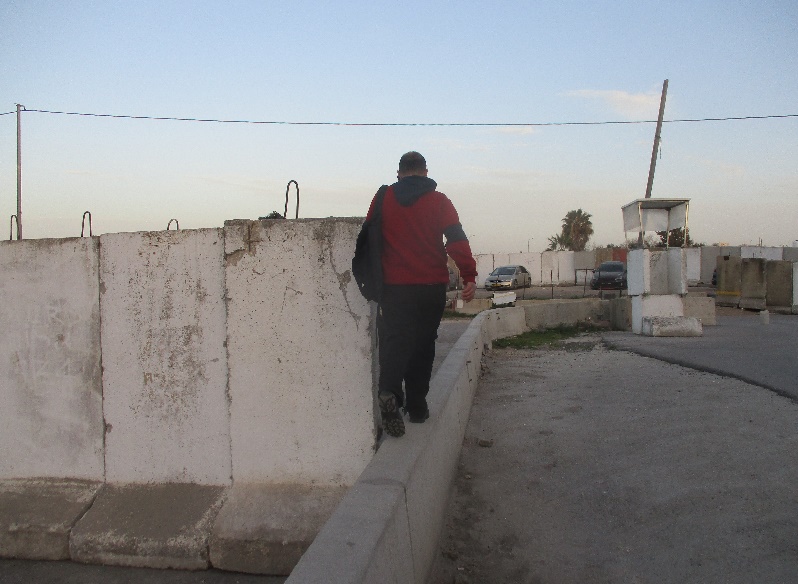 Tamar FleishmanFeb-16-2026Qalandiya CP: shortcut
-