
Qalandiya
“For they sow the wind, and they shall reap the whirlwind.” (Hosea 8:7)
Like an octopus, but with many, many more arms.
The occupation, with its thousands of tentacles, invades every public and private space.
Its malevolent emissaries leave destruction in their wake – both physical and psychological.
They rob youths of their dreams and hopes, leave their eyes burning with hate and despair.
For two months they’ve been punishing the community as a whole, and every single member.
Punishment of specific people, and collective punishment.
Punishment whose reason is unknown, having no expiration date.
Residents of the West Bank are being punished, as are the residents of Gaza.
Those arrested are too numerous to count, the number of people murdered and wounded increases.
The dismal reality of the Qalandiya refugee camp and the Qalandiya checkpoint tells the whole story.
At Qalandiya despair has faces, names.
At Qalandiya the two words: “Security requirements” have become a hollow, meaningless slogan.
Because when residents of Gaza return to their homes after being hospitalized on the West Bank the occupation doesn’t allow them to take with them the food they’ve bought for their families, food that’s so scarce in Gaza, the mantra of “Security requirements” is only a malicious lie.
Nor are the soldiers who daily emerge from the checkpoint area to fire tear gas and shock grenades at the children and youths throwing rocks serving “security requirements.”
Nor does the new firing position overlooking, and seeing into, the homes and shops in the refugee camp – a sniper’s perch – have anything to do with security.
Or the fact that for almost two months the parking lot at the checkpoint’s entrance, which was taken from the Palestinians in preparation for Ramadan Fridays, hasn’t yet been returned to those who need it and drivers are still locked out.
Nor is it necessary to say any more about the life-threatening policy of delaying ambulances carrying ill and wounded people to and from the West Bank. It was Haim, a Red Magen David staffer transporting to a Ramallah hospital a young, semi-conscious Palestinian connected to an IV, who wondered why the soldiers were delaying for a very long time his West Bank counterpart, saying: “They just doing it for no reason…”
That’s life, but it’s not for no reason. It’s an ongoing policy of punishing the innocent, a policy of tightening the screws, tightening them again, a policy of suffocation.
Qalandiya Checkpoint / Atarot Pass (Jerusalem)
See all reports for this place-
Click here to watch a video from Qalandiya checkpoint up to mid 2019 Three kilometers south of Ramallah, in the heart of Palestinian population. Integrates into "Jerusalem Envelope" as part of Wall that separates between northern suburbs that were annexed to Jerusalem in 1967: Kafr Aqab, Semiramis and Qalandiya, and the villages of Ar-Ram and Bir Nabala, also north of Jerusalem, and the city itself. Some residents of Kafr Aqab, Semiramis and Qalandiya have Jerusalem ID cards. A terminal operated by Israel Police has functioned since early 2006. As of August 2006, northbound pedestrians are not checked. Southbound Palestinians must carry Jerusalem IDs; holders of Palestinian Authority IDs cannot pass without special permits. Vehicular traffic from Ramallah to other West Bank areas runs to the north of Qalandiya. In February 2019, the new facility of the checkpoint was inaugurated aiming to make it like a "border crossing". The bars and barbed wire fences were replaced with walls of perforated metal panels. The check is now performed at multiple stations for face recognition and the transfer of an e-card. The rate of passage has improved and its density has generally decreased, but lack of manpower and malfunctions cause periods of stress. The development and paving of the roads has not yet been completed, the traffic of cars and pedestrians is dangerous, and t the entire vicinity of the checkpoint is filthy. In 2020 a huge pedestrian bridge was built over the vehicle crossing with severe mobility restrictions (steep stairs, long and winding route). The pedestrian access from public transport to the checkpoint from the north (Ramallah direction) is unclear, and there have been cases of people, especially people with disabilities, who accidentally reached the vehicle crossing and were shot by the soldiers at the checkpoint. In the summer of 2021, work began on a new, sunken entrance road from Qalandiya that will lead directly to Road 443 towards Jerusalem and Tel Aviv. At the same time, the runways of the old Atarot airport were demolished and infrastructure was prepared for a large bus terminal. (updated October 2021)
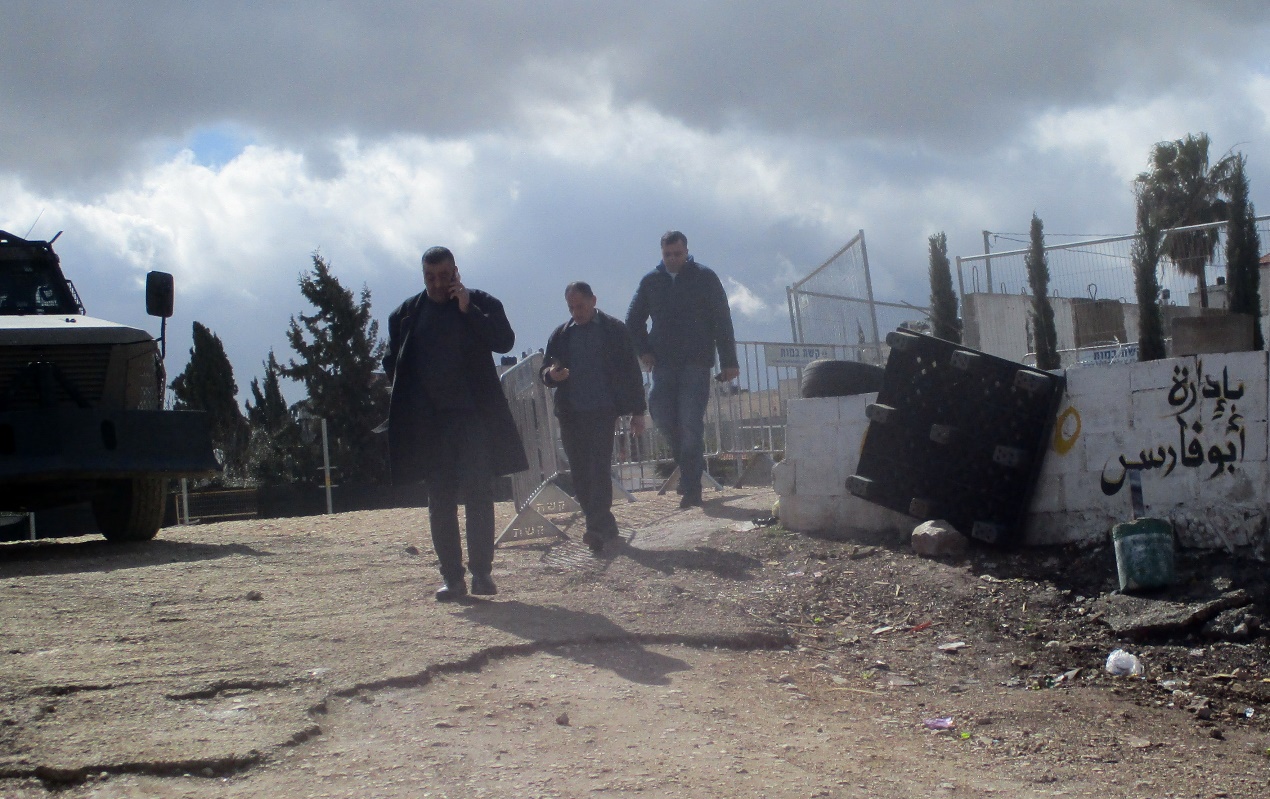 Tamar FleishmanFeb-27-2026Qalandiya: On the way to prayer
-