
Qalandiya
Another Friday with no help from the DCO, long queues and elderly
men and women standing in the queues, crowded together in despair
We arrived at 9 o`clock as usual. A strong smell of urine filled the air, especially in the area of the edge of the shed (the so-called "terminal"). It is extremely dirty but….hurray! The doors of the toilettes are open. We did not check the hygiene and hope they are fit for use.
We encountered three long queues up to the edge of the shed. Behind the turnstiles all the posts are open. The soldier in the booth is a novice who has not yet despaired of the helpless people in the queue, (so it seems), but all he can do is to be alert, discharge the turnstiles as fast as possible and explain to the people knocking on the fence that he is unable to help them.
Foreign activists whom we met told us that already at 8 o`clock when they arrived, there was such a load and that the representative of the DCO had appeared for a short while and then disappeared.
There is of course no Humanitarian Queue. It is Friday. The military authorities don`t consider it necessary. We begin phoning the DCO again and again and in the meantime, people are standing behind the shed.They simply don`t answer, no voice is heard. Sick people are in a hurry to be in time for their tests in the hospital and are afraid of being stuck for hours in the queue, a nurse is in a hurry to get to her work, a father with a trader`s license is forced to return because it is Friday and a man and two women aged over 60 and 65, are sent back because they are "preventees". A woman with a pacemaker asks for the humanitarian queue… and tells us that when she is obliged to go through the regular queue the soldiers are unable identify her card which exempts her from the electronic test, delaying her and causing a jam and shouting, until an officer with the authority to intervene is available.We try to help but are unable to do so and there is no DCO officer – it is Friday, as we said, and order has to be maintained.
The queue is composed, as usual on a Friday, mainly of elderly people going to prayers, heavy women in embroidered dresses, men leaning on walking sticks. When the DCO doesn't react (and from our experience we know that even when they answer they are not always ready to stand up and take charge of the situation on Fridays),we call Hanna Berg who knows with whom to speak and often succeeds in producing a change even if only for a few hours.
In the meantime the Norwegian volunteer joins us and tells us that on an average day 500 men and women pass through the CP in half an hour in the early morning hours , but on Fridays there are less than 100 , and explains this later on to the DCO officer (who later appeared after Hanna had made some trouble) that on Fridays there are elderly people in the queue who have no experience as to how to behave at the barrier, and require more time to respond, or no longer understood the the reflexes of standing at the barrier and the behavior when meeting the examiners working at the barrier.
Is this not a good reason to adapt the barrier to the special needs of these weakened people?
Suddenly two policemen appear avoiding any contact with us, and disappear.
Something is happening and the queue starts to move quickly. Not really quickly but better than before, somebody is prepared to speed up the movement. An invisible hand is in action at the Kalandia barrier…
And now even the DCO officer appears. He is friendly and seems to wish only well. (I forgot to write down the time). It turns out the the DCO officer who was supposed to be at the other end of the phone and respond to our problems, so called) was summoned to a more important place and the barrier was left at the mercy of the examiners and the people turning the turnstiles. Following the intervention of an invisible hand a substitute officer was called. His presence and probably the late hour as well, were very noticeable in this hopeless place. The queues became shorter, answers were given to questions in Arabic! True, only to those behind the fence…and we return home in despair.
Qalandiya Checkpoint / Atarot Pass (Jerusalem)
See all reports for this place-
Click here to watch a video from Qalandiya checkpoint up to mid 2019 Three kilometers south of Ramallah, in the heart of Palestinian population. Integrates into "Jerusalem Envelope" as part of Wall that separates between northern suburbs that were annexed to Jerusalem in 1967: Kafr Aqab, Semiramis and Qalandiya, and the villages of Ar-Ram and Bir Nabala, also north of Jerusalem, and the city itself. Some residents of Kafr Aqab, Semiramis and Qalandiya have Jerusalem ID cards. A terminal operated by Israel Police has functioned since early 2006. As of August 2006, northbound pedestrians are not checked. Southbound Palestinians must carry Jerusalem IDs; holders of Palestinian Authority IDs cannot pass without special permits. Vehicular traffic from Ramallah to other West Bank areas runs to the north of Qalandiya. In February 2019, the new facility of the checkpoint was inaugurated aiming to make it like a "border crossing". The bars and barbed wire fences were replaced with walls of perforated metal panels. The check is now performed at multiple stations for face recognition and the transfer of an e-card. The rate of passage has improved and its density has generally decreased, but lack of manpower and malfunctions cause periods of stress. The development and paving of the roads has not yet been completed, the traffic of cars and pedestrians is dangerous, and t the entire vicinity of the checkpoint is filthy. In 2020 a huge pedestrian bridge was built over the vehicle crossing with severe mobility restrictions (steep stairs, long and winding route). The pedestrian access from public transport to the checkpoint from the north (Ramallah direction) is unclear, and there have been cases of people, especially people with disabilities, who accidentally reached the vehicle crossing and were shot by the soldiers at the checkpoint. In the summer of 2021, work began on a new, sunken entrance road from Qalandiya that will lead directly to Road 443 towards Jerusalem and Tel Aviv. At the same time, the runways of the old Atarot airport were demolished and infrastructure was prepared for a large bus terminal. (updated October 2021)
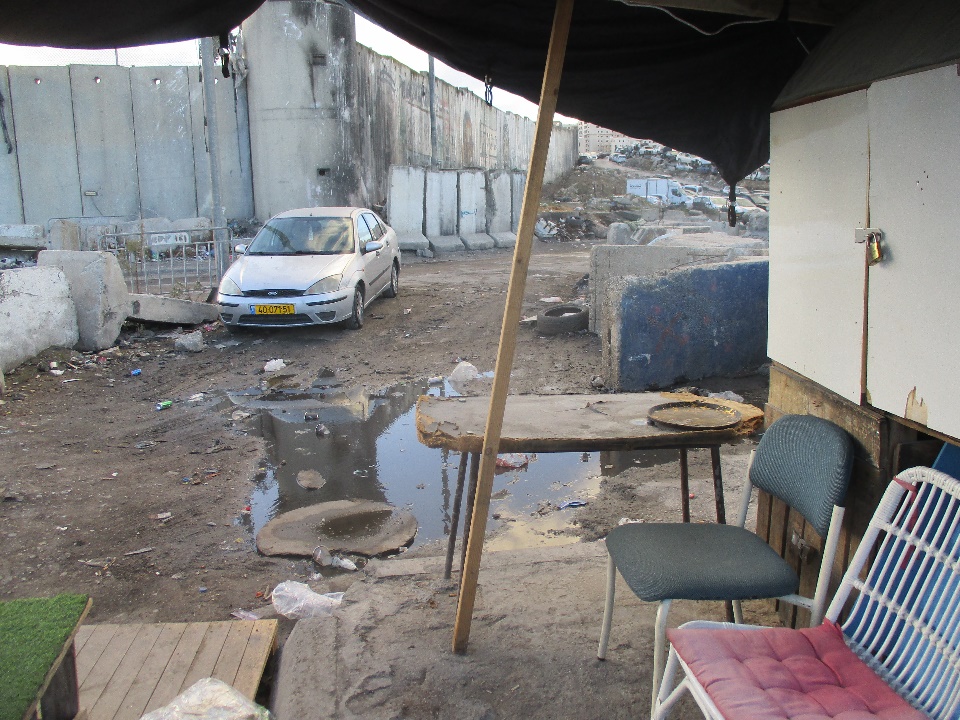 Tamar FleishmanNov-30-2025Qalandiya: Puddles and dirt after the rain
-