
.Qalandiya, 3/2/2011 PM.
Ofer, Kiryat Sefer, Kharbata, Givaat Zeev
Since one of us had a bad leg and another one felt fluish and we nevertheless didn’t want to cancel our shift, the only remaining healthy member of our team did the driving and we hardly left the car.
At the Ofer CP were no trucks. There is a nice new picnic area near the Ofer jail entrance for the families of the soldiers. No such facilities for the families of the prisoners on the other side, where we spotted quite a lot of waiting cars. The entrance to the prison and the military court went through some renovations and the wall around the compound is now completed. On the other side of the road the mountains have now been moved to facilitate the construction of a HUGE terminal.
We didn’t meet any Palestinian vehicles and the Bitunia CP looked deserted on our way to inspect the progress of the “Institutionalization of the Kiryat Sefer Passage”.
There was no sign preventing us from entering the ENORMOUS parking lot under construction with a circular road and with roundabouts. It would be fitting for a stadium. A Russian man who supervises the workers told us that we were not allowed to enter. He said it was all going to be a parking lot for vehicles dropping or collecting workers and the little concrete blocks were the offices of the army. We returned to the circular asphalted route around the compound to watch the first Palestinians returning from work on their way to the pedestrian CP which has been slightly ‘improved’ since we saw it last – at least the access is paved and the men no longer have to trudge through the mud. A menacing looking hummer approached us and a soldier asked what we were doing. We explained to him who we were and what we wanted and the hummer promptly moved to a strategic point where after a little while he totally blocked our view. When we drove off he followed us all the way to make sure we would not be trespassing.
On the way back we turned left to enter the Kharbata CP and were warmly greeted by a few Palestinians. We then stopped on the other side of the road beyond the CP where the workers head to on their way home. There is a long sleeve for pedestrians along the road past the barrier for cars. One Palestinian taxi was parked on the corner. The driver said he drives Palestinians along 443, but only a very short stretch, because in fact he cannot get beyond the Dor Gaz Station. We asked him about the new bright yellow sign instructing the public in three languages that crossing the Highway is prohibited unless at an official crossing site which is non-existent. Thousands of Palestinians cross this spot daily on foot and risk a 100 Sh. fine if caught by the police.
A soldier came up to find out what we were doing and when we explained to him the sign and its implications, he shrugged and said that he hadn’t put it up.
At the Givat Zeev CP the workers who have permits to work in G. Zeexited – it is allowed to get all the way to Jib -maybe two km. into area C
Qalandiya Checkpoint / Atarot Pass (Jerusalem)
See all reports for this place-
Click here to watch a video from Qalandiya checkpoint up to mid 2019 Three kilometers south of Ramallah, in the heart of Palestinian population. Integrates into "Jerusalem Envelope" as part of Wall that separates between northern suburbs that were annexed to Jerusalem in 1967: Kafr Aqab, Semiramis and Qalandiya, and the villages of Ar-Ram and Bir Nabala, also north of Jerusalem, and the city itself. Some residents of Kafr Aqab, Semiramis and Qalandiya have Jerusalem ID cards. A terminal operated by Israel Police has functioned since early 2006. As of August 2006, northbound pedestrians are not checked. Southbound Palestinians must carry Jerusalem IDs; holders of Palestinian Authority IDs cannot pass without special permits. Vehicular traffic from Ramallah to other West Bank areas runs to the north of Qalandiya. In February 2019, the new facility of the checkpoint was inaugurated aiming to make it like a "border crossing". The bars and barbed wire fences were replaced with walls of perforated metal panels. The check is now performed at multiple stations for face recognition and the transfer of an e-card. The rate of passage has improved and its density has generally decreased, but lack of manpower and malfunctions cause periods of stress. The development and paving of the roads has not yet been completed, the traffic of cars and pedestrians is dangerous, and t the entire vicinity of the checkpoint is filthy. In 2020 a huge pedestrian bridge was built over the vehicle crossing with severe mobility restrictions (steep stairs, long and winding route). The pedestrian access from public transport to the checkpoint from the north (Ramallah direction) is unclear, and there have been cases of people, especially people with disabilities, who accidentally reached the vehicle crossing and were shot by the soldiers at the checkpoint. In the summer of 2021, work began on a new, sunken entrance road from Qalandiya that will lead directly to Road 443 towards Jerusalem and Tel Aviv. At the same time, the runways of the old Atarot airport were demolished and infrastructure was prepared for a large bus terminal. (updated October 2021)
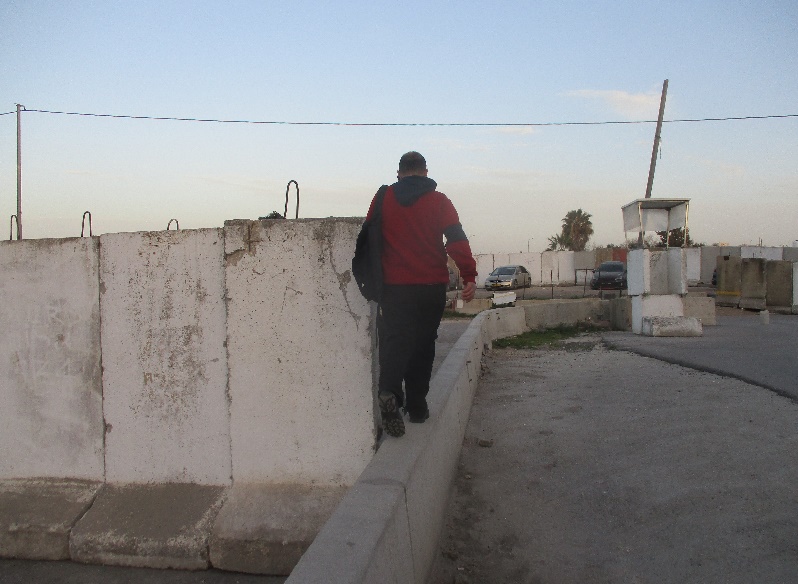 Tamar FleishmanFeb-16-2026Qalandiya CP: shortcut
-