
Qalandiya
So what’s new at Qalandiya? The occupation is flourishing, the Palestinians don’t count and we stand watching and weeping – it’s been 14 years already, an eternity…
05:00
H o r r I b l e: We could already see from a distance the entry line to the checkpoint spilling into the parking lot; as we approached the unbearable congestion became obvious. Many sat on the benches in the shed; they’d apparently decided to wait until the inhuman crowding had eased. Masses of people jammed into the fenced corridors; some seemed to have difficulty breathing in the crush and the pressure. Strong young men managed to detach the covering of the fenced corridor, move the barbed wire and push their way into the line. Each time the revolving gate opened those in the corridors began to press forward; someone was always on the verge of being trampled or seriously injured.
A Civil Administration staffer showed up only at 06:15, and only then did the humanitarian gate open – though its name indicates it’s intended for people requiring special consideration: parents carrying small children in their arms; women of all ages, some of whom have difficulty standing for lengthy periods of time, particularly in the terrible congestion; the elderly; the sick – all wait to be “granted” the “right” to cross to Jerusalem and their jobs. But the guardian of Israel, who neither slumbers nor sleeps, is too tired to reach the checkpoint during the hours of greatest congestion.
A group of about ten laborers who work at a particular factory approached us because one had his valid work permit confiscated. The DCO representative on site said the employer had cancelled it. That’s not true. What happened was that a soldier new to the checkpoint decided to confiscate the permit – the time and the money lost don’t interest him. After all, they’re only Palestinians. We looked into it later and determined, of course, that the DCO’s story wasn’t correct, and managed finally, after contacting many people, to solve the problem.
Complaints by residents of the Ramallah area who are required to cross through the congested Qalandiya checkpoint rather than through A-Jib, which is closer to their homes and less crowded, have been referred repeatedly to the Civil Administration, but so far without result. You can’t believe the stupid excuses they use to explain the injustice, and we won’t bother repeating them here.
A Palestinian who’s worked for years in Jerusalem, whom we’ve come to know very well, tells us that Friday, when the checkpoint wasn’t crowded, he saw soldiers at the inspection booths dancing to music from a cellphone. Are there no limits to chutzpah and contempt?!!
We repeatedly complained to the senior officers during our shift and afterwards. They tried to “enlighten” us, saying that if so many people had crossed by 07:30, there was nothing to complain about (!), and that there’s no line at 4 AM. But I guess we must be pretty dumb because we couldn’t understand why someone working in Atarot, 15 minutes from the checkpoint if you’re walking slowly , whose shift begins at a normal hour like 7 or 7:30 AM, should have to wake up in the middle of the night to reach the checkpoint and wait hours for it to open so he can go to work. But, again, of course, they’re only Palestinians; who cares whether they’re able to get a good rest, have a decent family life – let them spend their time waiting at checkpoints.
Qalandiya Checkpoint / Atarot Pass (Jerusalem)
See all reports for this place-
Click here to watch a video from Qalandiya checkpoint up to mid 2019 Three kilometers south of Ramallah, in the heart of Palestinian population. Integrates into "Jerusalem Envelope" as part of Wall that separates between northern suburbs that were annexed to Jerusalem in 1967: Kafr Aqab, Semiramis and Qalandiya, and the villages of Ar-Ram and Bir Nabala, also north of Jerusalem, and the city itself. Some residents of Kafr Aqab, Semiramis and Qalandiya have Jerusalem ID cards. A terminal operated by Israel Police has functioned since early 2006. As of August 2006, northbound pedestrians are not checked. Southbound Palestinians must carry Jerusalem IDs; holders of Palestinian Authority IDs cannot pass without special permits. Vehicular traffic from Ramallah to other West Bank areas runs to the north of Qalandiya. In February 2019, the new facility of the checkpoint was inaugurated aiming to make it like a "border crossing". The bars and barbed wire fences were replaced with walls of perforated metal panels. The check is now performed at multiple stations for face recognition and the transfer of an e-card. The rate of passage has improved and its density has generally decreased, but lack of manpower and malfunctions cause periods of stress. The development and paving of the roads has not yet been completed, the traffic of cars and pedestrians is dangerous, and t the entire vicinity of the checkpoint is filthy. In 2020 a huge pedestrian bridge was built over the vehicle crossing with severe mobility restrictions (steep stairs, long and winding route). The pedestrian access from public transport to the checkpoint from the north (Ramallah direction) is unclear, and there have been cases of people, especially people with disabilities, who accidentally reached the vehicle crossing and were shot by the soldiers at the checkpoint. In the summer of 2021, work began on a new, sunken entrance road from Qalandiya that will lead directly to Road 443 towards Jerusalem and Tel Aviv. At the same time, the runways of the old Atarot airport were demolished and infrastructure was prepared for a large bus terminal. (updated October 2021)
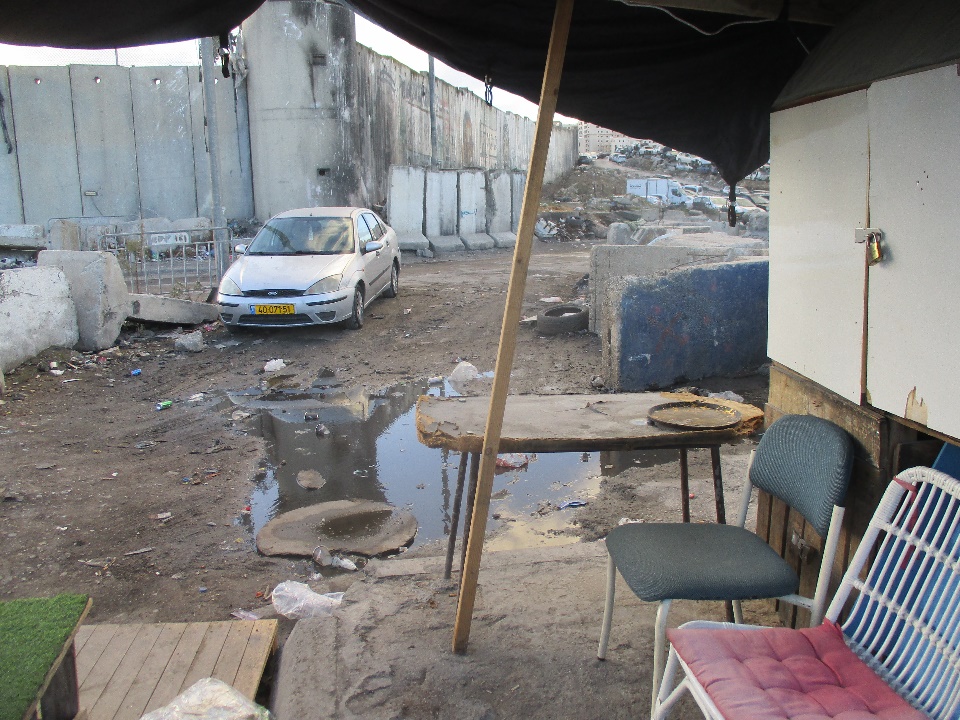 Tamar FleishmanNov-30-2025Qalandiya: Puddles and dirt after the rain
-