
Qalandiya
Qalandiya, Tues. AM, 19.11.13
Translation: Judith Green
A cursed morning at Qalandiya, worse than we've seen for months. First of all, it is wintry, and now people are standing in a deep line, deep within the parking lot in the cold and wind; such was the situation when we arrived at 5:40, and the lines got even longer during the next hour because, except for the #3 sleeve, the pace of the inspections was maddeningly slow. The woman soldier who was sitting in the "aquarium" seemed to feel insulted by our presence, as she went out and asked us for the reason of our standing around there (and this was after she had also asked our colleagues from the EAPPI, in a similar fashion, half an hour earlier). When she whether or not we have confidence in the IDF to do its work as is necessary, in order to return her to her workplace as fast as possible, we answered that we do have confidence in the IDF and we also have confidence in ourselves, and with that the issue was closed (although not before she told us, be the way, that she was about to finish a 12 hour shift in the "aquarium").
One and only ray of light this morning was that the DCO officers responsible for the humanitarian gate came at the hour of 6 (instead of 6:15), opened the gate immediately, and continued to open it every time that a group of people stood nearby. They paid attention to everything that was happening near the gate and worked quietly and efficiently, worth of praise.
The policeman on duty arrived at the same time, but we didn't see any advantage in his presence, in relation to the operation of the checkpoint.
We haven't felt such a high level of tension and anger at Qalandiya for a long time. Over and over, people approached us and called to us from the lines to go to them so that they could complain to us bitterly about the situation. Over and over, we heard the same complaint: that the soldiers in the sleeves were not working efficiently, that they were playing with their celphones and chatting with each other instead of maintaining a reasonable pace of work, and that had no supervision, so they could avoid responsibility for the "quality" of their work. We wanted to clarify if, in the inspection booths, there was a new unit that had not yet become accustomed to their work, but the DCO soldiers and the policemen were not interested in talking to us.
Palestinians who were standing in line complained quite a bit about us as well; "How much time, how many years, you have been coming here to the checkpoint, and nothing ever changes!" (truly, on this morning, it seemed as though nothing had ever changed since the worst days at Qalandiya). Several people told us that, in comparison to the previous week,when the situation was relatively easy, the last 2 days resembled that of today from the point of view of the long time which they had to spend in line. One man asked us, with even more anger, "What are those settlers doing here," relating to a young couple from the "Blue and White" organization (Interesting that he was aware of their political ideology, as we had never seen young people from the organization speaking with Palestinians at the checkpoint – and maybe it is a good thing, since the lack of empathy for the Palestinians of the couple who arrived on last Tuesday was quite striking).
The peak passed after 7:00, and the lines barely filled the enclosures when we left at 7:20.
Qalandiya Checkpoint / Atarot Pass (Jerusalem)
See all reports for this place-
Click here to watch a video from Qalandiya checkpoint up to mid 2019 Three kilometers south of Ramallah, in the heart of Palestinian population. Integrates into "Jerusalem Envelope" as part of Wall that separates between northern suburbs that were annexed to Jerusalem in 1967: Kafr Aqab, Semiramis and Qalandiya, and the villages of Ar-Ram and Bir Nabala, also north of Jerusalem, and the city itself. Some residents of Kafr Aqab, Semiramis and Qalandiya have Jerusalem ID cards. A terminal operated by Israel Police has functioned since early 2006. As of August 2006, northbound pedestrians are not checked. Southbound Palestinians must carry Jerusalem IDs; holders of Palestinian Authority IDs cannot pass without special permits. Vehicular traffic from Ramallah to other West Bank areas runs to the north of Qalandiya. In February 2019, the new facility of the checkpoint was inaugurated aiming to make it like a "border crossing". The bars and barbed wire fences were replaced with walls of perforated metal panels. The check is now performed at multiple stations for face recognition and the transfer of an e-card. The rate of passage has improved and its density has generally decreased, but lack of manpower and malfunctions cause periods of stress. The development and paving of the roads has not yet been completed, the traffic of cars and pedestrians is dangerous, and t the entire vicinity of the checkpoint is filthy. In 2020 a huge pedestrian bridge was built over the vehicle crossing with severe mobility restrictions (steep stairs, long and winding route). The pedestrian access from public transport to the checkpoint from the north (Ramallah direction) is unclear, and there have been cases of people, especially people with disabilities, who accidentally reached the vehicle crossing and were shot by the soldiers at the checkpoint. In the summer of 2021, work began on a new, sunken entrance road from Qalandiya that will lead directly to Road 443 towards Jerusalem and Tel Aviv. At the same time, the runways of the old Atarot airport were demolished and infrastructure was prepared for a large bus terminal. (updated October 2021)
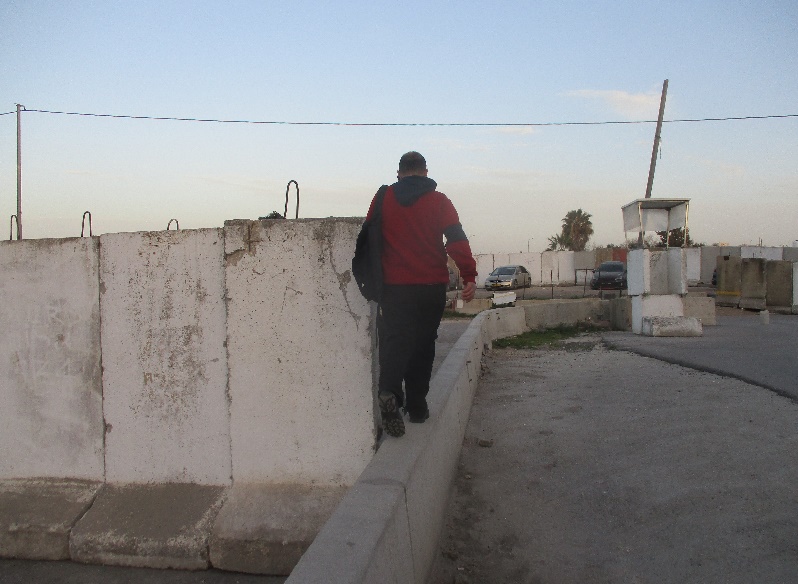 Tamar FleishmanFeb-16-2026Qalandiya CP: shortcut
-