
Qalandiya
A long but more relaxed morning in Qalandiya
It was the old story again, as we arrived at 05:10. There were lines stretching into the parking lot, and only three out of the five checkup posts were open. A phone call to the military offices, asking them to open the other stations gets the standard answer: there is not enough manpower. It is not worth the trouble of phoning anymore.
At 05:15 we started following one person at the end of a line in order to see how long it will take until he enters the checkup station. The result: 35 minutes. We asked another person, whom we met at 06:10, and we know from former talks, to call as he gets out of the checkpoint, and we got a phone call 30 minutes later.
Even after the two other stations were opened at 05:50, the lines did not get shorter, since there was an accumulation of people waiting during the last hour.
Despite it all, patience held on, the the discipline of the lines did not fall apart, although people who talked to us did not seem less bitter today.
The humanitarian gate was opened at 06:10, and later on it was openned as soon as a few people congregated near by. The two DCOsoldiers were working quietly and efficiently, and it is better that the daily policeman does not meddle with their work (this happens sometimes, but no today), and will let them do their job the best they can.
Today we spoke again with the daily policewoman about the light problems on road no. 45, the road going from the checkpoint towards the Atarot industrial area, on which many workers walk during the dark hours. She ensured us that the police complaint about the situation is still "open", and will remain so until the Jerusalem municipality will take care of it. The question is will it happen before of after there will be an accident on this road, if ever. We decided to bring the matter to the organization "green light", or to the journalist Dov Gilhar, from channel 10, and will see if it helps (by the way, another policeman had told us that this problem exists already for 6 years).
At the end of the shift, at 07:30, we checked the problem of the missing spikes near the north side of the parking lot (a Palestinian acquaintance had asked us to report it). The authorities had put the spikes there in order to prevent collision of the traffic coming from Kafr 'Akab towards the vehicles' checkpoint with the traffic coming from the opposite direction – into the village Akav, and northwards, towards Ramalla. But somehow it happenned that a weadth of the spikes, as wide as an average car, had disappeared, and the result is that drivers who try to get around the long line waiting for the vehicles' checkpoint are blocking the road, or bump into the cars coming from the other direction – and this makes the unbearable traffic jam in the area even worse. We will report this to "green light" and Gilhar if we see that the authorities don't take us seriously.
Qalandiya Checkpoint / Atarot Pass (Jerusalem)
See all reports for this place-
Click here to watch a video from Qalandiya checkpoint up to mid 2019 Three kilometers south of Ramallah, in the heart of Palestinian population. Integrates into "Jerusalem Envelope" as part of Wall that separates between northern suburbs that were annexed to Jerusalem in 1967: Kafr Aqab, Semiramis and Qalandiya, and the villages of Ar-Ram and Bir Nabala, also north of Jerusalem, and the city itself. Some residents of Kafr Aqab, Semiramis and Qalandiya have Jerusalem ID cards. A terminal operated by Israel Police has functioned since early 2006. As of August 2006, northbound pedestrians are not checked. Southbound Palestinians must carry Jerusalem IDs; holders of Palestinian Authority IDs cannot pass without special permits. Vehicular traffic from Ramallah to other West Bank areas runs to the north of Qalandiya. In February 2019, the new facility of the checkpoint was inaugurated aiming to make it like a "border crossing". The bars and barbed wire fences were replaced with walls of perforated metal panels. The check is now performed at multiple stations for face recognition and the transfer of an e-card. The rate of passage has improved and its density has generally decreased, but lack of manpower and malfunctions cause periods of stress. The development and paving of the roads has not yet been completed, the traffic of cars and pedestrians is dangerous, and t the entire vicinity of the checkpoint is filthy. In 2020 a huge pedestrian bridge was built over the vehicle crossing with severe mobility restrictions (steep stairs, long and winding route). The pedestrian access from public transport to the checkpoint from the north (Ramallah direction) is unclear, and there have been cases of people, especially people with disabilities, who accidentally reached the vehicle crossing and were shot by the soldiers at the checkpoint. In the summer of 2021, work began on a new, sunken entrance road from Qalandiya that will lead directly to Road 443 towards Jerusalem and Tel Aviv. At the same time, the runways of the old Atarot airport were demolished and infrastructure was prepared for a large bus terminal. (updated October 2021)
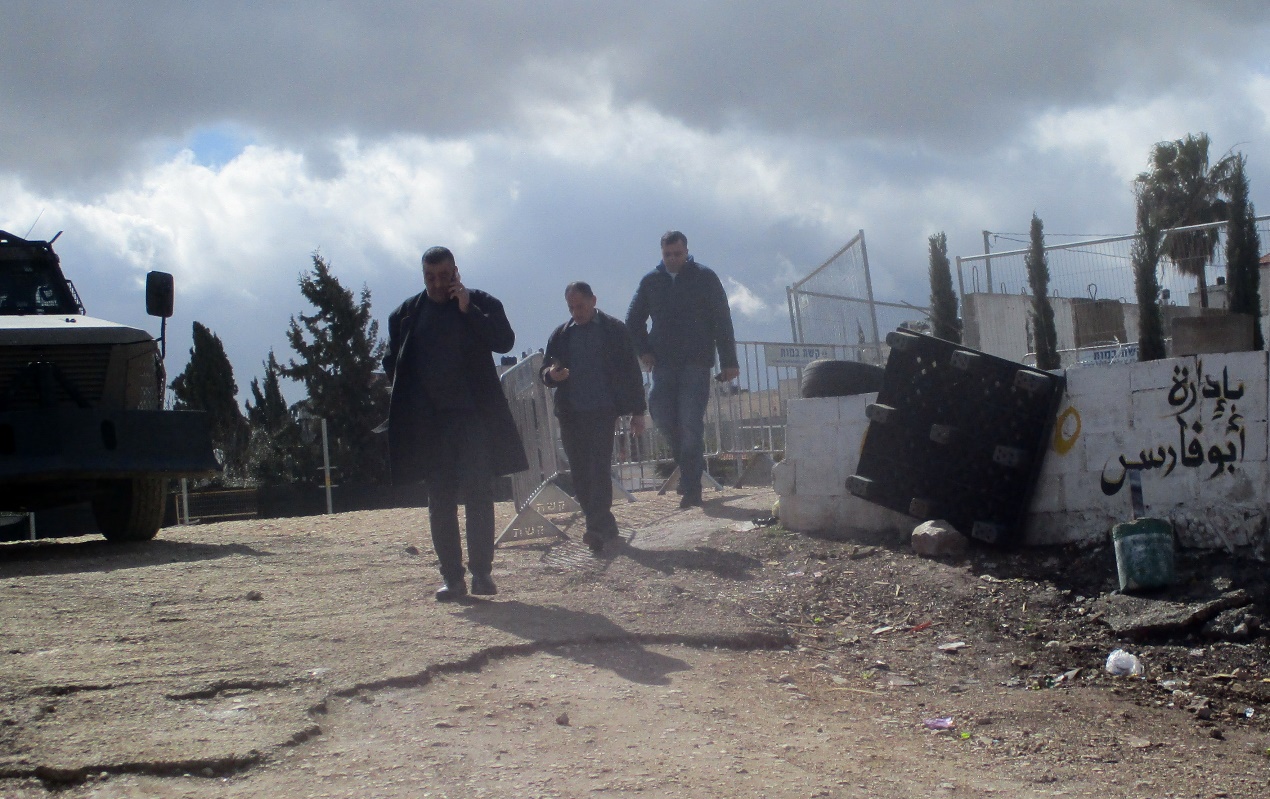 Tamar FleishmanFeb-27-2026Qalandiya: On the way to prayer
-