
Qalandiya
We returned to Qalandiya after a long absence, for fear of Omicron and other troubles. Learning from experience regarding the difficulties of parking on the Israeli side, because of the works in the place that reduced the parking spaces, this time we arrived with the driver who drives our friends in the Jerusalem area. He took us through the Hizma and a-Ram checkpoint directly to the Palestinian side of the checkpoint. As you approach the checkpoint from this direction you see the one end of the planned subsidence. On the way back we saw over the bridge to its other end on the Israeli side. Just before the square near the entrance to the checkpoint compound on the east side, we were already stuck in a traffic jam in front of the vehicle checkpoint. So we went down and continued on foot to the entrance. (K. Our driver continued to the square to turn around. He says he prefers the traffic jam we have already seen that stretches on the way back through the Hizma checkpoint, over the traffic jam in front of the Qalandiya checkpoint)
We arrived around 6:30. Abu Ramzi our friend who sells pretzels was not present. We asked the man who sells masks near where Abu Ramzi used to stand, if Abu Ramzi was there this morning. According to him, Abu Ramzi was and has already left. We sent him our regards
In the compound of the checkpoint itself, everything is conducted on a level playing field. No queues were observed. Everyone who comes, and many come, immediately enters the slalom before the first turnstiles. No delays were seen
The entire checkpoint compound is fenced with blue iron fences. On the east side there is access for vehicles to a large car park, but only taxis and minibuses for public transport are allowed to enter here. All pedestrians also enter on the sidewalk and through the ramp above it (the area under a shed manned during Ramadan). There is a gate in the blue fence on the northwest side closer to Qalandiya, but for over a year the gate has been locked. Why? Who knows … the people coming from Qalandiya are forced to go around all the empty and abandoned parking lot to enter from the east side. It may not be as terrible on a beautiful day as today, but very unpleasant on a cold, rainy winter day or in the summer in the sun
To save themselves the walk, the people sawed off the lower part of the fence and used to pass under near the locked gate, where the concrete at the base was sloping downwards and a space could be created through which to pass. We read in our colleague, Tamar’s report that the army blocked this space so that they could not pass. This time we witnessed it with our own eyes. The space is blocked by rails welded to fences.

וכך זה נראה עכשיו, מצולם מהצד הפנימי, בתוך מתחם המחסום:

כפי שניתן לראות בתמונה יש שני שלבים בסמוך לשער הנעול שהרווח ביניהם גדול יותר. כמו כן בהמשך יש שלב אחד שכופף כך שהרווח בינו לבין זה הסמוך אליו הוגדל. דרך המרווחים האלה בסורגים עוברים הילדים. קודם מעבירים את התיק, או שזוקרים אותו מלמעלה מעבר לגדר, ואז משתחלים להם בין הסורגים. גם צעירים רזים בוחרים בדרך הזו, או שהם מטפסים על הגדר ועוברים מלמעלה…

We were there about half an hour. Since no special problems were observed, we entered in the slalom at7a.m. at the middle entrance. We passed the carousel immediately. Inside there were queues which were not too long standing before the checkpoints and checkpoints not all of which were open. We moved to the queue in the further western section. The queue progressed quickly. Documents were checked without delay. The electronic positions through which Palestinians pass with a magnetic card were also not all open, but there were no delays. Everyone moved quickly . The passage took about 5 minutes
When we left, we saw, Tamar reported, that fences and roadblocks had been added to the pedestrian bridge. The young people used to jump over the concrete at the beginning of the ascent and save themselves the passage over the bridge. Also the fence had been raised above the blue fence and also blocked with bars all the space between the concrete blocks and the roof.

This is how it looks today.

From the bridge we watched the advancing work.
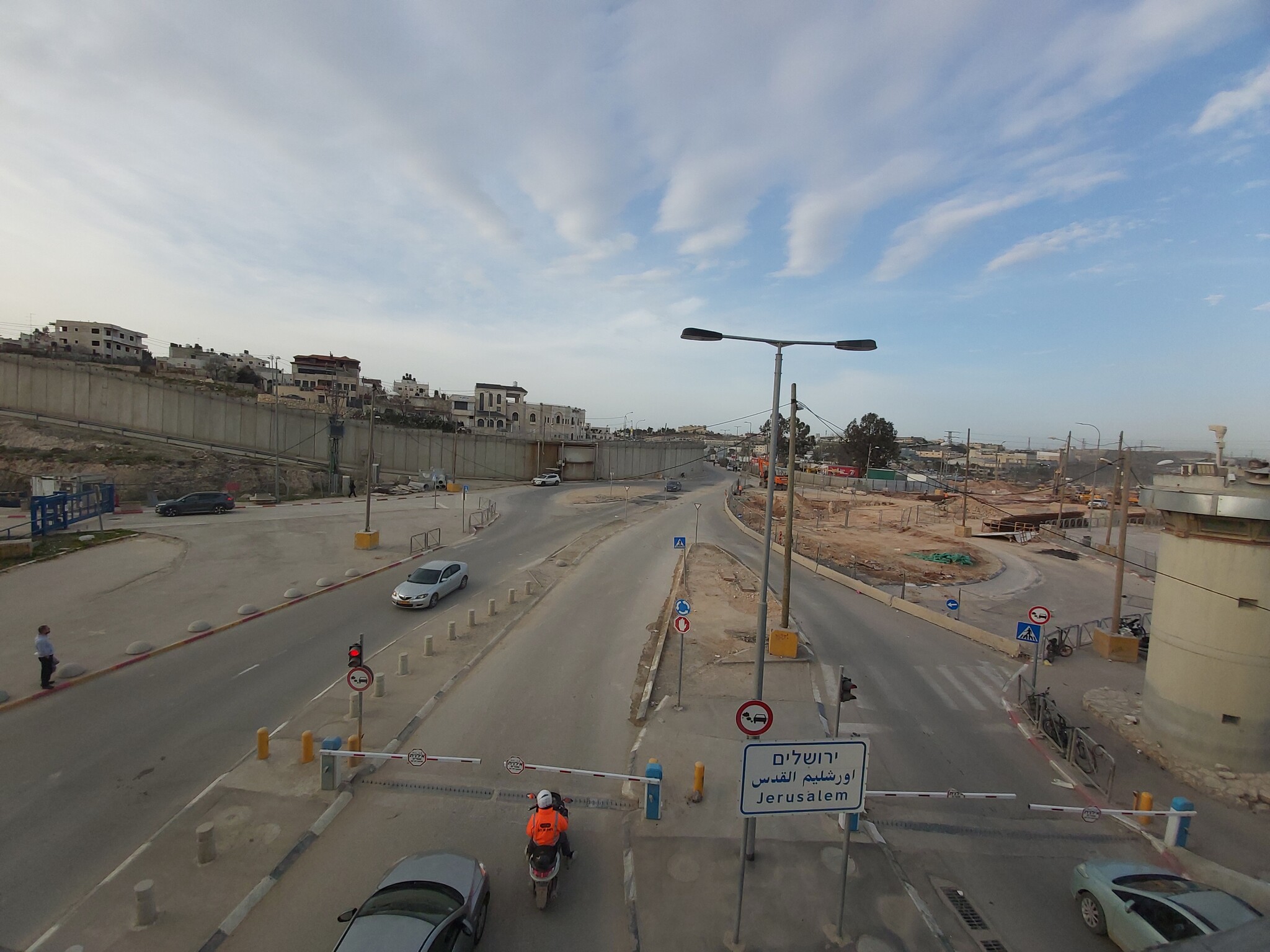


Over the bridge we watched the advance of other works. On the west side the area that was once a small airport runway had been completely flattens out. Are there any plans to establish a new Jewish neighborhood here ??? Stuck as if in the throat of the Palestinian buildings beyond the gray separation fence that stretches west here … We did not see any sign indicating what was planned here.

The intention was to return to our vehicle on a Palestinian bus. We asked a relatively older man (whom we thought would know Hebrew, which he did ) which bus arrives at the French Hill junction. He directed us to line 273. While we were waiting we talked a bit and heard that he was from Qalandiya and he said lately there are no problems at the checkpoint and in general. Unfortunately it turned out that this bus was not getting to the station we needed, and we got off at the . On the way back we talked at the Palestinian bus stop near the national headquarters with a woman who spoke English. It turned out that she was British, married to a Palestinian and had lived in Beit Hanina for 50 years. Eventually we advanced to the light rail station and reached each destination with the help of the train.
Qalandiya Checkpoint / Atarot Pass (Jerusalem)
See all reports for this place-
Click here to watch a video from Qalandiya checkpoint up to mid 2019 Three kilometers south of Ramallah, in the heart of Palestinian population. Integrates into "Jerusalem Envelope" as part of Wall that separates between northern suburbs that were annexed to Jerusalem in 1967: Kafr Aqab, Semiramis and Qalandiya, and the villages of Ar-Ram and Bir Nabala, also north of Jerusalem, and the city itself. Some residents of Kafr Aqab, Semiramis and Qalandiya have Jerusalem ID cards. A terminal operated by Israel Police has functioned since early 2006. As of August 2006, northbound pedestrians are not checked. Southbound Palestinians must carry Jerusalem IDs; holders of Palestinian Authority IDs cannot pass without special permits. Vehicular traffic from Ramallah to other West Bank areas runs to the north of Qalandiya. In February 2019, the new facility of the checkpoint was inaugurated aiming to make it like a "border crossing". The bars and barbed wire fences were replaced with walls of perforated metal panels. The check is now performed at multiple stations for face recognition and the transfer of an e-card. The rate of passage has improved and its density has generally decreased, but lack of manpower and malfunctions cause periods of stress. The development and paving of the roads has not yet been completed, the traffic of cars and pedestrians is dangerous, and t the entire vicinity of the checkpoint is filthy. In 2020 a huge pedestrian bridge was built over the vehicle crossing with severe mobility restrictions (steep stairs, long and winding route). The pedestrian access from public transport to the checkpoint from the north (Ramallah direction) is unclear, and there have been cases of people, especially people with disabilities, who accidentally reached the vehicle crossing and were shot by the soldiers at the checkpoint. In the summer of 2021, work began on a new, sunken entrance road from Qalandiya that will lead directly to Road 443 towards Jerusalem and Tel Aviv. At the same time, the runways of the old Atarot airport were demolished and infrastructure was prepared for a large bus terminal. (updated October 2021)
 Tamar FleishmanFeb-27-2026Qalandiya: On the way to prayer
-