
Qalandiya
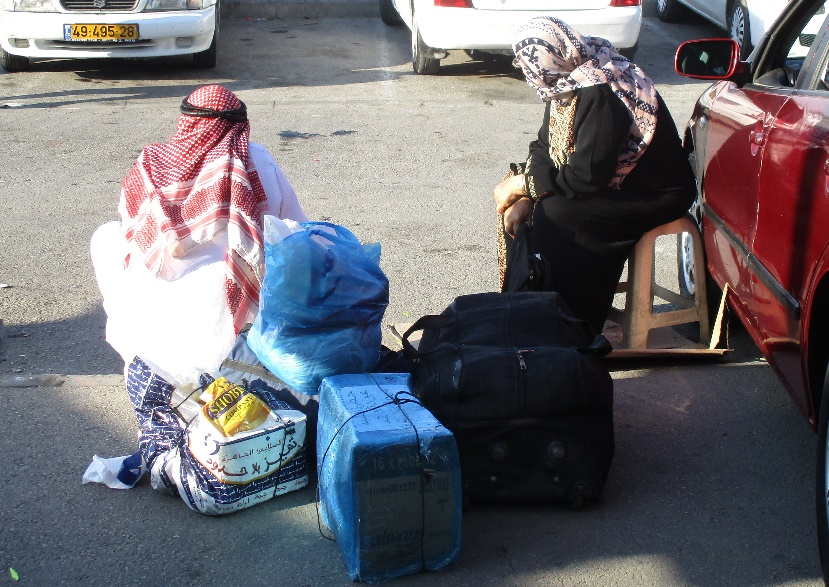
What is this holiday you have today?
– It’s not a holiday, why are you asking?
Because today no permits are being issued to Gazans.
Look at these two old people who, having left the hospital and bought all sorts of gifts for the kids, and then came here – were told to come here tomorrow.
Why shouldn’t they be allowed to cross? Look at them, they’re really old, what harm can they possibly do? And now they’re sitting and waiting for someone to come and take them back to Ramallah until tomorrow morning.
There are 50,000 people living in Jenin, and two ambulances in the city.
I didn’t know. Anwar, the ambulance driver, Khaled – the paramedic and Mohammad, the medical nurse told me this.
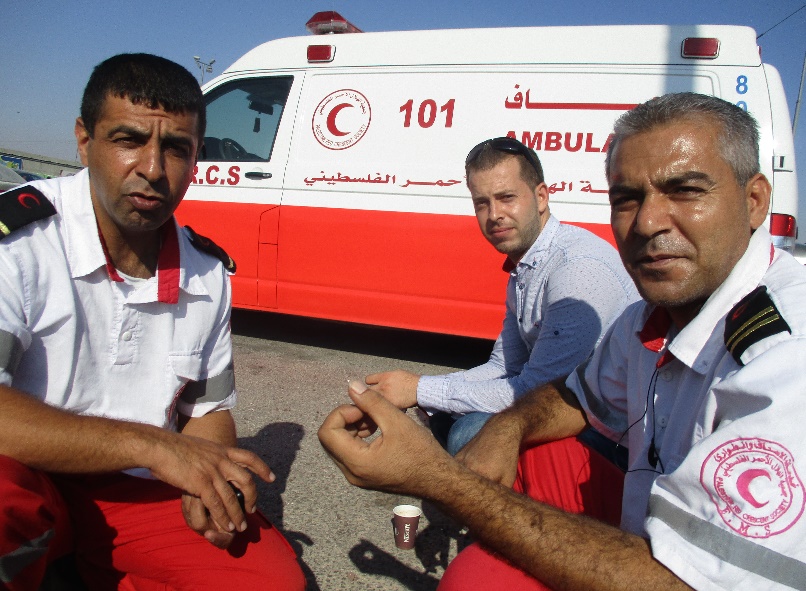
We sat for coffee beside the ambulance, waiting for a doctor coming back from Muqassad Hospital in East Jerusalem.
An hour earlier they carried a 25-year old man, who sustained a head injury in a traffic accident. A day after being treated in hospital in Jenin his condition became critical and doctors had to anesthetize him and send him, escorted by a doctor, to Muqassad Hospital.
The coordination procedures were all carried out ahead of time, the Jerusalem ambulance had already arrived at the checkpoint, but then the wounded man came to, and his life was in danger. The doctor – whose name the coordinators forgot to include in the application – feared for the young man’s life and insisted on staying with him all the way to Muqassad Hospital. This did not sit well with the soldiers at the checkpoint and all hell broke loose: all the echelons and hotlines had to be contacted. Time was running out with the wounded man’s life on the line. The soldiers insisting on procedure, and the doctor insisting on keeping his patient alive.
Half an hour later the knot was unraveled, and the doctor too was permitted to cross and escort the wounded man to Muqassad Hospital.
And all that time, a long time, while Anwar and Khaled and Mohammad sat idle waiting for the doctor, one single ambulance remained in the city of Jenin with its 50,000 inhabitants.
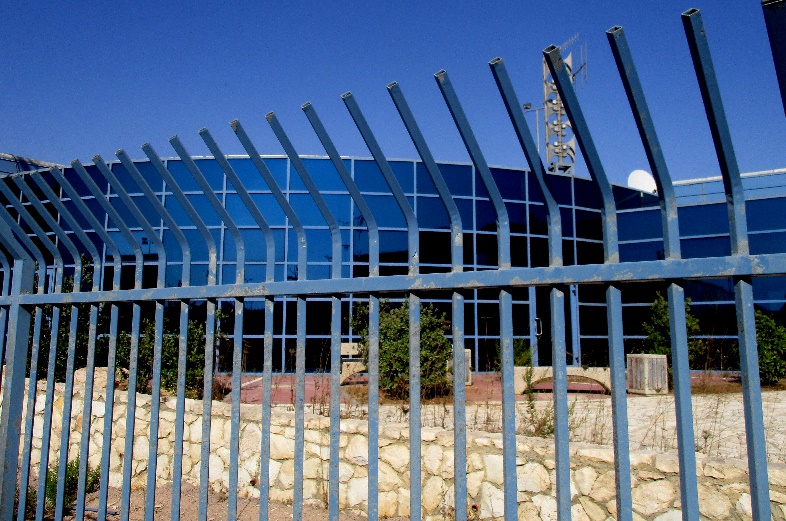
A blue building inside the checkpoint compound houses the community administration that is supposed to provide services to inhabitants of the Palestinian neighborhoods beyond the Separation Wall.
The director of this administration is Nadera Jaber.
Nadera contacted me and invited me to meet her, the children photos on my Facebook page had moved her.
We met in her office for a long talk, mostly exchanging opinions and views.
I also heard about the activity taking place in this building, as she said:
The post office is open three days a week;
The employment bureau receives public once a month;
The branch of the Ministry of the Interior is active two days a week for three hours at a rime (Mondays and Wednesdays);
The social security bureau is open once a week for five hours;
Nadera also told me about a master-plan to relieve transportation pressure, whereby the northern roundabout will be cancelled and a one-lane road will be paved from Kufr ‘Akeb all the way to the checkpoint. Only cars with yellow (Israeli) license plates will be allowed to travel it.
The plan has obtained all the necessary permits and is to be executed, barring unexpected delays, this coming November.
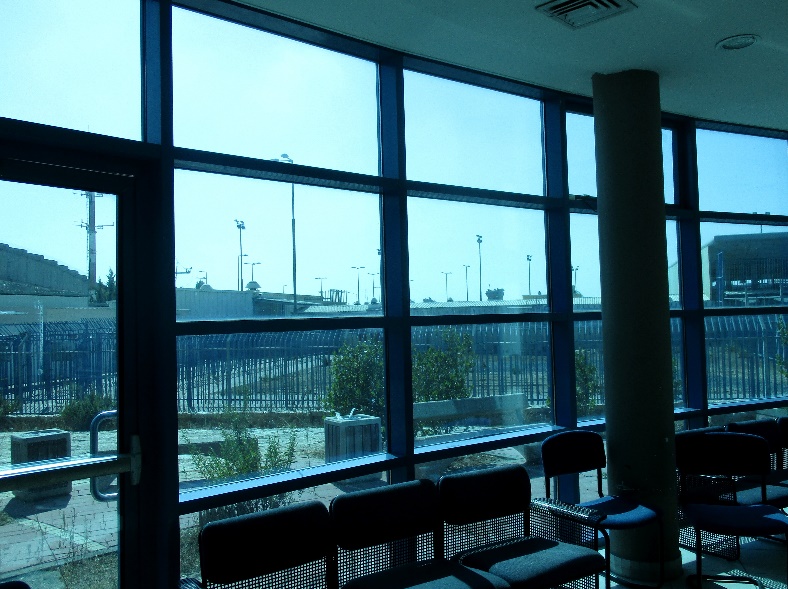
A look at the checkpoint from inside the community administration building, and at the same building from the checkpoint:
Qalandiya Checkpoint / Atarot Pass (Jerusalem)
See all reports for this place-
Click here to watch a video from Qalandiya checkpoint up to mid 2019 Three kilometers south of Ramallah, in the heart of Palestinian population. Integrates into "Jerusalem Envelope" as part of Wall that separates between northern suburbs that were annexed to Jerusalem in 1967: Kafr Aqab, Semiramis and Qalandiya, and the villages of Ar-Ram and Bir Nabala, also north of Jerusalem, and the city itself. Some residents of Kafr Aqab, Semiramis and Qalandiya have Jerusalem ID cards. A terminal operated by Israel Police has functioned since early 2006. As of August 2006, northbound pedestrians are not checked. Southbound Palestinians must carry Jerusalem IDs; holders of Palestinian Authority IDs cannot pass without special permits. Vehicular traffic from Ramallah to other West Bank areas runs to the north of Qalandiya. In February 2019, the new facility of the checkpoint was inaugurated aiming to make it like a "border crossing". The bars and barbed wire fences were replaced with walls of perforated metal panels. The check is now performed at multiple stations for face recognition and the transfer of an e-card. The rate of passage has improved and its density has generally decreased, but lack of manpower and malfunctions cause periods of stress. The development and paving of the roads has not yet been completed, the traffic of cars and pedestrians is dangerous, and t the entire vicinity of the checkpoint is filthy. In 2020 a huge pedestrian bridge was built over the vehicle crossing with severe mobility restrictions (steep stairs, long and winding route). The pedestrian access from public transport to the checkpoint from the north (Ramallah direction) is unclear, and there have been cases of people, especially people with disabilities, who accidentally reached the vehicle crossing and were shot by the soldiers at the checkpoint. In the summer of 2021, work began on a new, sunken entrance road from Qalandiya that will lead directly to Road 443 towards Jerusalem and Tel Aviv. At the same time, the runways of the old Atarot airport were demolished and infrastructure was prepared for a large bus terminal. (updated October 2021)
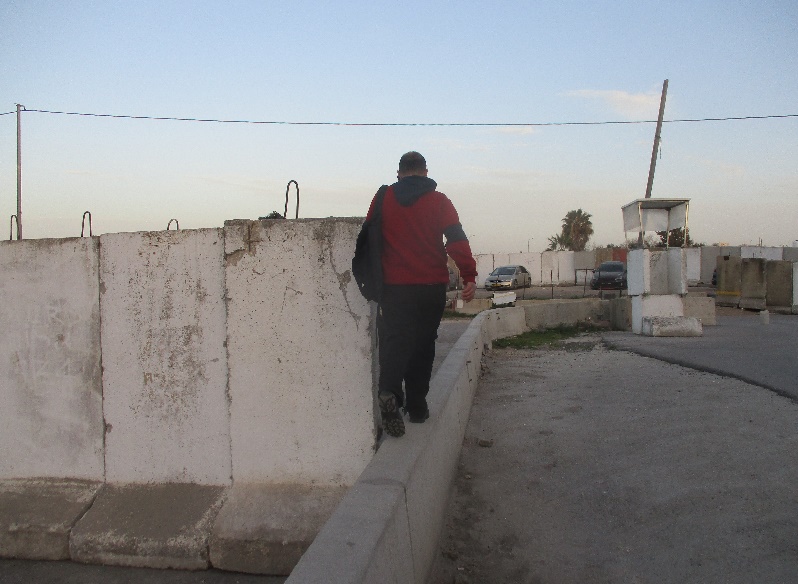 Tamar FleishmanFeb-16-2026Qalandiya CP: shortcut
-