
Qalandiya - a control system over everyone coming back to the West Bank has been installed

Every time I drive to Qalandiya I look over at Ofer detention/prison camp and think of those who are held there and wonder who – of my acquaintances – is either there now or likely to end up there amidst these suffocating walls.
So there, as I reached Qalandiya and stood with a group of old acquaintances, I was told that
- Several days ago, the army broke into Abdallah’s home and took him.
- Why? What was he accused of? I asked.
- That he’s Hamas. That’s what his father and his brother Ibrahim said, whom I know.
So now Abdallah, too, is imprisoned in Ofer.
I write this because his younger brother, Ahmad, too, indicted following a rather anemic post on Facebook, was sentenced to six months and is held at Ofer.
Abdallah’s sentence was only one month, and I wonder: Only one month?
For lesser violations than belonging to a terrorist organization they sentence one for a year and more, over there at the military court.
So it’s true that in recent years, losing any hope for any kind of horizon, Abdallah has become more religious and regards the observing of Islam writs his own personal fulfilment, but I who have known him and his family for years can say that he has nothing to do with terrorist activity.
What can I say, broken hearted with the fact that he is held at Ofer? I know what kind of a man Abdallah was before being sent to jail. I have no idea, however, what kind of a man he will be when he gets out of this horrid place.
What I also found out during the hours I spent on both sides of the checkpoint, is that the closure and its rules continue, that the vehicle checkpoint has resumed its usual activity, that the pedestrian checkpoint shuts down every day at 5 p.m. and is opened only at 5 a.m. the next morning; That throughout the West Bank, villages whose entrances were blocked with barriers and boulders have been opened, and that from the coming Friday, pre-Ramadan, entrance of East Jerusalem residents to Al Aqsa Mosque is limited to forty-year-olds and up.
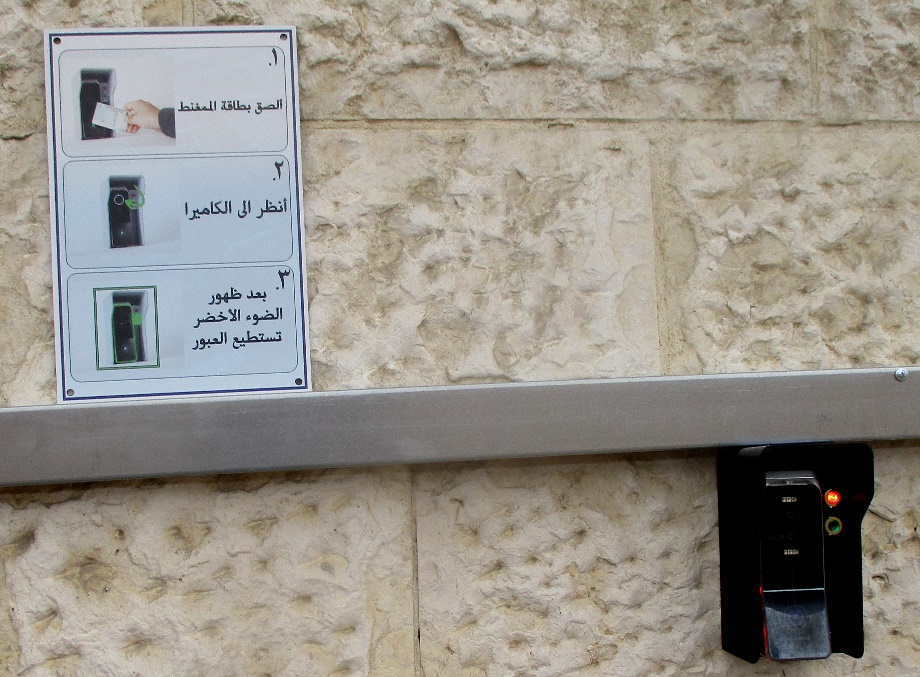
The news at the checkpoint itself is a control system over everyone coming back to the West Bank.
A sign has been installed over the entrance, informing the public of this fact, and two rows of inspection installations on the walls guide the pedestrians how to use the surveilling and controlling system.


The gate at the exit and entrance to the checkpoint compound whose top half is left broken and not only strong fellows jump over it to spare themselves walking the exhausting hundreds of meters – women and children do too.

Talking with one of the security guards there, I was glad to discover that we agree on the need for dialogue between enemies, that one needs to speak directly and not through mediators, or as the guy said, “Not by broken phone.”

Qalandiya Checkpoint / Atarot Pass (Jerusalem)
See all reports for this place-
Click here to watch a video from Qalandiya checkpoint up to mid 2019 Three kilometers south of Ramallah, in the heart of Palestinian population. Integrates into "Jerusalem Envelope" as part of Wall that separates between northern suburbs that were annexed to Jerusalem in 1967: Kafr Aqab, Semiramis and Qalandiya, and the villages of Ar-Ram and Bir Nabala, also north of Jerusalem, and the city itself. Some residents of Kafr Aqab, Semiramis and Qalandiya have Jerusalem ID cards. A terminal operated by Israel Police has functioned since early 2006. As of August 2006, northbound pedestrians are not checked. Southbound Palestinians must carry Jerusalem IDs; holders of Palestinian Authority IDs cannot pass without special permits. Vehicular traffic from Ramallah to other West Bank areas runs to the north of Qalandiya. In February 2019, the new facility of the checkpoint was inaugurated aiming to make it like a "border crossing". The bars and barbed wire fences were replaced with walls of perforated metal panels. The check is now performed at multiple stations for face recognition and the transfer of an e-card. The rate of passage has improved and its density has generally decreased, but lack of manpower and malfunctions cause periods of stress. The development and paving of the roads has not yet been completed, the traffic of cars and pedestrians is dangerous, and t the entire vicinity of the checkpoint is filthy. In 2020 a huge pedestrian bridge was built over the vehicle crossing with severe mobility restrictions (steep stairs, long and winding route). The pedestrian access from public transport to the checkpoint from the north (Ramallah direction) is unclear, and there have been cases of people, especially people with disabilities, who accidentally reached the vehicle crossing and were shot by the soldiers at the checkpoint. In the summer of 2021, work began on a new, sunken entrance road from Qalandiya that will lead directly to Road 443 towards Jerusalem and Tel Aviv. At the same time, the runways of the old Atarot airport were demolished and infrastructure was prepared for a large bus terminal. (updated October 2021)
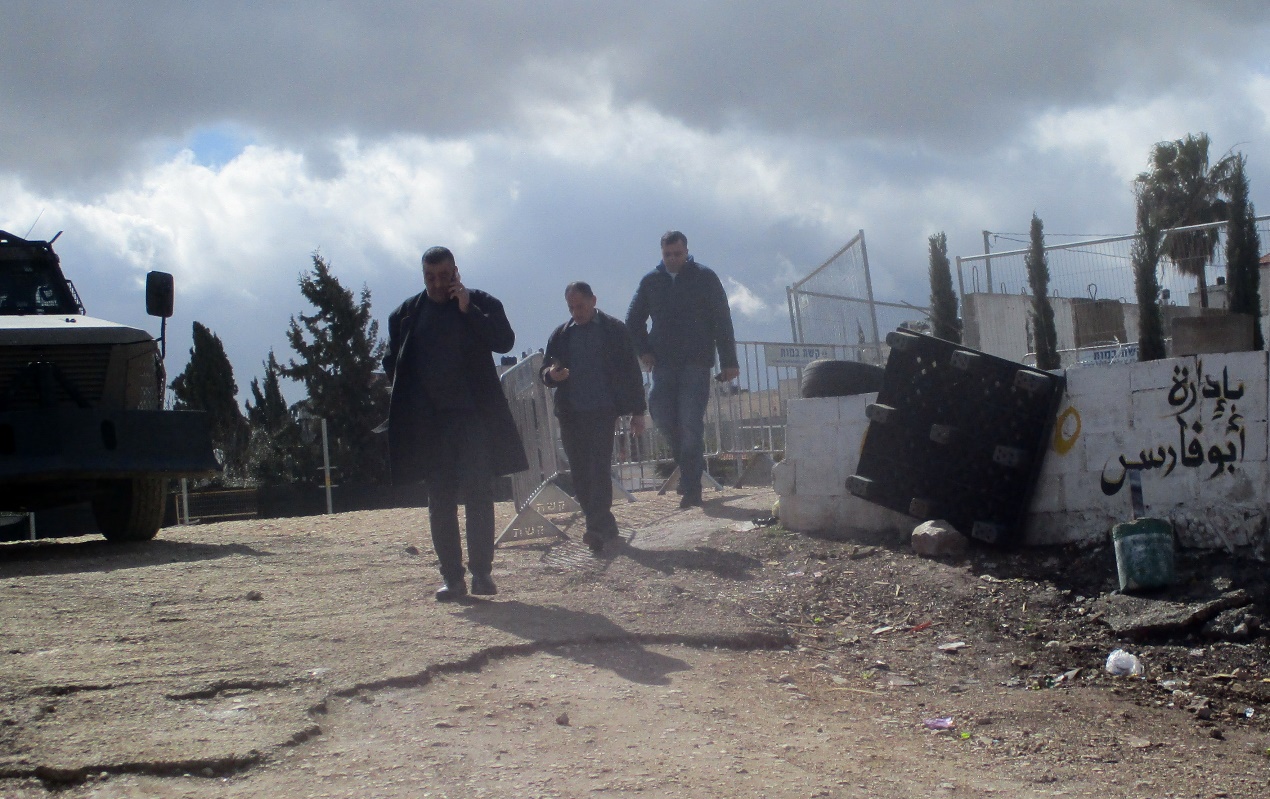 Tamar FleishmanFeb-27-2026Qalandiya: On the way to prayer
-