
Qalandiya - a fictitious number
At the Gaza-bound transport platform a transit waited, as well as people and much luggage.
There was not sufficient space in the boot and in the aisle inside for all the bags so people had to hire two additional vehicles costing 250 shekels each. Some of the money was collected among the passengers and completed by the transport company manager.
The whole time I stood among and with the Gazans, at the center of the vehicle checkpoint a white-license-plate ambulance was parked, obviously Palestinian. The ambulance and whoever were inside it waited for a long time. When its Jerusalem counterpart arrived and I saw that its driver was Waseem, an old acquaintance of mine, I carefully – step by step – approached the ambulances and saw that a stretcher was being passed from one to the other, with a transparent plastic box: an emergency treatment kit for babies.
A baby was born with a faulty heart and was being driven to Muqassad Hospital in East Jerusalem, said Waseem.
A Palestinian baby is not someone whose health must be considered and must be rushed to hospital where he might be operated on and his faulty heart fixed. What counts are procedures, even at the cost of lives. And procedures forbid an ambulance with a white license plate to cross the checkpoint and drive to the Palestinian hospital in East Jerusalem.
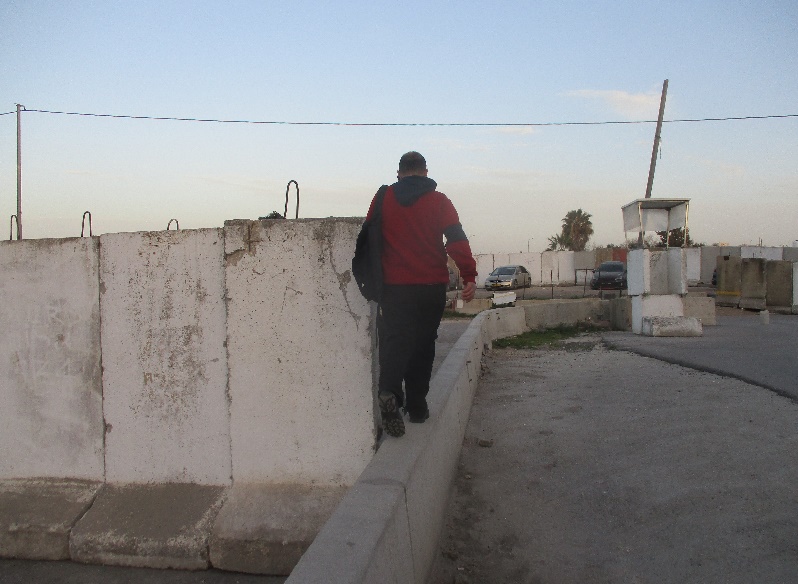
While I was wondering about the state of the infant, the uniformed and armed soldiers there were wondering why I was there, why I was taking pictures, and even why – being ordered to delete what I had photographed – I didn’t.

I was detained while they called up some hotline or other, and only after Alex, the checkpoint’s supreme commander, did not see fault with what I had done, this idiotic saga was over, and even if the picture I took is not the greatest, it is mine and only I decide its fate.
And the baby? What will happen to it?
On the other – the Palestinian – side of the checkpoint, it is havoc, a destruction scene.
Everything that had been paved was now destroyed, dug out and piled as rubble after a bombing from the air. Whoever had to cross there, man or vehicle, had a hell of a crossing.
While crossing the checkpoint I met Omar who showed the soldier behind the armored glass the document photographed on his phone, and said: I have a fictive number.
The soldier shrugged and said: I don’t know of any such thing, go away. Omar insisted. He wouldn’t go away.
The soldier exited his post, called over the security guard, consulted with him in Russian, the guard shrugged too, he doesn’t know of any such thing either. But Omar stayed, sure of himself and his rights.
After a while another guard arrived who did know of such a thing and knew the procedure regarding it, gave the fictive number of the photographed document in Omar’s phone, and the road was opened.
So: Omar was born in the US and has American citizenship. 10 years ago the family returned to its home in East Jerusalem. Now Omar is 19 years old, works in Israel, he has no Israeli document of any kind, he has a document with the kind of ID number that the Israeli authorities issued him and which they call a “fictive number”.
Perhaps this is so that anyone who is not eligible for the rights of the Israeli Law of Return – anyone who is not Jewish – would not be able to acquire Israeli citizenship?
It is not similar, but this whole matter of official fictive documents and data that bypass laws for denying rights reminded me of the fictive marriages taking place under the British Mandate, back in the 1920s’ 30s and 40s…

במהלך חציית המחסום פגשתי את עומר שהציג לחייל שבעמדה הממוגנת את המסמך שמצולם בטלפון שלו ואמר: יש לי מספר פיקטיבי.
החייל משך בכתפיו ואמר: לא מכיר דבר כזה, לך מפה. עומר התעקש. לא הלך משם.
החייל יצא מהעמדה, קרא למאבטח, התייעץ אתו ברוסית, גם המאבטח משך בכתפיו, גם המאבטח לא הכיר דבר כזה. אבל עומר, בטוח בעצמו ובצדקתו נשאר.
אחרי זמן לא קצר הגיע מאבטח אחר שכן הכיר דבר כזה וכן הכיר את הנוהל שאמור להתבצע בעניין כזה, מסר בקשר את המספר הפיקטיבי שבמסמך המצולם שבטלפון של עומר והדרך נפתחה.
אז ככה:
לעומר שנולד בארה”ב יש אזרחות אמריקנית. לפני 10 שנים המשפחה חזרה לביתה שבמזרח ירושלים. היום עומר בן 19, עובד בישראל, אין לו תעודה ישראלית משום סוג שהוא, יש לו מסמך עם סוג של מספר זיהוי שהשלטונות הישראלים הנפיקו לו ושקוראים לו מספר פיקטיבי.
אולי זה ככה כדי שמי שלא עומד בתנאי חוק השוות, קרי מי שאינו יהודי לא יתאזרח כאן?
זה לא דומה, אבל כל העניין הזה של מסמכים ונתונים רשמיים פיקטיביים עוקפי חוקי מניעת זכויות הזכיר לי את הנישואים הפיקטיביים של בתקופת המנדט.
Qalandiya Checkpoint / Atarot Pass (Jerusalem)
See all reports for this place-
Click here to watch a video from Qalandiya checkpoint up to mid 2019 Three kilometers south of Ramallah, in the heart of Palestinian population. Integrates into "Jerusalem Envelope" as part of Wall that separates between northern suburbs that were annexed to Jerusalem in 1967: Kafr Aqab, Semiramis and Qalandiya, and the villages of Ar-Ram and Bir Nabala, also north of Jerusalem, and the city itself. Some residents of Kafr Aqab, Semiramis and Qalandiya have Jerusalem ID cards. A terminal operated by Israel Police has functioned since early 2006. As of August 2006, northbound pedestrians are not checked. Southbound Palestinians must carry Jerusalem IDs; holders of Palestinian Authority IDs cannot pass without special permits. Vehicular traffic from Ramallah to other West Bank areas runs to the north of Qalandiya. In February 2019, the new facility of the checkpoint was inaugurated aiming to make it like a "border crossing". The bars and barbed wire fences were replaced with walls of perforated metal panels. The check is now performed at multiple stations for face recognition and the transfer of an e-card. The rate of passage has improved and its density has generally decreased, but lack of manpower and malfunctions cause periods of stress. The development and paving of the roads has not yet been completed, the traffic of cars and pedestrians is dangerous, and t the entire vicinity of the checkpoint is filthy. In 2020 a huge pedestrian bridge was built over the vehicle crossing with severe mobility restrictions (steep stairs, long and winding route). The pedestrian access from public transport to the checkpoint from the north (Ramallah direction) is unclear, and there have been cases of people, especially people with disabilities, who accidentally reached the vehicle crossing and were shot by the soldiers at the checkpoint. In the summer of 2021, work began on a new, sunken entrance road from Qalandiya that will lead directly to Road 443 towards Jerusalem and Tel Aviv. At the same time, the runways of the old Atarot airport were demolished and infrastructure was prepared for a large bus terminal. (updated October 2021)
 Tamar FleishmanFeb-16-2026Qalandiya CP: shortcut
-