
Qalandiya - A very busy morning probably due to a computer malfunction


A crowded morning at Qalandiya
06.15. On the Israeli side, there were already many people waiting for transport to work, sitting on the low bench next to the Wall. The public transport parking lot is full, with buses actually parked close to the beginning of the pedestrian bridge. We meet many people on the bridge, some telling us that there is chaos in the checkpoint where passage has been stopped. This seemed strange because if the checkpoint was closed, how could there be so many who had passed through?
When we reached the Palestinian side we found the checkpoint porch and steps crowded. People were sitting on the steps and more kept arriving from the parking area on the east side. When entrances showed green lights occasionally, we heard shouts and saw pushing that we hadn’t experienced for a long time, with young folk jumping over the fences of the ‘slalom’ before the turnstiles, as in “olden times.”
At first, we could not understand what had happened. We were told that yesterday everything ran smoothly. There was a rumor that the delay was because of a lack of masks – but for a long time now masks have been necessary inside the checkpoint and there is always a person selling masks as needed. But later we found the real problem was a breakdown in the computer – and our informant said a friend of his at the Bethlehem checkpoint told him there was the same problem there.
A man arrived accompanying a woman in a wheelchair. On a normal day, the staff inside would see them on their camera and come out to open the special door so as to avoid turnstiles. We phoned the D.C.O, a number that we had. The soldier who answered said she wasn’t at the checkpoint but would try to find help and that we should call again in 10 minutes. She didn’t seem to know at all how the checkpoint looked from the Palestinian side. We called Hanna Barag to ask if she had an alternative phone number to call but she didn’t. We phoned the same soldier again after 15 minutes. She said that because of the crowds it was difficult to help (again it was clear she didn’t understand the procedure at all). While we were talking a security guard arrived via the side door. It wasn’t our calls that brought him – her husband had entered the checkpoint himself (the people in line had let him go ahead) to ask that the door be opened! He came with the guard and the two of them took his wife in, with our good wishes…
We went to see Abu Ramzi the beigel-seller, after not meeting a long while. Once again he had with him a grandson who at that moment arrived with a fresh-from-the-oven batch of beigels. This eastern side of the checkpoint was full of cars bringing and collecting people. And more kept coming. Only public transport vehicles can enter the parking area in front of the building itself. Crowds were milling around waiting for the pressure at the checkpoint to lessen. There are little kiosks selling felafel and snacks on the pavement. Close to Abu Ramzi was a boy selling pitot with oil and zaatar, and on the opposite side of the road, the usual tea kiosk in a commercial vehicle was open.
Abu Ramzi said Id el-Adha was “be-seder”. Soon he will be having another eye operation. It seems the earlier one was entirely successful.
We went back to the building via the passages that had been prepared for Ramadan. There we saw two large tractors ready for work. We didn’t know their particular purpose, but it is interesting that a man told us there is a plan to build more road where the current vehicle entry is to the checkpoint. This is a big project which will take 3 years and during that time, according to him, the traffic will go through Himzeh! Considering how heavy the traffic is through Himzeh anyway with settler cars, this sounds very strange. We will have to get more accurate information.
Gradually the queues started entering the checkpoint and people sitting on the steps began joining them. By 7.15 there were hardly queues and people who had been waiting at the eastern end joined them.
The electronic document-checking machines were all working and people were passing through without delay – as we also did. Altogether it took us 15 minutes to pass and by 7.35 we were through. There was no one to ask what had caused the delay earlier.
On the way to our car, we again met Y. whom we wrote about in earlier reports (30.6.21, 27.5). Sylvia has asked again for his ‘refusal’ to be canceled but was refused. He has to continue passing with special permits in spite of his refusal at Givat Zeev . We spoke about the documents he has sent and hope he will renew his permit before his present one expires on 21.8. We can’t understand why they keep him refused entry even though he anyway is allowed to come into work. After all, if he planned to do harm he could continue from Qalandiya to do so anywhere in the country, and not to return to Givat Zeev (close to his home in Bidu) to work …
We were approached by a man who said Sylvia had helped him in the past – and now needed help for his son – 25 years, married and with a child – who had been in goal a year ago … We gave him Sylvia’s details again.
Qalandiya Checkpoint / Atarot Pass (Jerusalem)
See all reports for this place-
Click here to watch a video from Qalandiya checkpoint up to mid 2019 Three kilometers south of Ramallah, in the heart of Palestinian population. Integrates into "Jerusalem Envelope" as part of Wall that separates between northern suburbs that were annexed to Jerusalem in 1967: Kafr Aqab, Semiramis and Qalandiya, and the villages of Ar-Ram and Bir Nabala, also north of Jerusalem, and the city itself. Some residents of Kafr Aqab, Semiramis and Qalandiya have Jerusalem ID cards. A terminal operated by Israel Police has functioned since early 2006. As of August 2006, northbound pedestrians are not checked. Southbound Palestinians must carry Jerusalem IDs; holders of Palestinian Authority IDs cannot pass without special permits. Vehicular traffic from Ramallah to other West Bank areas runs to the north of Qalandiya. In February 2019, the new facility of the checkpoint was inaugurated aiming to make it like a "border crossing". The bars and barbed wire fences were replaced with walls of perforated metal panels. The check is now performed at multiple stations for face recognition and the transfer of an e-card. The rate of passage has improved and its density has generally decreased, but lack of manpower and malfunctions cause periods of stress. The development and paving of the roads has not yet been completed, the traffic of cars and pedestrians is dangerous, and t the entire vicinity of the checkpoint is filthy. In 2020 a huge pedestrian bridge was built over the vehicle crossing with severe mobility restrictions (steep stairs, long and winding route). The pedestrian access from public transport to the checkpoint from the north (Ramallah direction) is unclear, and there have been cases of people, especially people with disabilities, who accidentally reached the vehicle crossing and were shot by the soldiers at the checkpoint. In the summer of 2021, work began on a new, sunken entrance road from Qalandiya that will lead directly to Road 443 towards Jerusalem and Tel Aviv. At the same time, the runways of the old Atarot airport were demolished and infrastructure was prepared for a large bus terminal. (updated October 2021)
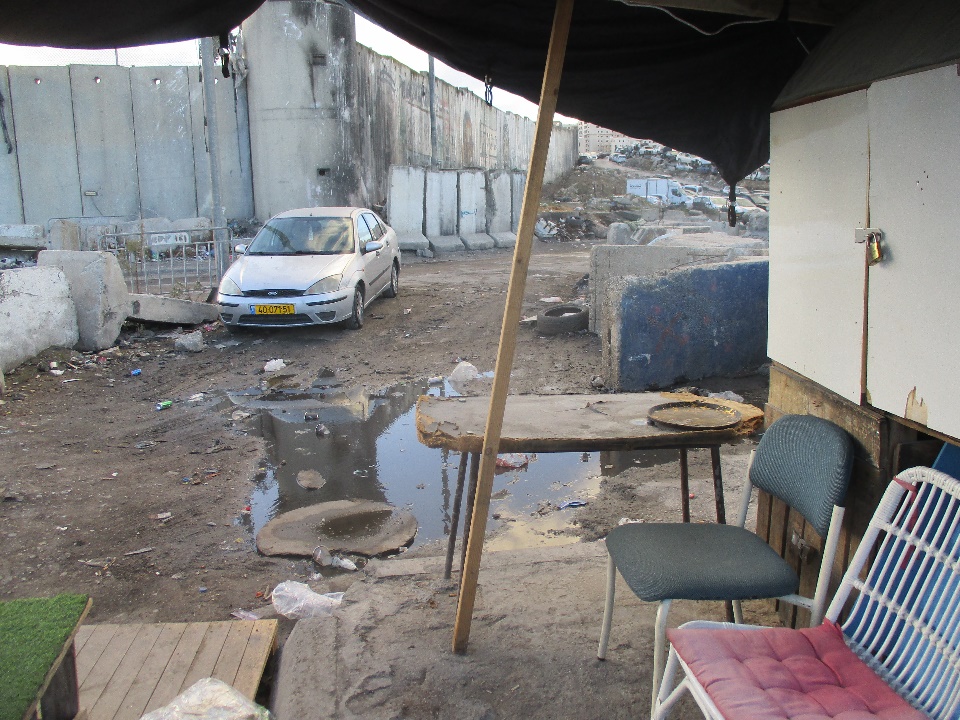 Tamar FleishmanNov-30-2025Qalandiya: Puddles and dirt after the rain
-