
Qalandiya - an engineering tool used for measuring created havoc
The large story is a web of private persons whose lives and deaths are controlled by a powerful arbitrary force, to the very last detail.
The story is about a mother who came with her 4-year old son all the way from Hizma village (the child in the picture) to bring him to a doctor in Sur Bahr village. He has a problem with the basis of his left hand, she said.

Two days before the doctor’s appointment she came to the DCO offices and presented her application to go to East Jerusalem, for a Palestinian wishing to cross over to the other side of the apartheid wall cannot just go ahead and abide his own caprice: they need a written and signed permit from the authorities’ representative.
“You’ll have your answer on Sunday”, they told her. She came on Sunday before the offices were closed, and received a negative answer.
Why? -She has no idea and received no explanation. She insisted on staying and presenting her case to the security guard present. “The DCO is now closed, but I’ll check with the DCO duty officer”, said the man and explained the rejection with the fact that the appropriate doctor may be found in the West Bank, no need to turn to the Jerusalem doctor she had chosen.
The woman and her child waited. I waited with them. Suddenly there were loud voices coming from the checking posts. I approached. Apparently, the women-soldiers sitting protected behind their armored glass windows suspected a young man for carrying something looking like a weapon. They stopped the dozens of people awaiting their turn behind him, instructed the man to approach the window, open the bag, and out his things one by one, presenting them, and laughing at him all the while. The ritual over, the young man was free to do.
He came to me and presented the object that created this havoc = an engineering tool used for measuring.
They laughed at me, he said sadly before we parted.

I waited with the mother and son for the duty officer’s answer, which took its time. Every time we asked, we were told it would come in a few minutes.
An hour went by, I left. Unlike me, the mother continued her wait, still hoping for the best.
While we waited, a conversation took place between me and the present security guards:
“We are always screwed”, said the guards who told me the Jews always called them “Arabs” pejoratively, while the Palestinians call them “traitors”. What about the Nation Law? I asked. –They walked on our heads, came the answer.
One of the security guards introduced himself as the nephew of Madhat Yusuf, the soldier abandoned by the Israeli army in the notorious incident. Looking at Madhat Yusef on the official memorial site, I discovered chilling similarity between the uncle and the young man who spoke with me.
Qalandiya Checkpoint / Atarot Pass (Jerusalem)
See all reports for this place-
Click here to watch a video from Qalandiya checkpoint up to mid 2019 Three kilometers south of Ramallah, in the heart of Palestinian population. Integrates into "Jerusalem Envelope" as part of Wall that separates between northern suburbs that were annexed to Jerusalem in 1967: Kafr Aqab, Semiramis and Qalandiya, and the villages of Ar-Ram and Bir Nabala, also north of Jerusalem, and the city itself. Some residents of Kafr Aqab, Semiramis and Qalandiya have Jerusalem ID cards. A terminal operated by Israel Police has functioned since early 2006. As of August 2006, northbound pedestrians are not checked. Southbound Palestinians must carry Jerusalem IDs; holders of Palestinian Authority IDs cannot pass without special permits. Vehicular traffic from Ramallah to other West Bank areas runs to the north of Qalandiya. In February 2019, the new facility of the checkpoint was inaugurated aiming to make it like a "border crossing". The bars and barbed wire fences were replaced with walls of perforated metal panels. The check is now performed at multiple stations for face recognition and the transfer of an e-card. The rate of passage has improved and its density has generally decreased, but lack of manpower and malfunctions cause periods of stress. The development and paving of the roads has not yet been completed, the traffic of cars and pedestrians is dangerous, and t the entire vicinity of the checkpoint is filthy. In 2020 a huge pedestrian bridge was built over the vehicle crossing with severe mobility restrictions (steep stairs, long and winding route). The pedestrian access from public transport to the checkpoint from the north (Ramallah direction) is unclear, and there have been cases of people, especially people with disabilities, who accidentally reached the vehicle crossing and were shot by the soldiers at the checkpoint. In the summer of 2021, work began on a new, sunken entrance road from Qalandiya that will lead directly to Road 443 towards Jerusalem and Tel Aviv. At the same time, the runways of the old Atarot airport were demolished and infrastructure was prepared for a large bus terminal. (updated October 2021)
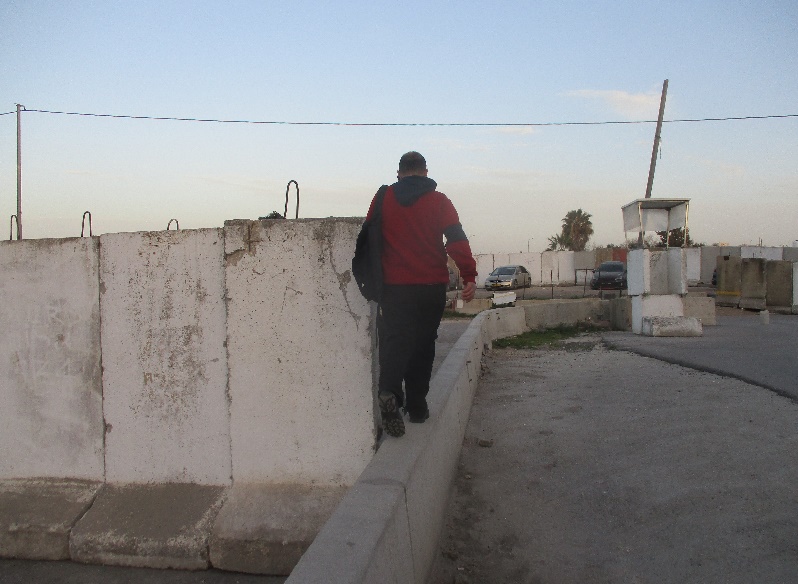 Tamar FleishmanFeb-16-2026Qalandiya CP: shortcut
-