
Qalandiya and Beit Hanina
About one baby-girl and one murdered woman-journalist and the line connecting here and there

Qalandiya Checkpoint separates people marked by the ruling power as rightless from those whose relative rights might be forfeited at any given moment.
Still, on both sides live people who are not really different, for neither the checkpoint nor the apartheid wall tell them apart nor blunt their feelings or their longing to be free.
There is no real difference between the baby-girl born in Ramallah who – because of procedures and circumstances – was detained at the checkpoint, wrapped by her mother, and any baby-girl born within walking distance from the spot where the ambulance was detained.
“She is one-and-a-half months old”, said the ambulance driver. “No”, said the mother for whom every single day in her daughter’s life counts: “She is one year and ten days old”.
The baby, born with a faulty bladder, has been assigned for surgery to the Saint Joseph Hospital in East Jerusalem.
Just as the mother counts the days, I counted the minutes of waiting for permission to let the mother and daughter pass from the West Bank ambulance to a Jerusalem one to continue their journey.

Fifty minutes were needed to solve the mixup created between the hospital and the offices that issue a transit permit for the ill, and I ask – why is the Israeli Security Service needed between a baby and her doctors? Is not a baby here just as eligible for one as a baby there? Is this not a birth right to medical treatment?

In the same context of freedom and rights, at Beit Hanina – the residence neighborhood of Shireen Abu Aqleh, murdered at dawn of the same day – a protest was held by numerous participants. Many Palestinians protested and many Israeli police tried in vain to disperse the protestors, exerting violence and conducting arrests.
We stood there, a large crowd, at all corners of the junction while the many armed police pushed us violently – physically and verbally – and took no heed of women, men, young and old.
A young man standing behind me yelled at the policemen:
“You don’t have much time left!”


When he repeated this cry, a group of policemen pushed through, made him fall to the ground with his face down, police knees pushed him to the asphalt, his hands were shackled behind his back and he was taken into custody by four civilian-dressed undercover agents who suddenly put on police caps. Two of them held his arms and dragged him away while two walked at his sides, facing back, looking at house roofs, their hand at the ready to grab the gun hidden on their hip.
Facing the Palestinian protest and the power show, while men, women and children constantly swarmed towards the junction, I found myself standing, wondering and thoughtlessly repeating: “So, so!”
As the commander in charge realized that the crowd was constantly growing, he yelled on his phone: “Bring out the Border Police with sponge ammo!” Soon armed Border Policemen arrived with chains of sponge ammunition on their chests, a ‘skunk’ vehicle came from the other direction, arrests continued. When I heard behind my back one policeman telling the other: “Arrest the woman with the red bag”, I knew I was the woman with the red bag, got carried by the huge crowd and disappeared, remembering what I was told some hours earlier by Mohammad, the paramedic who passed the baby-girl from one ambulance to another:
If you think everything you do and write helps someone or changes anything – it doesn’t.

Qalandiya Checkpoint / Atarot Pass (Jerusalem)
See all reports for this place-
Click here to watch a video from Qalandiya checkpoint up to mid 2019 Three kilometers south of Ramallah, in the heart of Palestinian population. Integrates into "Jerusalem Envelope" as part of Wall that separates between northern suburbs that were annexed to Jerusalem in 1967: Kafr Aqab, Semiramis and Qalandiya, and the villages of Ar-Ram and Bir Nabala, also north of Jerusalem, and the city itself. Some residents of Kafr Aqab, Semiramis and Qalandiya have Jerusalem ID cards. A terminal operated by Israel Police has functioned since early 2006. As of August 2006, northbound pedestrians are not checked. Southbound Palestinians must carry Jerusalem IDs; holders of Palestinian Authority IDs cannot pass without special permits. Vehicular traffic from Ramallah to other West Bank areas runs to the north of Qalandiya. In February 2019, the new facility of the checkpoint was inaugurated aiming to make it like a "border crossing". The bars and barbed wire fences were replaced with walls of perforated metal panels. The check is now performed at multiple stations for face recognition and the transfer of an e-card. The rate of passage has improved and its density has generally decreased, but lack of manpower and malfunctions cause periods of stress. The development and paving of the roads has not yet been completed, the traffic of cars and pedestrians is dangerous, and t the entire vicinity of the checkpoint is filthy. In 2020 a huge pedestrian bridge was built over the vehicle crossing with severe mobility restrictions (steep stairs, long and winding route). The pedestrian access from public transport to the checkpoint from the north (Ramallah direction) is unclear, and there have been cases of people, especially people with disabilities, who accidentally reached the vehicle crossing and were shot by the soldiers at the checkpoint. In the summer of 2021, work began on a new, sunken entrance road from Qalandiya that will lead directly to Road 443 towards Jerusalem and Tel Aviv. At the same time, the runways of the old Atarot airport were demolished and infrastructure was prepared for a large bus terminal. (updated October 2021)
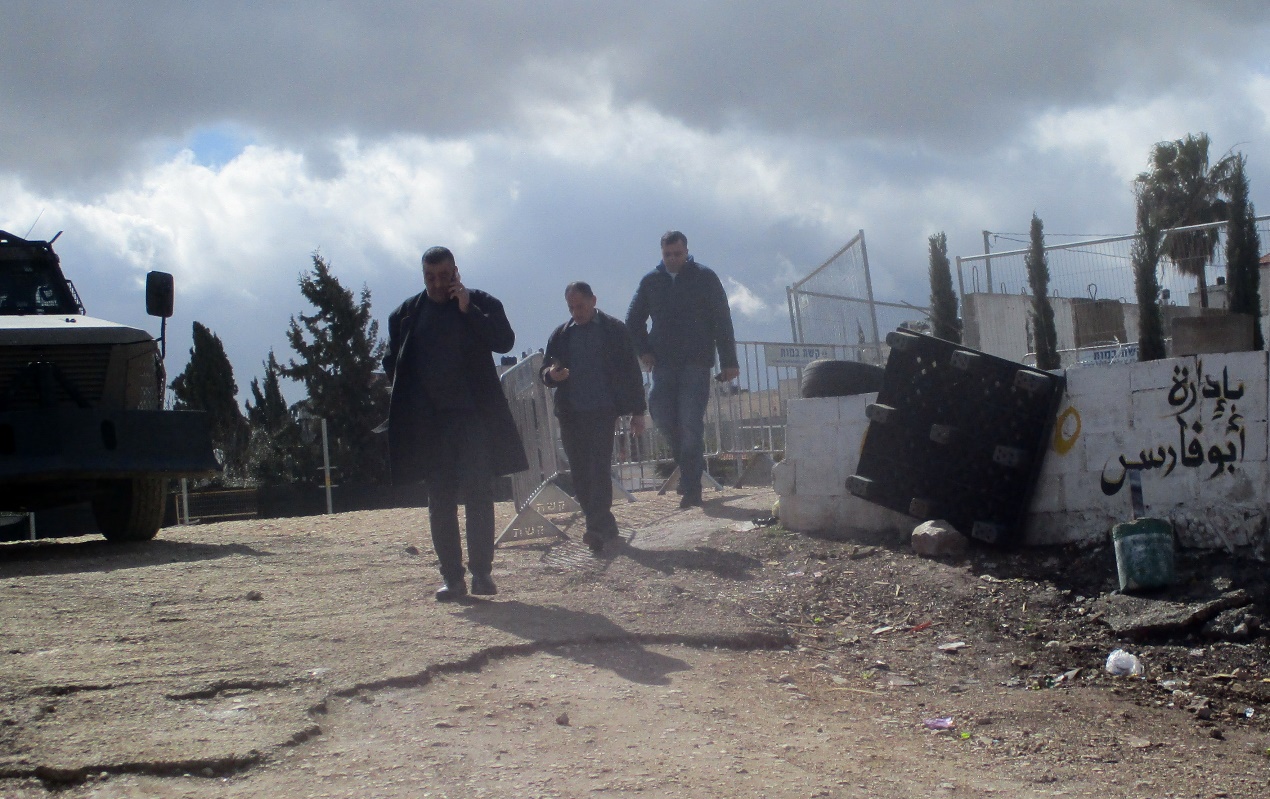 Tamar FleishmanFeb-27-2026Qalandiya: On the way to prayer
-