
Qalandiya, at the vehicle checkpoint the pressure is great
A reasonable morning at the Qalandiya checkpoint, almost everything is back to normal after the end of Ramadan. We arrived at about a quarter to six. The section of the road on the Israeli side, which leads from the last square to the entrance square to the checkpoint, remains open. This allows us to drive directly and not make a detour on the way to pass the checkpoint. We passed by car and parked in the private parking lot on the Palestinian side.
The curlicues and batons that blocked the entrance to the nearby private parking lot were removed and also the bodega that was placed near the nearest entrance to the square disappeared as if it hadn’t been. We parked there as usual.

The kiosk and the falafel stand of the morning hours are back in their place. Abu Ramzi, the pretzel seller was not there. We found him in the shed at the entrance to the pedestrian barrier, along with the cookie seller. It’s been over a year since his wife died and life without a wife is difficult for him. A wedding costs a lot of money. He managed to collect some, with the help of charity, but he still lacks about ten thousand NIS…
In the shed itself, queues formed from time to time, but pretty quickly they got shorter and then got longer again and God forbid. It seems that around six o’clock is the peak of pressure at the pedestrian barrier. At the vehicle checkpoint the pressure is great and from time to time loud whistles are heard from the direction of the cars and especially the trucks. It seemed that some unusual traffic jam had formed on the bus route. We saw a lot of buses and also a lot of people walking around down in the area below the tower. From the tower itself we could occasionally hear shouts from the soldiers on the loudspeaker, but we could not understand what they were saying.


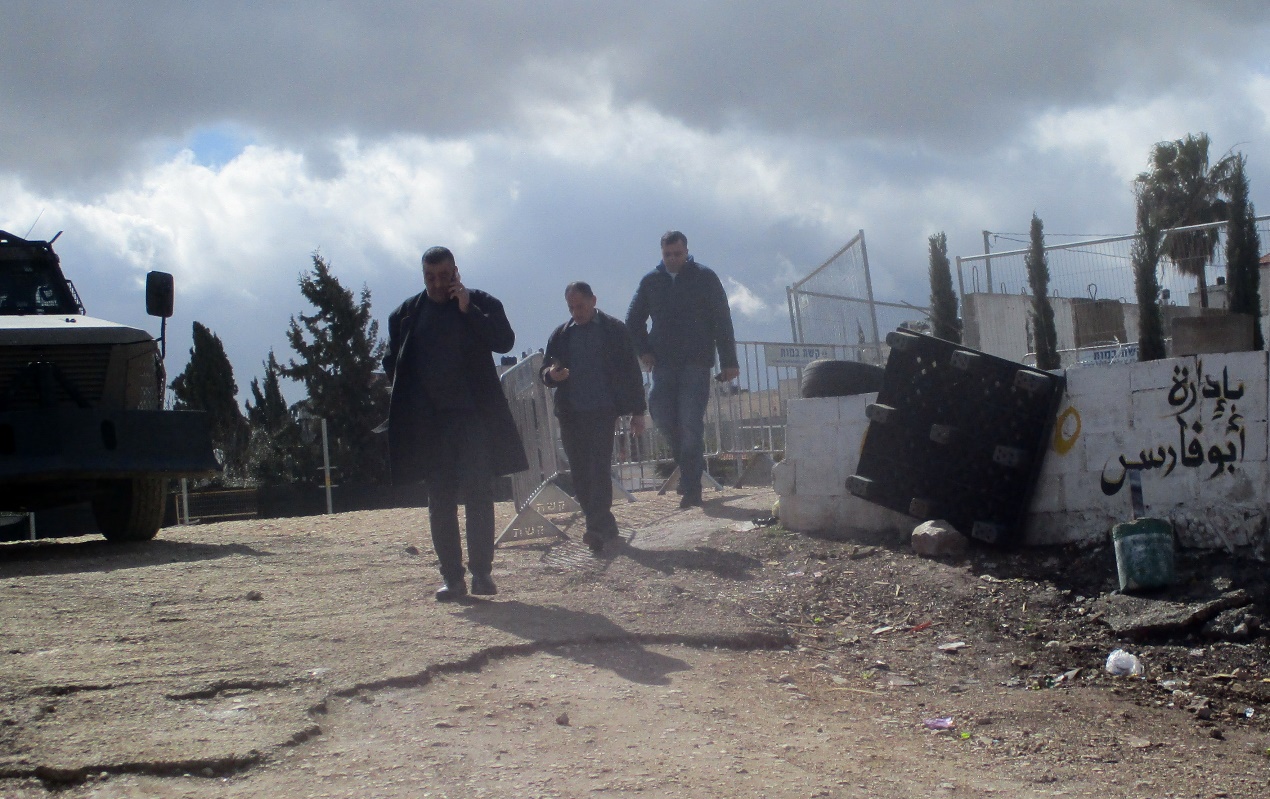
The gate that closes the entrance of pedestrians to the checkpoint complex from Qalandiya remains wide open, to the great joy of those coming from that direction. One can only wonder why it was closed for about two years… the cement blocks that bordered the entry routes for women on the Fridays of Ramadan were moved aside. The checkers were taken away and people enter freely and are very satisfied with it. There was even a narrow passage in the wall demarcating the road near the section with the wall painting and a passage between the low cement blocks delimiting the travel routes. This allows pedestrians to pass comfortably, without having to make a turn or jump over (which only the young men did).
After half past six it seems that there are no longer queues in the shed and the peak of pressure has passed. There are still many people, but no delays. After about an hour we went back to the parking lot. There is traffic congestion even when traveling towards A-Ram, of course without comparison to the traffic towards the vehicle barrier. We saw that they had blocked travel on the old road to the west and now traffic only passes on the new road that was recently paved that goes up to the top of the hill. In the lower part, the depression is probably being dug now. Next time we will stop and take a picture here. Traffic clears, but there is pressure again in front of the now manned Jib barrier. Some cars drive freely through the opposite track. Then they probably join the traffic where cars coming from the road coming from the Kfar Aqab area also join in. Also further down the road leading to the Hizma checkpoint is quite congested and since we lingered here we also crawled through the morning traffic inside the city…
Qalandiya Checkpoint / Atarot Pass (Jerusalem)
See all reports for this place-
Click here to watch a video from Qalandiya checkpoint up to mid 2019 Three kilometers south of Ramallah, in the heart of Palestinian population. Integrates into "Jerusalem Envelope" as part of Wall that separates between northern suburbs that were annexed to Jerusalem in 1967: Kafr Aqab, Semiramis and Qalandiya, and the villages of Ar-Ram and Bir Nabala, also north of Jerusalem, and the city itself. Some residents of Kafr Aqab, Semiramis and Qalandiya have Jerusalem ID cards. A terminal operated by Israel Police has functioned since early 2006. As of August 2006, northbound pedestrians are not checked. Southbound Palestinians must carry Jerusalem IDs; holders of Palestinian Authority IDs cannot pass without special permits. Vehicular traffic from Ramallah to other West Bank areas runs to the north of Qalandiya. In February 2019, the new facility of the checkpoint was inaugurated aiming to make it like a "border crossing". The bars and barbed wire fences were replaced with walls of perforated metal panels. The check is now performed at multiple stations for face recognition and the transfer of an e-card. The rate of passage has improved and its density has generally decreased, but lack of manpower and malfunctions cause periods of stress. The development and paving of the roads has not yet been completed, the traffic of cars and pedestrians is dangerous, and t the entire vicinity of the checkpoint is filthy. In 2020 a huge pedestrian bridge was built over the vehicle crossing with severe mobility restrictions (steep stairs, long and winding route). The pedestrian access from public transport to the checkpoint from the north (Ramallah direction) is unclear, and there have been cases of people, especially people with disabilities, who accidentally reached the vehicle crossing and were shot by the soldiers at the checkpoint. In the summer of 2021, work began on a new, sunken entrance road from Qalandiya that will lead directly to Road 443 towards Jerusalem and Tel Aviv. At the same time, the runways of the old Atarot airport were demolished and infrastructure was prepared for a large bus terminal. (updated October 2021)
 Tamar FleishmanFeb-27-2026Qalandiya: On the way to prayer
-