
Qalandiya - At the vehicles checkpoint construction work


We returned again this week to Qalandiya, as last week we were unable to cross to the Palestinian side because of the shooting of the woman in the vehicles checkpoint. There is still a lot of building going on in all the roads of the vehicle crossing area.
06.15.We walked from the parking lot towards the checkpoint. The place was humming with people at this hour, sitting wherever possible and waiting for transport to work. Seconds after the photo was taken, a van arrived and half the people climbed inside.
Building in the vehicles area. Passage toward the West Bank is through the gate, open at present. Unable to go completely around the circle. Vehicles towards Jerusalem pass via the route closest to the bus area and also closest toe the pedestrian checkpoint which generally serves drivers in the direction of the west bank. There is now a temporary checking station.
Leaving the pedestrian checkpoint and afterwards on traffic islands there are large concrete pillars being built, where apparently there will be a bridge to enable pedestrians to reach the bus terminal without crossing roads.
We crossed to the Palestinian side and met our friend Abu Ramzi, the beigel seller. He had sold all his stock early today and sent a friend to bring fresh supplies. A constant stream of pedestrians, without delays. When we arrived one entrance was closed, to be followed by another – and there were red lights above them. Soon a queue developed in front of the remaining open doo – a sight we had already forgotten. Nevertheless, it seems that inside there were more than two bag-checking stations open, or that people without parcels were being let in via a side door, because people were entering very quickly. Otherwise there would have been a much longer line forming outside.
Queue forming and getting longer at the single open entrance.
Mornings are already cold in Jerusalem. We went to buy tea at the kiosk which, we noticed already from afar, had moved back to its original side for the road. Also, the new plant nursery had vanished. While preparing our tea, our informant Muhammad told us that the very day we had previously visited, municipality inspectors and soldiers confiscated their refrigerator and equipment and plants, and anything of value. This was done without any warning, roughly and with threats, and without giving them any documents to certify what they had taken. We gave him the phone number of Council member Havilio in the hope tha the might be able to help, in addition to our colleague Yehudit to contact Yesh Din if necessary.
Our informant is himself without a permit to enter Israel, refused by both the police and by Security – by the police for being caught more than once without a permit (“he has to earn a living”); he does not know why by Security. For that, we gave him Sylvia’s details. We know, however, that it is extremely difficult to overcome a refusal issued by the police.
Our friend S. arrives and we decided to pass through with her at 7.10. Inside there were short lines in front of the bag checking machines, which moved quickly. We were held up a few minutes at the document-checking station, because the woman soldier didn’t know what to do with us and did not get help from the officer in the neighbouring station. She checked by phone and then we explained that we were from Machsomwatch, which satisfied her. S., who has a magnetic card and computerised permit, was already through, of course, and waiting for us. We accompanied her to the bus terminal, partly to check the toilets that we had only now heard of.
Next to the vehicles checkpoint on the West Bank side closest to the bus terminal on the Israel side, there is a route to public transport. Empty buses pass there. Passengers get out and go to the checking station. Only blue identity card owners, pupils, and special permit holders are allowed to pass.
We approached the toilet building – similar to the one in the old checkpoint. A local man warned us that the place was disgusting. Its condition was catastrophic, even worse than the old ones before they were recently cleaned. In the washbasin there is a tap but no water. We did not dare entering the stalls themselves to see if there was running water…
We parted from S. with Shana Tova greetings, and left for home.
Qalandiya Checkpoint / Atarot Pass (Jerusalem)
See all reports for this place-
Click here to watch a video from Qalandiya checkpoint up to mid 2019 Three kilometers south of Ramallah, in the heart of Palestinian population. Integrates into "Jerusalem Envelope" as part of Wall that separates between northern suburbs that were annexed to Jerusalem in 1967: Kafr Aqab, Semiramis and Qalandiya, and the villages of Ar-Ram and Bir Nabala, also north of Jerusalem, and the city itself. Some residents of Kafr Aqab, Semiramis and Qalandiya have Jerusalem ID cards. A terminal operated by Israel Police has functioned since early 2006. As of August 2006, northbound pedestrians are not checked. Southbound Palestinians must carry Jerusalem IDs; holders of Palestinian Authority IDs cannot pass without special permits. Vehicular traffic from Ramallah to other West Bank areas runs to the north of Qalandiya. In February 2019, the new facility of the checkpoint was inaugurated aiming to make it like a "border crossing". The bars and barbed wire fences were replaced with walls of perforated metal panels. The check is now performed at multiple stations for face recognition and the transfer of an e-card. The rate of passage has improved and its density has generally decreased, but lack of manpower and malfunctions cause periods of stress. The development and paving of the roads has not yet been completed, the traffic of cars and pedestrians is dangerous, and t the entire vicinity of the checkpoint is filthy. In 2020 a huge pedestrian bridge was built over the vehicle crossing with severe mobility restrictions (steep stairs, long and winding route). The pedestrian access from public transport to the checkpoint from the north (Ramallah direction) is unclear, and there have been cases of people, especially people with disabilities, who accidentally reached the vehicle crossing and were shot by the soldiers at the checkpoint. In the summer of 2021, work began on a new, sunken entrance road from Qalandiya that will lead directly to Road 443 towards Jerusalem and Tel Aviv. At the same time, the runways of the old Atarot airport were demolished and infrastructure was prepared for a large bus terminal. (updated October 2021)
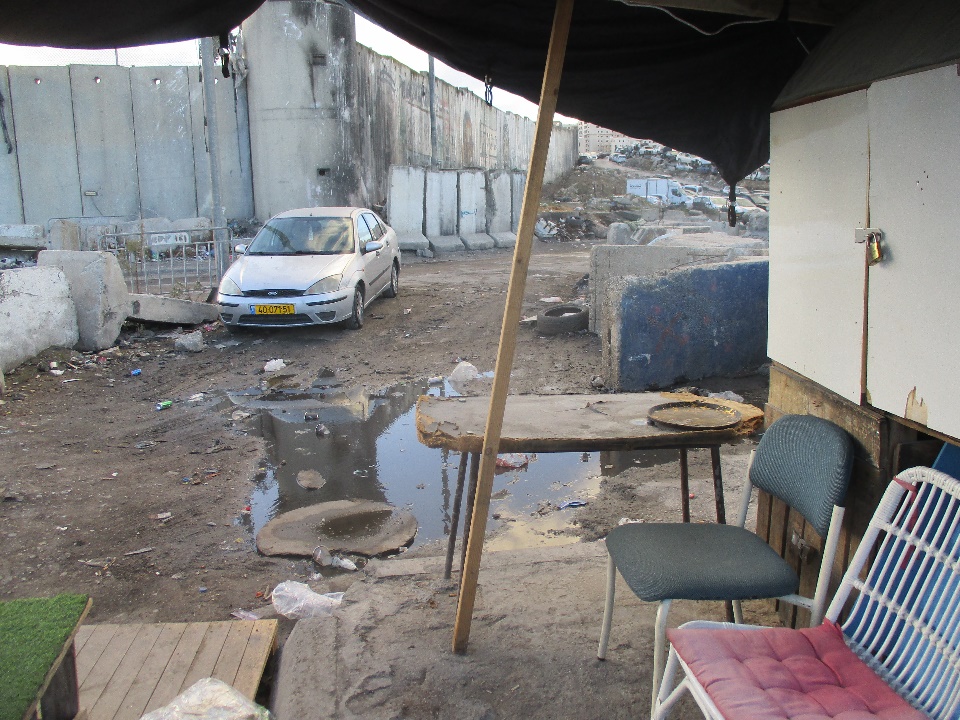 Tamar FleishmanNov-30-2025Qalandiya: Puddles and dirt after the rain
-